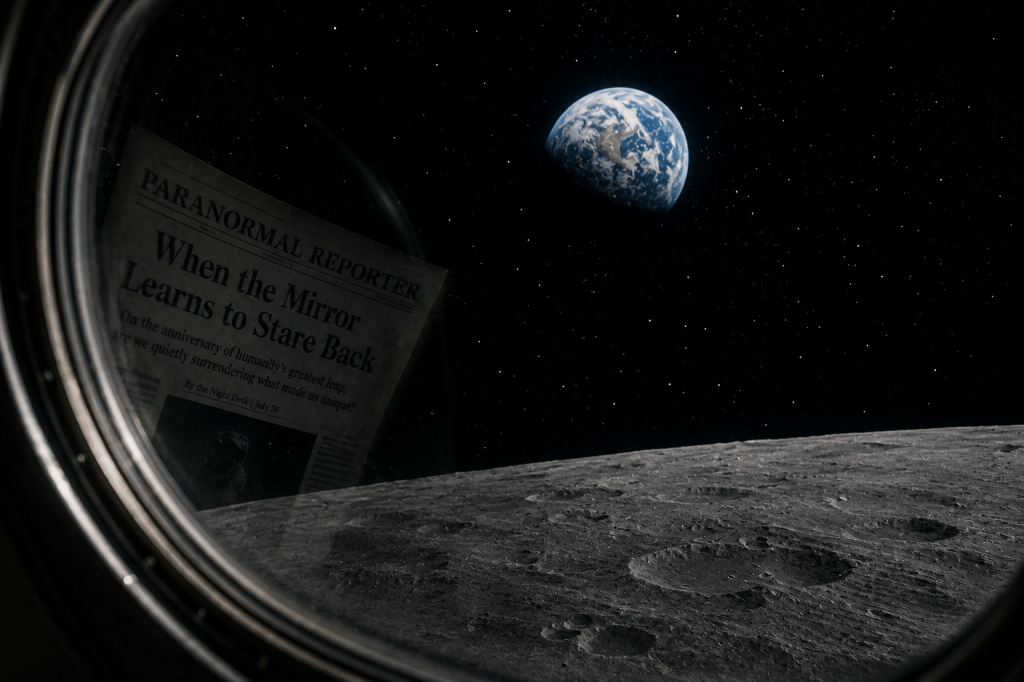
On the anniversary of humanity’s greatest leap, are we quietly surrendering what made us unique?
July 20, 2026
A Date That Changed Humanity
July 20 is remembered around the world as the day humanity first walked on the Moon. Whether you view the Apollo missions as mankind’s greatest triumph or simply another chapter in history, the symbolism remains powerful: human curiosity carried us somewhere no one had ever been.
For centuries, people looked at the Moon and imagined impossible things. They saw faces in its craters, civilizations hidden on its surface, spirits watching from above, and gateways into another world. Those stories were never about the Moon itself. They were about us—our imagination.
While historians note that Neil Armstrong’s first step technically occurred on July 21 in Universal Time, for millions watching in the United States it was still the evening of July 20—a date forever linked with humanity’s first footsteps on another world.
Today, that imagination faces a very different mystery.
Not one that hides in the sky.
One that sits quietly on our desks.
Every Generation Has Its Doppelgänger
Folklore has always warned us about copies.
European legends spoke of the Doppelgänger—a perfect duplicate said to mimic a living person. In Japanese tradition, stories described spirits capable of taking human form. Native American traditions include tales of deceptive entities that imitate familiar voices or appearances. Ancient myths from nearly every culture carry one recurring warning:
Not everything that looks human truly is.
The fear was never about monsters.
It was about imitation.
Throughout history, humanity has worried less about what hunts us than what quietly replaces us.
The Comfortable Copy
Something curious is happening in modern life.
Music can now sound like artists who never recorded it.
Paintings appear from machines that never held a brush.
Stories emerge from systems that have never lived a single day.
Convenience is rarely frightening at first.
After all, calculators did not destroy mathematics.
Cameras did not erase painters.
Computers did not eliminate writers.
Tools become dangerous only when people forget they are tools.
The real mystery isn’t whether technology can imitate creativity.
It’s whether people begin accepting imitation as the same thing.
The Paranormal Pattern
Paranormal researchers have long noticed an unusual pattern in witness reports.
Many encounters begin with something almost perfect.
A voice slightly off.
Eyes that don’t quite match.
Movements just a fraction too smooth.
The uncanny has always lived inside nearly-perfect copies.
Psychologists call it the “uncanny valley.” Folklore simply called it a warning.
Perhaps that’s why so many people feel an instinctive discomfort when something appears human without sharing the experiences that shape humanity.
Instinct has survived longer than explanation.
Losing the Campfire
Before televisions, before the internet, before endless screens, strange stories traveled differently.
They were spoken.
Someone told them around a campfire.
Someone remembered them decades later.
Every retelling changed slightly because every storyteller left a fingerprint.
No two ghost stories were ever identical.
That wasn’t a flaw.
That was proof a human had been there.
Today’s world increasingly favors perfect repetition.
Perfect copies.
Perfect predictions.
Perfect recommendations.
But perfection has never been where folklore lived.
Ghost stories survive because people forget details.
Legends endure because memories bend.
Mysteries grow because humans wonder.
The Greatest Haunted House
Maybe the haunted house of the future won’t creak.
It won’t have shadow figures in hallways.
It won’t even need ghosts.
Perhaps it will simply be a place where every painting, every photograph, every poem, every conversation, and every song feels technically flawless—yet strangely empty.
Not because machines created them.
But because people stopped creating them themselves.
That’s a quieter haunting than any phantom.
The Real Mystery
On this July 20, it’s worth remembering why humanity reached the Moon.
Not because we built better machines.
Because we dared to ask impossible questions.
Machines answered none of them until people imagined them first.
History suggests humanity’s greatest strength has never been efficiency.
It has been curiosity.
Perhaps that’s the lesson hidden beneath every old ghost story.
The monster was rarely the creature in the darkness.
It was forgetting who you were while chasing something easier.
And unlike ghosts…
That possibility doesn’t require believing in the paranormal.
Sources and Historical References
- NASA – Apollo 11 Moon Landing (July 20, 1969), documenting humanity’s first lunar landing.
- Sigmund Freud, The Uncanny (1919), exploring why familiar things can become unsettling.
- Masahiro Mori, “The Uncanny Valley” (1970), introducing the concept of discomfort toward almost-human likenesses.
- Folklore references include European Doppelgänger traditions, Japanese shapeshifting spirit legends, and comparative folklore studies found in works by folklorist Katharine Briggs and anthropologist Claude Lévi-Strauss.
 The ChillX Zone
Leave a comment