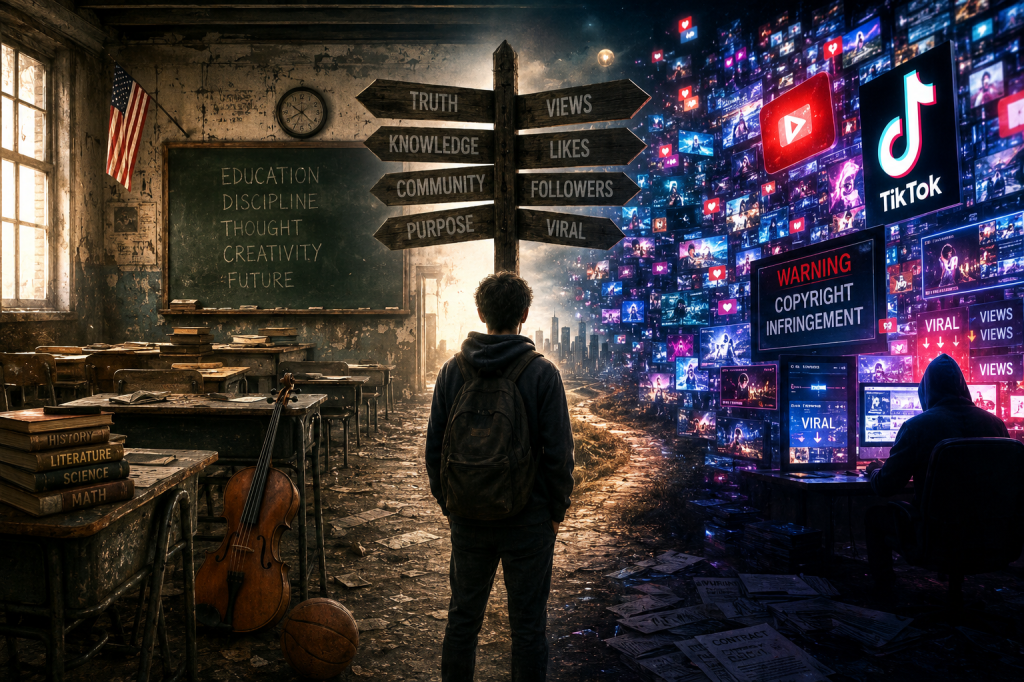
A disclaimer before the discussion.
July 18,2026
This is not an attack on any individual, profession, institution, or generation. It is an examination of cultural trends, educational priorities, technological incentives, and the unintended consequences of systems that were often built with good intentions.
Disagreement is expected. Debate is healthy. What follows is an argument—not an absolute truth.
The House We Built
Every generation inherits a society it did not create.
America’s public education system was never designed to be perfect. It emerged during a period of rapid industrialization when the nation needed widespread literacy, civic education, and a workforce capable of participating in a modern economy.
For millions, it succeeded.
Public schools dramatically expanded access to education regardless of wealth, produced scientists, engineers, doctors, artists, tradespeople, and entrepreneurs, and created one of the largest educated populations in history.
Criticism should never erase those accomplishments.
Yet systems that solve one era’s problems often struggle to solve the next generation’s.
When Stability Became Stagnation
Institutions naturally resist change.
Rules become traditions.
Traditions become bureaucracy.
Eventually bureaucracy becomes an end unto itself.
Innovation slows—not because people stop caring, but because changing large systems becomes increasingly difficult.
Instead of asking, “What should education prepare people for now?” society often asks, “How do we preserve what already exists?”
Those are fundamentally different questions.
A stable institution is valuable.
A stagnant institution eventually loses the ability to adapt.
The Subjects That Slowly Lost Their Place
Throughout history, subjects like music, visual arts, theater, and vocational education have frequently been reduced or eliminated in some schools during periods of budget pressure or emphasis on standardized testing.
Music itself was never abolished across America.
However, many communities witnessed programs shrink dramatically.
For students who discovered identity, discipline, collaboration, and creativity through the arts, those cuts represented more than a scheduling change.
They represented the loss of another language through which human beings understand one another.
Music teaches mathematics.
It teaches cooperation.
It teaches listening.
It teaches emotion.
A society that undervalues those lessons risks producing technically competent people who struggle to create, empathize, or communicate.
Who Was Left Behind?
Every system rewards certain strengths.
Some students excel in structured classrooms.
Others excel through movement, experimentation, craftsmanship, entrepreneurship, or artistic expression.
When society defines success too narrowly, many people conclude—not that the system failed them—but that they themselves are failures.
That is a costly mistake.
Communities have also seen declining opportunities for vocational training, apprenticeships, neighborhood arts programs, civic organizations, and other institutions that once gave people a sense of belonging.
When fewer paths are recognized as legitimate, more people feel excluded.
Alienation grows where participation disappears.
Reincorporating the Forgotten
A healthier society does not require abandoning traditional education.
It requires expanding what success looks like.
That could include:
- Stronger vocational and technical education.
- Greater investment in music and the arts.
- Apprenticeship pathways alongside college.
- Community mentorship programs.
- Financial literacy.
- Media literacy.
- Civic engagement.
- Entrepreneurship education.
- Respect for skilled trades alongside academic careers.
The goal is not to replace one path with another.
It is to recognize that different people contribute in different ways.
The Incentive Economy
The internet democratized publishing.
That achievement cannot be understated.
Anyone with an idea can potentially reach millions.
But every platform is shaped by incentives.
When attention becomes currency, engagement becomes profit.
Creators compete for visibility.
Algorithms reward watch time, clicks, emotional reactions, novelty, and frequency.
Those incentives can encourage originality—but they can also encourage repetition, sensationalism, and, in some cases, unauthorized use of copyrighted material.
Copyright infringement exists across many online platforms, including video-sharing and social media services, despite significant moderation and copyright enforcement efforts by those companies.
Most major platforms also provide systems that allow rights holders to identify or remove infringing content, though critics argue these systems are imperfect and can be both overinclusive and underinclusive.
The underlying challenge is not simply technology.
It is that economic incentives often reward visibility faster than originality.
The Noise Problem
Modern society generates more information than any human being can process.
Important issues compete with entertainment.
Nuance competes with outrage.
Long-form discussion competes with fifteen-second clips.
Many people feel that serious conversations about education, housing, healthcare, mental health, community decline, loneliness, infrastructure, and institutional reform receive less public attention than viral controversies.
Whether this reflects deliberate suppression, market incentives, audience preferences, or some combination of these factors remains a matter of debate.
Regardless of the cause, many observers argue that sustained public attention has become increasingly difficult to maintain.
Why You May Feel Unwelcome
Sometimes people feel unwelcome not because society explicitly rejects them, but because they cannot find where they belong.
Institutions become specialized.
Communities become fragmented.
Families move.
Neighborhood organizations disappear.
Work becomes increasingly digital.
Friendships become increasingly online.
People become connected to everyone and close to very few.
Belonging cannot be mass-produced.
It has to be built.
A Better Future
Reform should not begin with destruction.
It should begin with gratitude.
The American public education system accomplished extraordinary things.
It expanded literacy.
It created opportunity.
It helped build one of the world’s most productive societies.
Those successes deserve recognition.
But success in one century does not guarantee success in the next.
Improvement requires acknowledging where people have fallen through the cracks.
The answer is not abandoning public education.
It is broadening it.
The answer is not eliminating technology.
It is aligning technology with human flourishing.
The answer is not silencing disagreement.
It is creating spaces where disagreement can produce understanding instead of division.
A society becomes healthier when more people feel they have a meaningful place within it.
That goal belongs to everyone.
Final Thoughts
No institution is beyond criticism.
No generation is solely responsible for today’s problems.
No single company, school, or government created modern society’s challenges.
Likewise, no single reform will solve them.
The future depends less on assigning blame than on rebuilding trust, expanding opportunity, encouraging creativity, protecting original work, and ensuring that every person has a genuine chance to contribute.
If people feel unwelcome, the question should not only be why.
It should also be what kind of society would make them feel welcome again?
 The ChillX Zone
Leave a comment