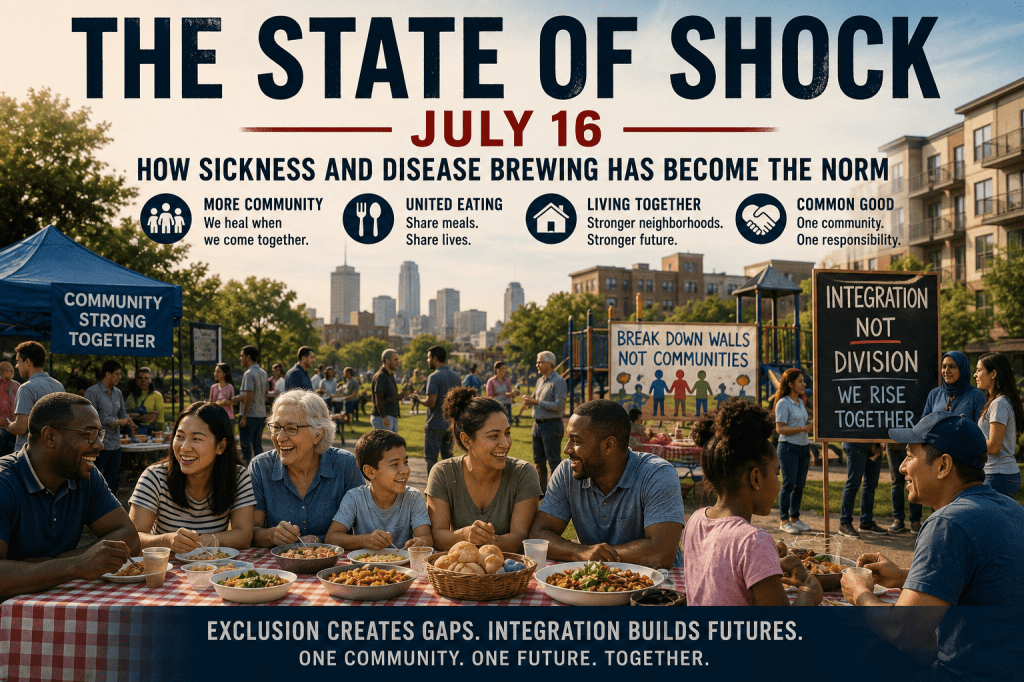
How social isolation, declining health, and civic disengagement are reshaping communities
July 16, 2026
Communities across the nation appear to be experiencing a growing sense of strain. Rising concerns over physical health, mental well-being, loneliness, and civic disengagement have left many wondering whether modern society has drifted away from the habits that once strengthened neighborhoods and families.
While advances in medicine continue to improve lives, many chronic illnesses, stress-related conditions, and mental health challenges have become increasingly common. These trends have prompted renewed discussion about whether stronger community connections could play a meaningful role in improving public well-being.
Rebuilding the Common Good
A healthy society is built on more than hospitals, schools, and infrastructure. It depends on people knowing one another, working together, and sharing responsibility for the places where they live.
Community dinners, neighborhood festivals, volunteer projects, youth sports, public parks, civic organizations, and local events all create opportunities for people from different backgrounds to interact in positive ways. These shared experiences help build trust and reduce the social distance that can develop when groups rarely encounter one another.
The common good grows when communities create spaces where participation is encouraged rather than division reinforced.
When Communities Become Isolated
Many cities today reflect increasing separation by income, housing costs, education, and sometimes ethnicity. Gentrification, suburban expansion, and economic pressures have changed the makeup of neighborhoods, often leaving long-time residents and newcomers with fewer opportunities to build relationships.
When people live, work, shop, and socialize within separate circles, misunderstandings can become easier to form. Limited interaction may contribute to stereotypes, distrust, and a weaker sense of shared responsibility.
The challenge is not diversity itself, but ensuring that communities have meaningful opportunities to connect across social and economic differences.
Living Together
Housing policy has long been part of conversations about integration. Some policymakers have proposed mixed-income developments or housing voucher programs as ways to encourage neighborhoods with greater economic diversity.
Supporters argue that such approaches can expand access to schools, employment opportunities, and public resources while increasing interaction among residents from different backgrounds. Critics raise concerns about implementation, affordability, and preserving established communities.
Regardless of the policy approach, the broader objective remains the same: creating neighborhoods where residents share common spaces, participate in civic life, and recognize one another as neighbors rather than strangers.
Civic Life as Preventive Medicine
Communities become stronger when people have reasons to gather.
Shared meals, neighborhood improvement projects, local markets, cultural celebrations, volunteer organizations, and civic associations all create opportunities for cooperation that extend beyond political or cultural differences.
These activities cannot eliminate every social challenge, but they can foster relationships that make communities more resilient during times of disagreement or crisis.
Looking Forward
The health of a nation is measured not only by economic growth or medical advances, but also by the strength of its communities.
As society continues to evolve, rebuilding civic engagement may prove just as important as investing in physical infrastructure. The more opportunities people have to meet, serve, and live alongside one another, the greater the likelihood that trust, cooperation, and a shared commitment to the common good will follow.
Strong communities are rarely built through separation. They are built through participation, shared responsibility, and the simple act of bringing people together.
 The ChillX Zone
Leave a comment