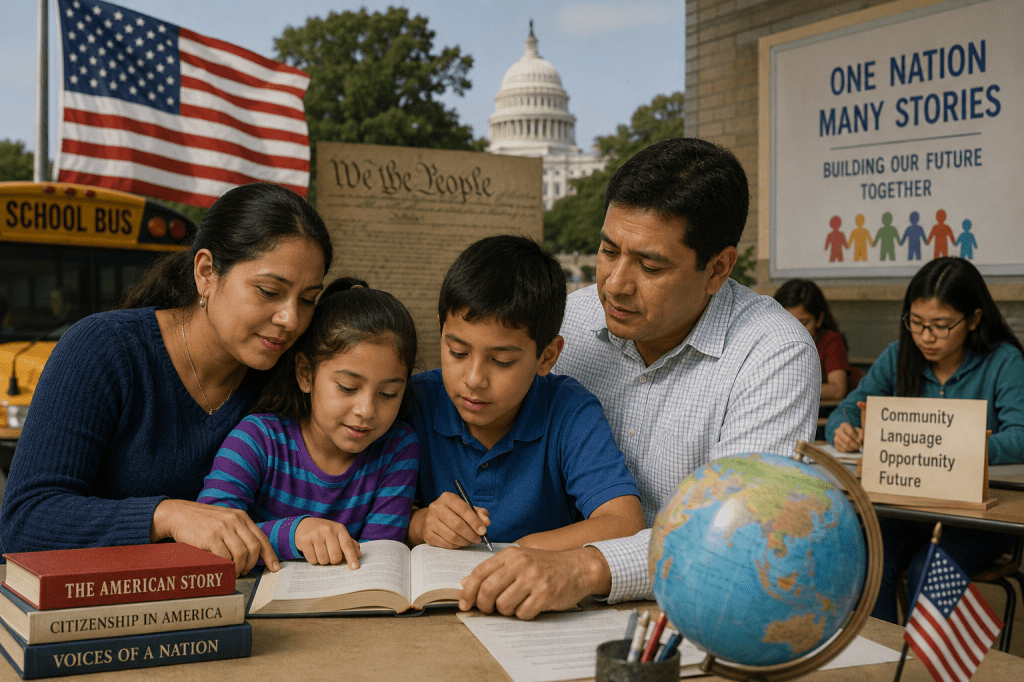
How early childhood, language, and civic identity influence the next generation
July 17, 2026
In every generation, a nation is shaped not only by its laws and institutions, but also by the youngest members of society. The first years of life often determine far more than childhood memories. They influence language, social customs, cultural understanding, and, in many ways, how an individual connects to the country they call home.
As immigration has transformed communities across America, one consistent observation continues to emerge. Children born in a country—or those who arrive during infancy—often become indistinguishable from their peers in language, mannerisms, and social behavior. Their parents, however, may continue to rely on traditions and language carried from another homeland.
A Different Beginning
The difference between arriving at seven years old and arriving at seven months old can be profound.
A child who immigrates after beginning school has already formed a linguistic foundation. Their native language often remains dominant, even after years of learning English. Accents may remain, family customs continue, and cultural references from their birthplace frequently stay with them throughout adulthood.
Children who arrive during infancy, or who are born in the United States to immigrant parents, usually experience something entirely different. English becomes their natural language because it surrounds them from the earliest stages of development. School, neighbors, friendships, media, and everyday experiences reinforce the language and customs of the country where they are growing up.
Developmental psychology has long recognized that the earliest years of life represent an especially important period for language acquisition and social learning. During this time, the brain readily absorbs the sounds, grammar, and social patterns present in a child’s environment.
The Family Interpreter
One of the more remarkable patterns within immigrant families is the changing role of children.
It is not uncommon for sons and daughters to become translators for their parents while still in elementary school. Doctor appointments, school conferences, banking, shopping, government paperwork, and countless daily interactions may depend upon the child explaining one world to another.
In many households, the youngest member quietly becomes the bridge between two cultures.
This role often develops naturally rather than by design. Children adapt quickly because they are immersed in their surroundings each day, while parents balancing work, family responsibilities, and learning a new language may require far more time to reach the same level of fluency.
More Than Language
Language is only one piece of integration.
Children also absorb social expectations, humor, customs, and civic traditions through repeated exposure. Their understanding of fairness, responsibility, teamwork, and public behavior is influenced by schools, neighborhoods, and the broader community.
At the same time, many families intentionally preserve the customs of their country of origin. The result is often a generation comfortable moving between two cultural worlds rather than belonging exclusively to one.
The outcome differs from family to family, reminding us that no two immigrant experiences are exactly alike.
The Constitutional Question
The Framers of the United States Constitution placed a unique qualification on the nation’s highest office by requiring the President to be a natural-born citizen.
Historians continue to debate every aspect of that decision, but many agree that concerns about foreign influence played a significant role in the thinking of the late eighteenth century. The young republic had recently secured its independence and sought to reduce the possibility that loyalty to another nation could influence its highest executive office.
The Constitution itself does not explain the reasoning in detail, leaving later generations to interpret the historical context through correspondence, debates, and contemporary writings.
Whether one agrees with that qualification today or not, it demonstrates that questions surrounding national identity and civic allegiance have existed since the nation’s earliest days.
Society’s Responsibility
Immigration has always brought opportunity as well as challenges.
Every society hopes that newcomers will contribute positively while respecting the laws and civic expectations of their adopted home. Likewise, successful integration depends not only on individual effort but also on access to education, employment, and opportunities to participate fully in community life.
When harmful behaviors appear within any community, it is important to distinguish between individual actions and entire populations. Criminal conduct, civic responsibility, and social participation are influenced by many factors—including family environment, education, economic opportunity, and community institutions—and should not be attributed solely to a person’s place of birth or ancestry.
Looking Ahead
Perhaps the greatest lesson is that the first years of life leave lasting impressions.
Children raised from infancy within a society generally learn its language effortlessly and become familiar with its customs almost without realizing it. Those who arrive later often carry the strengths of two cultures, balancing the traditions of one homeland with the opportunities of another.
The future of any nation depends less on where children begin than on how they are educated, welcomed, and prepared to become responsible citizens. The earliest chapters of life help write that story, but the choices made by families, communities, and individuals determine how the rest of it unfolds.
 The ChillX Zone
Leave a comment