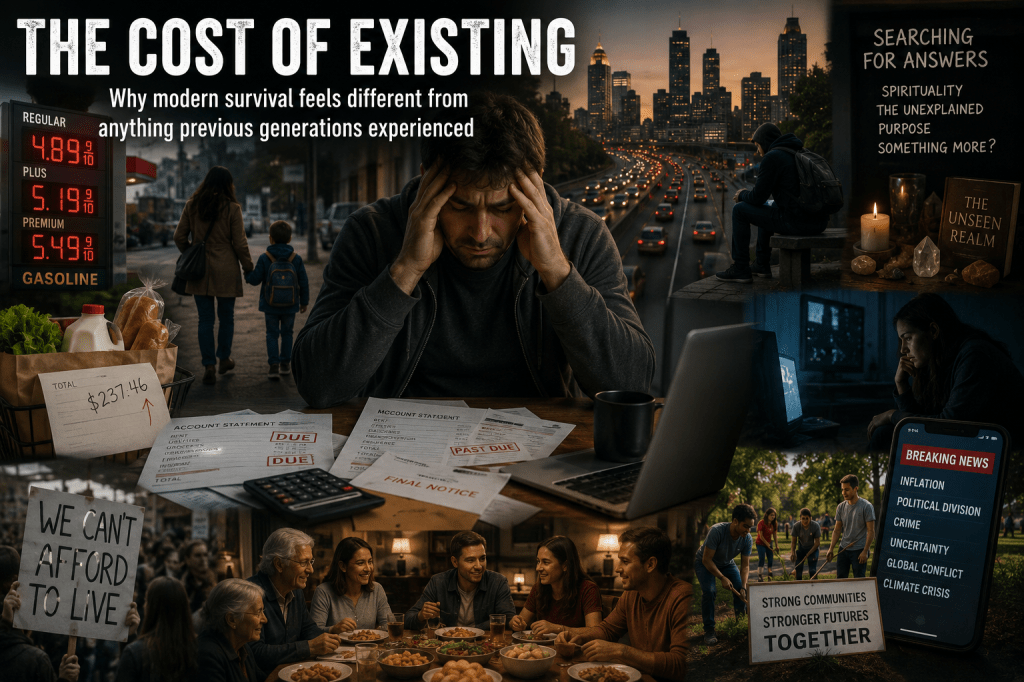
Why modern survival feels different from anything previous generations experienced
July 15, 2026
There was a time when survival meant enduring the elements.
Families worried about putting food on the table, protecting their homes, and overcoming hardships brought by war, economic depression, or natural disaster. Life was often difficult, but the challenges were clear and understood. Communities leaned on one another because they had little choice.
Today, survival has taken on a different meaning.
Many people are no longer fighting nature—they are struggling against rising costs, isolation, constant stress, information overload, and an increasingly complicated society. While living standards have improved in countless ways, many Americans say they feel as though simply existing has become exhausting.
The New Burden
Previous generations expected to work hard.
What they did not expect was to remain connected to work around the clock, navigate endless streams of information, or face a cost of living that often outpaces wages.
Housing, healthcare, childcare, education, and basic necessities have become growing concerns for millions of families. Financial pressure now reaches well beyond low-income households, affecting many middle-class families who once considered themselves secure.
Survival has become less about endurance and more about constant adaptation.
A Society Under Pressure
Communities are changing.
Neighbors often know one another less than they once did. Civic organizations have declined in many areas, while digital communication has replaced many face-to-face relationships.
Technology has connected people across continents but, for many, widened the distance between those living on the same street.
The result is a growing sense that society is carrying pressures unlike those experienced by previous generations—not necessarily because life is harder in every respect, but because the demands are relentless.
Searching for Relief
When people experience prolonged stress, they often search for ways to regain control.
Some turn to faith.
Others seek wellness practices, meditation, outdoor recreation, or stronger community involvement.
Still others become interested in unexplained phenomena, alternative beliefs, or ideas that promise answers to questions conventional institutions seem unable to resolve.
History shows that periods of uncertainty frequently lead people to search beyond the ordinary for meaning and reassurance.
What Was Lost
Many older Americans remember neighborhoods where children played outside until sunset, local organizations filled community calendars, and families gathered regularly around dinner tables.
Those memories may not represent every community, but they remind us that shared experiences once formed a stronger part of everyday life.
Modern conveniences have saved time in many ways, yet they have not always produced a greater sense of belonging.
Rebuilding More Than the Economy
Economic recovery alone cannot repair a fractured society.
Communities grow stronger when people volunteer together, support local businesses, attend civic meetings, mentor young people, and create opportunities for neighbors to know one another.
The strength of a nation has never depended solely on its wealth. It has also depended on trust, cooperation, and a willingness to invest in the common good.
Looking Ahead
Every generation faces its own definition of survival.
Yesterday’s challenges were often physical. Today’s are increasingly emotional, financial, and social.
The question facing modern society is not simply how to make life easier, but how to make it more connected, more purposeful, and more resilient.
If the greatest resource any nation possesses is its people, then rebuilding stronger communities may prove just as important as rebuilding stronger economies.
 The ChillX Zone
Leave a comment