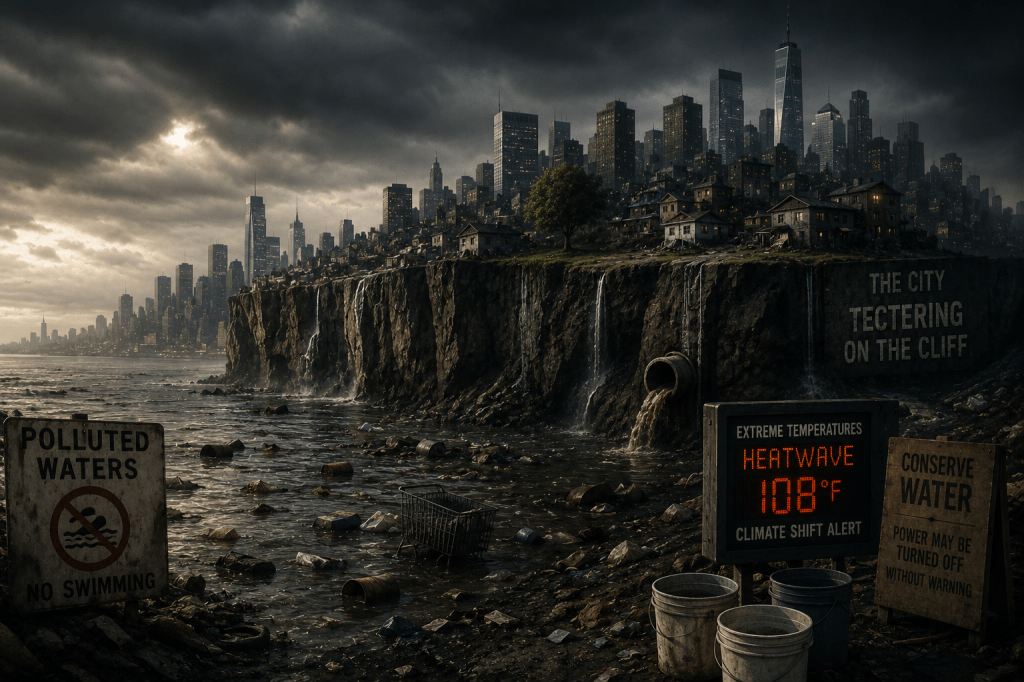
Rising temperatures, strained resources, shrinking green spaces, and an uncertain future are forcing us to ask an uncomfortable question: could modern cities one day be forced to live by entirely different rules?
July 9, 2026
This article explores a speculative scenario inspired by environmental concerns, urban planning challenges, and paranormal themes. It is intended as thought-provoking commentary rather than a prediction of future events.
Cities Built for Yesterday
Modern cities were designed around the assumption that electricity, clean water, and endless growth would always be available. Today, that assumption is beginning to feel less certain.
Heatwaves grow longer, storms become more intense, and aging infrastructure struggles to keep pace. At the same time, millions of people live surrounded by concrete, with only a small patch of grass—or none at all—to reconnect with nature.
The Water Beneath Our Feet
Polluted rivers, stressed reservoirs, and increasing demand have turned clean water into one of the world’s most valuable resources. While major cities continue to function, many experts warn that water management will become one of the defining challenges of this century.
What happens if conservation becomes more than a recommendation?
Could carrying water become an ordinary part of city life once again?
When the Lights Go Out
Imagine a future where electricity isn’t guaranteed 24 hours a day. Heating and cooling systems operate only during certain hours to reduce demand. Elevators sit idle to conserve power. Residents climb stairs carrying groceries, water, and supplies—not because technology failed, but because resources are carefully rationed.
It sounds extreme.
History reminds us that societies have adapted to difficult conditions before.
The Paranormal Feeling
There is something strangely unsettling about cities today. Towering skylines glow through polluted skies while nature seems increasingly distant. Some describe it as an atmosphere that’s difficult to explain—a feeling that the city itself has become disconnected from the natural world.
Is it simply environmental anxiety?
Or are people sensing that civilization is approaching a turning point?
What May Be Necessary
If environmental pressures continue to grow, tomorrow’s cities may need to become smaller, greener, and less dependent on constant consumption. Conservation may no longer be optional. Communities may rely more on local resources, shared infrastructure, and simpler ways of living.
The greatest challenge may not be technological.
It may be learning to live with less.
Final Thoughts
The city on the cliff is more than a place—it’s a metaphor for modern civilization. We continue building higher while the ground beneath us becomes increasingly uncertain.
Whether the future brings adaptation, innovation, or something far stranger, one truth remains: the choices made today will shape the cities that future generations inherit.
 The ChillX Zone
Leave a comment