Why a Stable Society Protects Freedom Without Elevating Any Single Worldview
July 5, 2026
The Universal Need for Order
Civilizations do not emerge from chaos. They emerge from order.
Long before political philosophy attempted to define government, nature had already established a pattern repeated throughout every observable system. At every scale—from individual cells to ecosystems, from families to nations—stability depends upon organization. Biology calls it homeostasis. Physicists describe systems seeking equilibrium. Ecologists observe balance among competing organisms. Human societies are no exception.
Order is not the opposite of freedom. It is the condition that allows freedom to exist.
Without predictable laws, reliable institutions, and shared expectations, rights become temporary privileges enforced only by whoever possesses the greatest strength. History repeatedly demonstrates that liberty flourishes only where sufficient order exists to protect it.
The challenge for every civilization has never been whether order is necessary. The challenge has always been determining how much order is required without sacrificing the individual freedoms that give society its vitality.
The American Experiment
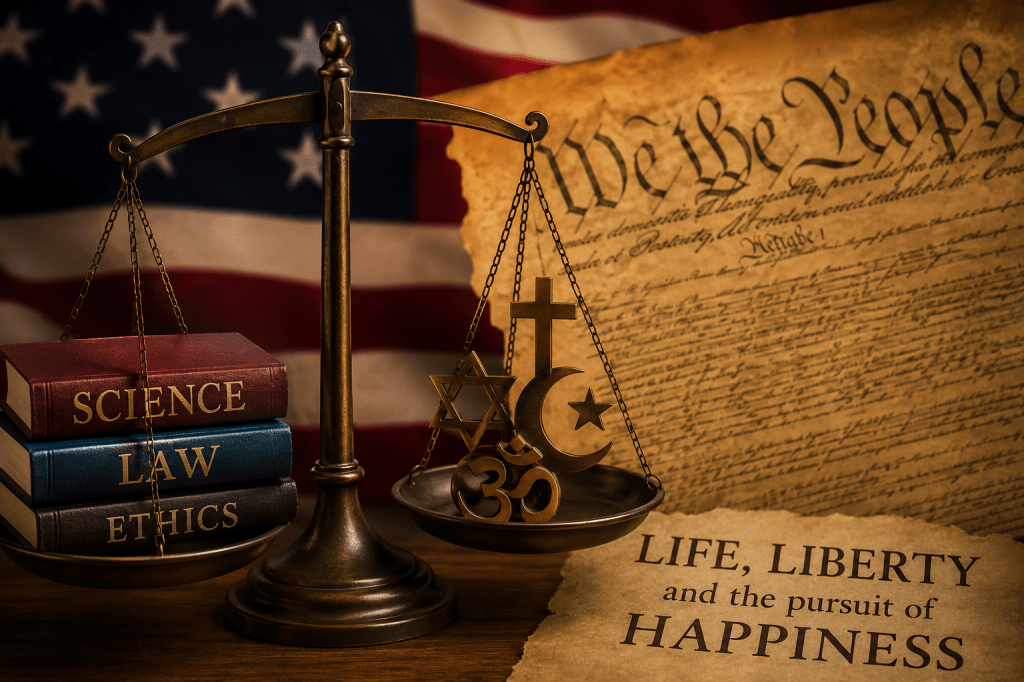
When the United States was founded upon the principles of life, liberty, and the pursuit of happiness, it represented a remarkable departure from much of human history.
Rather than organizing society around a single church, monarchy, or inherited social class, the nation’s guiding philosophy placed the individual at the center of government. Rights were understood to exist before government itself, and the government’s role was to preserve those rights rather than define their source.
Perhaps equally important was what the founding principles did not attempt to accomplish.
They did not require every citizen to think alike.
They did not establish one universal philosophy through which every American would understand morality, purpose, or existence.
Instead, they created a framework in which differing beliefs could coexist under common laws.
That distinction remains one of the defining characteristics of a free society.
The Science of Human Belief
Modern science has revealed something earlier civilizations could only observe intuitively: human beings naturally construct systems of belief.
Psychologists have shown that the brain continuously organizes information into patterns that provide meaning and guide decision-making. Anthropologists have documented thousands of distinct religious, philosophical, and cultural traditions across human history. Neuroscientists continue to study how identity, morality, and purpose emerge from complex interactions within the brain.
Although these disciplines differ in methodology, they point toward a similar conclusion.
The capacity to develop beliefs appears to be a universal feature of human cognition.
What varies is not whether people believe, but what they believe.
Differences arise through family, culture, education, personal experience, environment, and countless other influences that shape human development throughout life.
Science does not identify one universal belief system shared by every individual. Instead, it demonstrates that diversity of belief is a predictable consequence of human diversity itself.
Why Government Should Remain Neutral
If differing systems of belief are a natural characteristic of humanity, then government occupies a unique position.
Its responsibility is not to determine which beliefs are ultimately correct.
Its responsibility is to preserve the conditions under which citizens with differing beliefs may live together peacefully.
The moment institutions begin assigning official superiority to one worldview, neutrality gives way to preference.
Preference eventually produces unequal treatment.
Unequal treatment weakens public trust.
And diminished trust ultimately weakens the very order government exists to preserve.
Civil peace depends less upon universal agreement than upon universal fairness.
Accommodation Already Exists
Society routinely accommodates ordinary human needs without interpreting those accommodations as ideological endorsements.
Consider the modern lunch break.
Many workplaces provide approximately thirty minutes during the middle of the day for employees to eat.
This schedule is practical, familiar, and widely accepted.
Yet no scientific principle declares that every person must eat precisely at noon. Some individuals naturally eat earlier, others later. Cultural traditions vary widely. Personal preferences differ. Shift workers often follow entirely different schedules.
The lunch period exists not because noon carries universal significance, but because structured accommodation benefits both workers and employers.
Health improves.
Productivity increases.
Operations remain organized.
Accommodation serves the needs of individuals while preserving the efficiency of the institution.
Extending the Principle
The same conceptual framework can apply to recognized systems of belief.
Providing limited, predictable time for religious observance, meditation, reflection, or comparable practices does not require government or employers to endorse any particular worldview.
Rather, it acknowledges an observable fact about human society: many individuals organize their lives around sincerely held systems of meaning.
Accommodating those practices, when reasonably possible, functions much like accommodating meal breaks.
It recognizes a recurring human need without requiring everyone to share identical reasons for using the allotted time.
The accommodation is procedural, not philosophical.
Its purpose is to maintain participation while respecting diversity.
Equality Through Consistency
True neutrality does not require treating every activity as identical.
It requires applying consistent principles fairly.
If institutions already recognize that employees occasionally require structured time for universally accepted human needs, then carefully considered accommodations for established systems of belief can be understood through the same administrative lens.
The objective is not to elevate one religion over another.
Nor is it to diminish those with no religious beliefs at all.
Rather, the objective is to preserve equal participation by ensuring that no citizen is unnecessarily disadvantaged because of sincerely held convictions that coexist peacefully within society.
Such an approach strengthens institutions because it reduces unnecessary conflict while reinforcing public confidence that individuals are judged according to their conduct rather than their beliefs.
The Balance Between Order and Liberty
Science continues to demonstrate that resilient systems balance stability with adaptability.
Rigid systems often fracture under pressure.
Chaotic systems fail to organize themselves effectively.
The strongest systems maintain clear rules while allowing diversity within those rules.
A free society operates according to the same principle.
Order provides the structure.
Liberty provides the flexibility.
Together they create conditions in which people with profoundly different beliefs can contribute to a common civilization without surrendering their individual identities.
The enduring strength of the American experiment lies not in requiring uniformity of thought, but in maintaining an orderly society where freedom of conscience remains protected equally for all.
 The ChillX Zone
Leave a comment