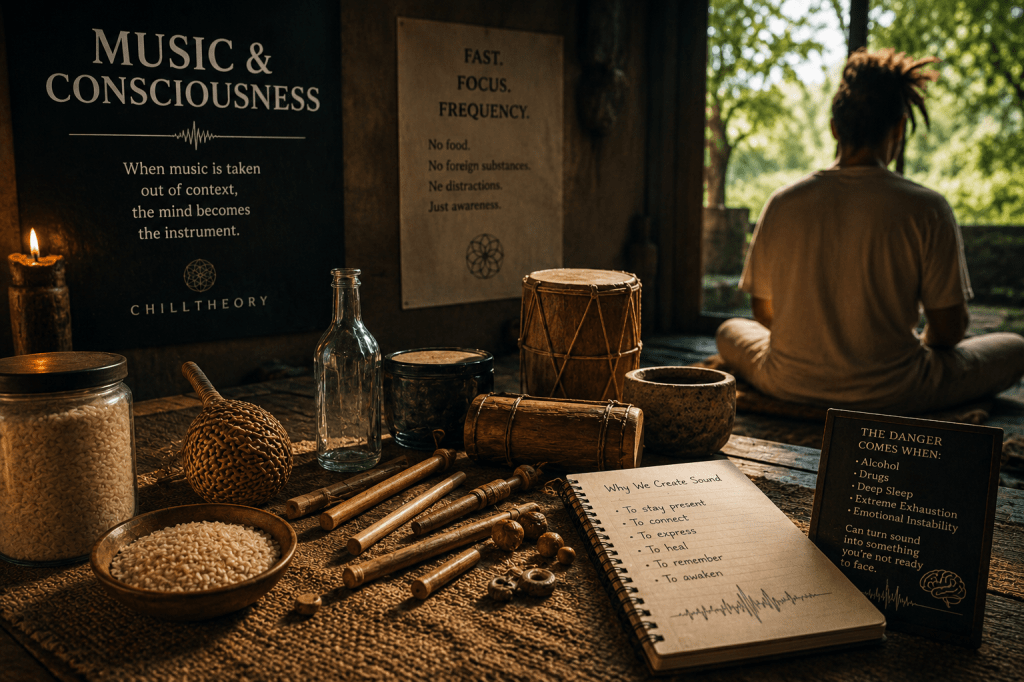
Can music become more powerful when the mind is altered? Exploring the science of fasting, sound, dreams, and altered states of consciousness.
July 3, 2026
Music has accompanied humanity for thousands of years. It can calm anxiety, strengthen memories, improve concentration, and create powerful emotional experiences. Entire civilizations have used rhythm and sound in ceremonies, meditation, healing practices, and celebration.
But what happens when music is experienced under unusual conditions?
What if the body is fasting, the mind is quiet, distractions are removed, and the only sounds we create come from simple handmade instruments?
And what happens if those same sounds are combined with alcohol, recreational drugs, or unusually deep sleep?
These questions sit at the intersection of neuroscience, psychology, and human consciousness.
Why Would Someone Fast?
People fast for many different reasons.
Some do it for religious or spiritual reflection.
Others fast for discipline, mental clarity, metabolic health, or simply to disconnect from constant stimulation.
A fast can also be viewed as a temporary reduction in outside influence. For a period of time, no food enters the body, and many people also choose to reduce unnecessary media, entertainment, and other distractions.
The goal is not deprivation.
The goal is awareness.
Making Music From Everyday Objects
Imagine spending the day using only simple acoustic objects to create sound.
A container filled with rice becomes a shaker.
Two sticks become rhythm.
Hands become percussion.
A glass bottle becomes a resonating instrument.
Instead of electronic equipment or amplified speakers, every sound is created naturally.
Why?
Because attention changes.
Without constant digital stimulation, small sounds become more noticeable.
Subtle rhythms become more meaningful.
The brain begins paying attention to details that might otherwise be ignored.
This is not mystical.
It is one example of how focused attention can reshape perception.
Sound Changes the Brain
Scientific research has shown that music can influence several brain systems.
Music may:
- Reduce stress hormones.
- Improve mood.
- Influence heart rate and breathing.
- Strengthen memory.
- Increase emotional responses.
- Affect attention and concentration.
Rhythm can also encourage the brain to synchronize with repeating patterns, a process sometimes called neural entrainment.
This does not mean music controls the mind.
It means the brain naturally responds to organized sound.
When Music Meets Altered States
Context matters.
The same piece of music can feel completely different depending on the listener’s physical and mental state.
Consider someone who is:
- Extremely sleep deprived.
- Recovering from heavy alcohol use.
- Using recreational drugs.
- Experiencing a high fever.
- Entering unusually deep sleep.
Each of these conditions changes normal brain function.
During these states, dreams may become unusually vivid.
Sleep paralysis may occur.
Some people report hearing voices, sensing a presence, or experiencing frightening hallucinations while falling asleep or waking.
These experiences can feel completely real.
Current neuroscience suggests they result from changes in brain activity rather than the music itself.
Music may influence emotion or the tone of an experience, but it is not known to create nightmares or hallucinations on its own.
Why Some Music Feels Different
Have you ever noticed that the same song can feel peaceful one day and unsettling another?
The music may not have changed.
You did.
Stress levels…
Fatigue…
Environment…
Memories…
Expectations…
All influence how the brain interprets sound.
Music becomes part of the experience rather than the cause of it.
The Danger of Combining Music With Intoxication
Alcohol and many drugs alter perception, judgment, sleep quality, and emotional regulation.
Heavy intoxication or withdrawal can increase the likelihood of vivid dreams, nightmares, hallucinations, and episodes of confusion.
Adding emotionally intense music during these altered states may amplify the emotional experience for some people because the brain is already processing reality differently.
This does not mean music becomes dangerous by itself.
Rather, it highlights how powerful context can be.
A peaceful melody heard while relaxed may feel comforting.
The same melody heard during alcohol withdrawal, severe sleep deprivation, or a frightening dream could be experienced very differently.
A Thought Experiment
Imagine spending twenty-four hours with no alcohol, no drugs, no processed food, minimal technology, and only simple handmade instruments.
Throughout the day, you create gentle rhythms using natural objects while paying close attention to your breathing and surroundings.
Would the music sound different?
Or would you be different?
Perhaps the greatest influence is not the instrument…
It is the state of mind of the person holding it.
Final Thoughts
Music is one of humanity’s oldest forms of communication.
It can comfort, inspire, energize, and heal.
It can also become emotionally overwhelming when experienced during periods of exhaustion, intoxication, illness, or altered consciousness.
The evidence suggests that music itself is not the danger.
The combination of altered brain states, expectation, emotion, and environment can dramatically change how music is experienced.
Perhaps the real mystery is not whether music changes consciousness…
…but how consciousness changes music.
ChillTheory
Science. Consciousness. Frequency.
 The ChillX Zone
Leave a comment