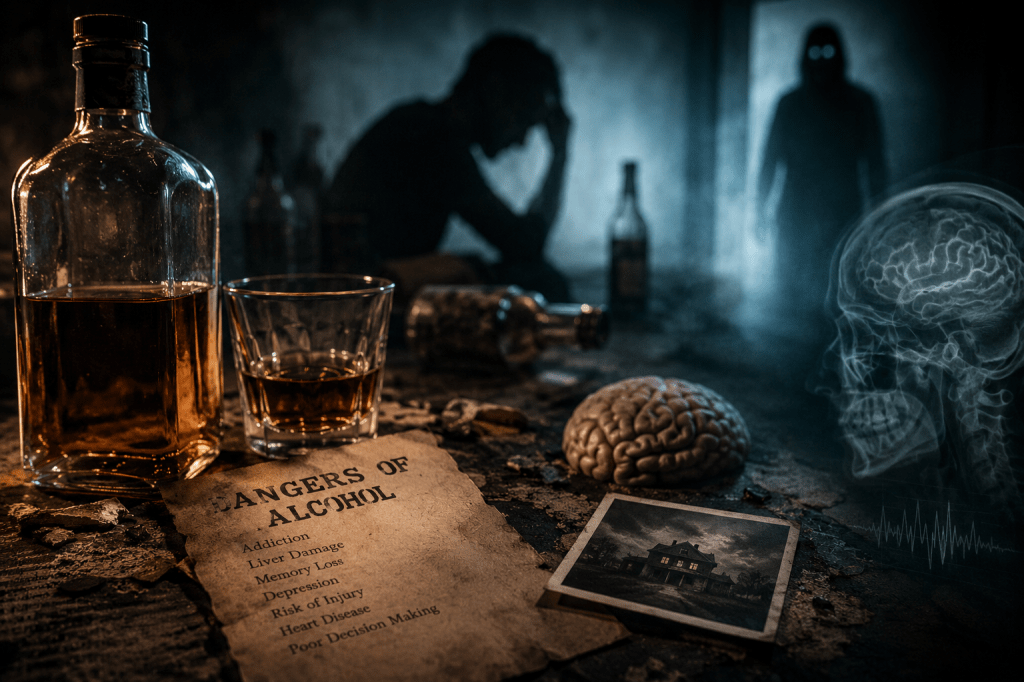
From neuroscience and addiction to ancient folklore and unexplained encounters, exploring where science ends and mystery begins.
July 2, 2026
Long before modern medicine, written history, or even the wheel, humans were fermenting fruit, grains, and honey into alcohol. Archaeological discoveries suggest that alcoholic beverages have existed for at least 9,000 years, making them one of humanity’s oldest psychoactive substances.
Throughout history, alcohol has been celebrated, feared, worshipped, and abused. It has been used in religious ceremonies, royal feasts, medicinal remedies, and cultural traditions across nearly every civilization on Earth.
But alongside its long history lies an equally enduring question:
Why has alcohol always been linked with stories of the strange and unexplained?
What Alcohol Really Does to the Brain
Alcohol is a depressant that slows activity in the central nervous system.
As blood alcohol levels rise, communication between neurons becomes less efficient. Judgment becomes impaired, reaction times slow, emotions become amplified, and memory formation can begin to fail.
At higher levels of intoxication, alcohol can affect:
- Balance and coordination
- Decision-making
- Emotional regulation
- Sleep quality
- Visual and auditory perception
- Memory formation
Heavy drinking over long periods is associated with serious health risks, including liver disease, cardiovascular disease, several cancers, depression, anxiety, addiction, and cognitive decline.
Science clearly explains many of these effects.
But not all reported experiences fit neatly into simple intoxication.
The Hidden Cost of Heavy Drinking
While alcohol is often marketed as a way to relax, excessive consumption can gradually reshape both physical and mental health.
Long-term misuse has been linked to:
- Increased risk of accidents and injuries
- Relationship breakdowns
- Poor sleep quality
- Anxiety and depression
- Reduced cognitive performance
- Alcohol dependence
Ironically, many people drink to escape stress, yet excessive alcohol often increases stress over time by disrupting sleep, affecting brain chemistry, and making emotional regulation more difficult.
When Reality Begins to Shift
One of alcohol’s lesser-known effects is its ability to alter perception.
Some individuals experience:
- Hearing voices
- Seeing figures that disappear moments later
- Distorted shadows
- Feelings of being watched
- Vivid nightmares
- Sleep paralysis
Medical science explains many of these experiences through changes in brain activity, sleep disruption, sensory processing, and, in severe cases, alcohol withdrawal.
Yet these experiences have inspired thousands of supernatural stories throughout history.
Ancient Beliefs About Spirits and Intoxication
Many ancient cultures believed intoxication weakened the boundary between worlds.
Some traditions warned that excessive drinking made a person spiritually vulnerable.
Others believed altered states of consciousness allowed communication with ancestors, gods, or unseen entities.
Across Europe, Asia, Africa, and the Americas, folklore often connected drunkenness with mysterious encounters, strange visions, and unexplained presences.
Although these beliefs vary widely, the recurring theme is striking:
Alcohol changes more than behavior—it changes perception.
Shadow Figures, Voices, and Shared Experiences
Modern paranormal investigators frequently receive reports involving people who experienced unusual phenomena after periods of heavy drinking.
Common reports include:
- Shadow-like figures standing in doorways
- Whispers heard when no one else is present
- Unexplained knocks or footsteps
- Feelings of overwhelming dread
- Objects seemingly moving without explanation
These reports are anecdotal and do not constitute scientific evidence of paranormal activity.
However, their consistency across cultures and generations continues to fuel debate among researchers, psychologists, and paranormal enthusiasts alike.
Science vs. The Supernatural
Neuroscience provides powerful explanations for many extraordinary experiences.
Sleep deprivation, alcohol intoxication, withdrawal, expectation, fear, and environmental factors can all influence how the brain interprets reality.
At the same time, science does not claim that every unusual personal experience has been fully explained.
The existence of unexplained reports does not confirm supernatural causes—but neither does it automatically eliminate every mystery.
Maintaining curiosity while remaining grounded in evidence allows us to explore these questions responsibly.
The Psychology of Fear and Suggestion
Our brains are extraordinary pattern-recognition machines.
When perception is altered—whether through stress, fatigue, intoxication, or fear—the mind can become more likely to interpret ambiguous sounds, shadows, or sensations as meaningful.
This does not make the experience feel any less real to the person experiencing it.
It simply reminds us that consciousness is one of the most complex frontiers in science.
The Final Question
Alcohol has shaped civilizations, inspired celebrations, fueled conflict, and altered human consciousness for thousands of years.
Science explains much of what happens inside the brain during intoxication.
History and folklore remind us that humanity has always associated altered states of consciousness with deeper mysteries.
So perhaps the most interesting question is not whether alcohol opens a doorway to another world…
…but why changing the chemistry of the brain can so dramatically change our experience of reality.
ChillTheory
Science. Consciousness. Frequency.
 The ChillX Zone
Leave a comment