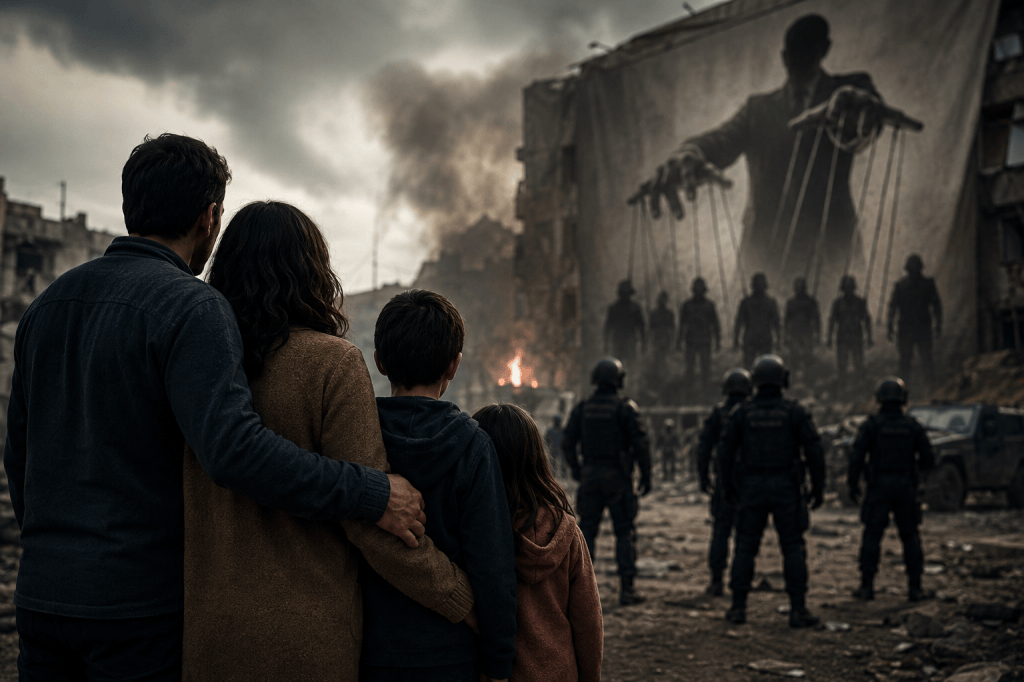
How political conflicts often extend beyond their intended targets, leaving innocent families to bear the lasting consequences.
Political conflict is often presented as a struggle between governments, parties, ideologies, or movements. Headlines focus on leaders, elections, legislation, protests, and military operations. Yet beneath the surface lies a quieter, more devastating reality: families are frequently the ones who bear the greatest burden.
Sometimes they are targeted directly.
Sometimes they become collateral damage.
Sometimes they are drawn into conflict unintentionally, simply because of who they are related to or where they happen to live.
Regardless of the circumstances, the suffering experienced by innocent families raises difficult questions about power, morality, and the darker aspects of human behavior.
Families as Instruments of Pressure
Throughout history, political opposition groups, authoritarian governments, insurgencies, and extremist organizations have understood that influencing one individual can be achieved by exerting pressure on those closest to them.
A journalist may be threatened through intimidation directed at their spouse. A public official may face anonymous harassment aimed at their children. A community leader may be silenced after relatives become victims of violence or coercion.
The objective is often psychological rather than military. Fear spreads more effectively when it reaches the home. When family members no longer feel safe, even the strongest convictions can begin to weaken.
In these situations, innocent people become unwilling participants in struggles they never chose.
The Unintended Victims
Not every tragedy is the result of deliberate targeting.
Political unrest, armed conflict, and civil disorder frequently create circumstances in which ordinary families suffer without ever being intended targets.
A home may be destroyed during military operations.
A family business may collapse because of sanctions, unrest, or prolonged instability.
Children may lose access to education because schools become unsafe.
Communities may fracture as neighbors are forced to choose sides.
These consequences may not arise from deliberate malice, but they are no less painful for those who endure them.
History repeatedly demonstrates that civilians often pay the highest price for conflicts initiated by others.
When the Truth Should Be Clear
Perhaps the most troubling situations arise when the facts are available, when innocence could reasonably be recognized, yet those with power continue down a destructive path.
There are moments when evidence exists, witnesses speak, and opportunities for restraint remain.
Yet some individuals or organizations choose intimidation over justice.
They choose fear over dialogue.
They choose destruction over reconciliation.
Whether driven by ideology, revenge, ambition, or the desire to maintain control, these choices transform political disagreement into something far darker.
At that point, the conflict is no longer simply about competing ideas. It becomes a deliberate abandonment of moral responsibility.
The Psychology of Dehumanization
One reason this becomes possible is dehumanization.
When people cease seeing others as individuals—with families, hopes, fears, and aspirations—they become easier to dismiss as obstacles rather than human beings.
History offers countless examples where propaganda portrayed opponents as enemies of society, traitors, or less than human.
Once that mental barrier is crossed, actions that would otherwise seem unimaginable become easier to justify.
The family, once viewed as innocent, becomes merely another means to achieve political objectives.
The Shadow Behind the Violence
This raises a question that has occupied philosophers, theologians, and psychologists for centuries.
Can a force of such calculated cruelty truly exist?
Can someone—or something—operate with a consciousness seemingly devoted to causing suffering, manipulating events from the shadows while remaining largely unseen?
For some, the answer is found in religious concepts of evil, where destructive spiritual forces tempt humanity toward hatred and violence.
For others, the explanation lies entirely within human nature. History has shown that ordinary individuals, under certain conditions, can commit extraordinary acts of cruelty when influenced by fear, ideology, obedience, or the pursuit of power.
Whether one believes evil is spiritual, psychological, or entirely human, its effects often appear strikingly similar: deception replaces truth, compassion gives way to indifference, and innocent lives become expendable.
The Power of Deception
Perhaps the greatest weapon employed by those who seek power through fear is not violence itself but deception.
False narratives divide communities.
Rumors destroy reputations.
Propaganda encourages neighbors to distrust one another.
Selective information convinces people that injustice is somehow justified.
When deception succeeds, people may unknowingly participate in systems that harm innocent individuals while believing they are serving a greater cause.
This is why transparency, accountability, and independent institutions remain essential safeguards within any society.
Breaking the Cycle
History also provides reasons for hope.
Many societies have emerged from periods of intense political violence by recognizing a simple but profound truth: no lasting victory can be built upon the suffering of innocent families.
Justice requires evidence.
Power requires accountability.
Political disagreement should never become permission to abandon basic human dignity.
Protecting civilians, respecting due process, and preserving the rights of families are not signs of weakness—they are the foundations of stable and democratic societies.
Conclusion
Political conflict will likely remain part of human history. Competing visions for society are inevitable. However, there is a clear moral distinction between opposing ideas and targeting the innocent.
When families become instruments of intimidation, the damage extends far beyond individual households. Trust erodes. Communities fracture. Future generations inherit trauma they did nothing to create.
Whether the darkness behind such actions originates from human ambition, ideological extremism, or beliefs about deeper spiritual forces, the outcome is the same: innocent lives are placed at risk.
The enduring challenge for every generation is not merely to recognize evil when it appears in obvious forms, but also to resist the quieter forms of deception that encourage people to look away, remain silent, or accept the unacceptable.
A society is ultimately measured not by how fiercely it defeats its political opponents, but by how faithfully it protects those who never chose to be part of the conflict in the first place.
 The ChillX Zone
Leave a comment