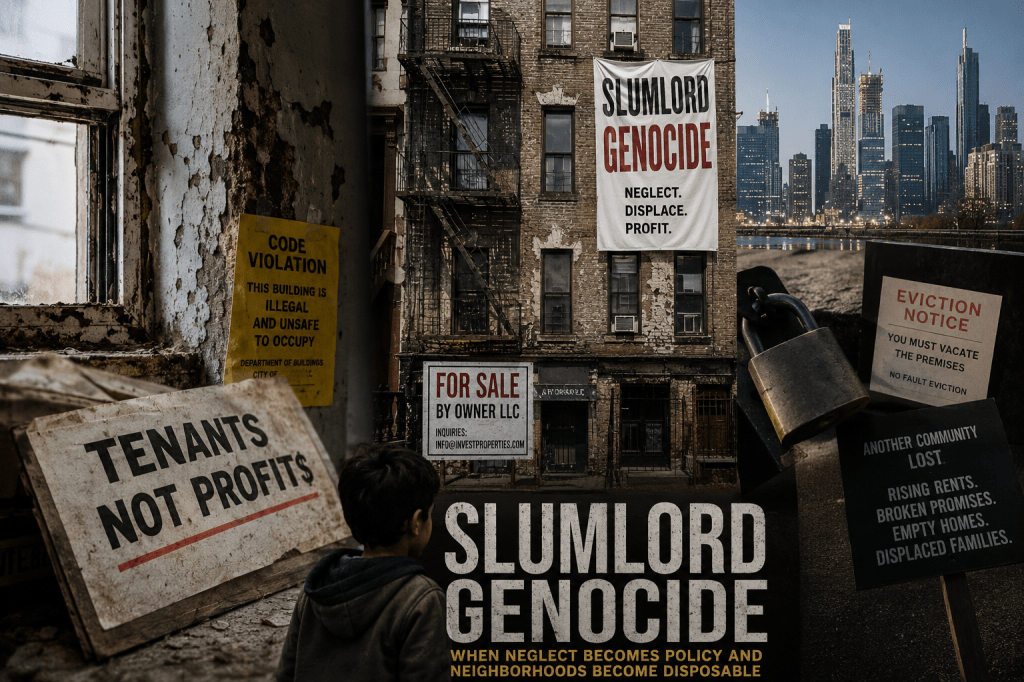
When Neglect Becomes Policy and Neighborhoods Become Disposable
June 26, 2026
“Cities aren’t destroyed overnight. They decay one building inspection at a time, one ignored complaint at a time, one absentee owner at a time.”
The Quiet Violence of Neglect
There is a form of violence that rarely makes the evening news.
No gunshots. No explosions. No military campaign.
Instead, there are leaking roofs, black mold creeping through children’s bedrooms, lead paint peeling from century-old walls, asbestos hidden behind cheap renovations, broken elevators trapping elderly residents, and landlords who live hundreds—or thousands—of miles away from the communities collecting their rent.
Residents call it “just another day.”
But what happens when neglect becomes so systematic that entire neighborhoods suffer shorter life expectancies, chronic illness, displacement, and economic collapse?
Some residents have begun calling it something more severe:
Slumlord genocide.
Not genocide in the legal definition reserved for intentional destruction of protected groups, but as a provocative phrase expressing what many perceive as the systematic destruction of communities through calculated neglect, disinvestment, and displacement.
Housing as Extraction
Across America’s largest metropolitan areas, a growing percentage of rental housing is controlled by investors who may never set foot inside their own buildings.
Limited liability companies.
Private equity funds.
Investment trusts.
Property management firms hired to maximize returns while minimizing expenses.
To a spreadsheet, a broken boiler is simply deferred maintenance.
To a tenant, it’s another winter without heat.
The distance between ownership and responsibility has never been greater.
The “Fix It Just Enough” Economy
Veteran housing inspectors remember the unofficial motto of the 1990s.
“Patch it.”
Not repair.
Not replace.
Patch.
A leaking roof?
Cover it with tar.
Lead paint?
Paint over it.
Water damage?
Replace the drywall—but never investigate the mold behind it.
Electrical problems?
Reset the breaker.
Inspection coming?
Clean the hallway.
This culture of temporary repairs became profitable.
The problem didn’t disappear.
It simply became invisible until the next emergency.
Toxic Buildings, Cheap Materials
Modern slumlording isn’t always about ignoring repairs.
Sometimes it’s about choosing the cheapest possible solution.
Imported construction products manufactured under weaker environmental regulations.
Counterfeit electrical components.
Substandard plumbing fixtures.
Flooring containing excessive volatile organic compounds.
Insulation of questionable origin.
Lead contamination.
Improper asbestos removal.
When building materials become commodities purchased solely on price, safety often becomes optional.
The tenants become the testing ground.
Poison by Neglect
Public health researchers have long documented housing as one of the strongest predictors of health.
Poor housing contributes to:
- Childhood asthma
- Lead poisoning
- Developmental delays
- Heat-related illness
- Carbon monoxide exposure
- Fire deaths
- Mental health disorders
These aren’t isolated incidents.
They’re predictable outcomes.
When maintenance budgets shrink, emergency room visits grow.
Absentee Ownership, Invisible Accountability
Many tenants have never met their landlord.
Instead, they encounter layers of bureaucracy.
Property manager.
Regional manager.
Corporate office.
Holding company.
Investment partnership.
The ownership structure becomes so complex that responsibility disappears into paperwork.
Who fixes the roof?
Who removes the mold?
Who answers when a child becomes sick?
Everyone points somewhere else.
Gentrification’s Double Edge
Neighborhood decline often creates the conditions for redevelopment.
Property values fall.
Buildings deteriorate.
Public investment slows.
Crime increases.
Then investors arrive.
The same neglected buildings suddenly become opportunities.
Luxury apartments replace affordable housing.
Longtime residents face rent increases they cannot afford.
Communities that survived decades of neglect are displaced just as improvements finally arrive.
The cycle repeats.
Neglect.
Acquisition.
Renovation.
Displacement.
Profit.
The Cost of Looking Away
Municipal governments often face impossible choices.
Thousands of code violations.
Hundreds of inspectors.
Millions of square feet requiring oversight.
Enforcement becomes reactive instead of preventive.
By the time officials intervene, damage has already accumulated.
Children have already been exposed.
Families have already moved.
Buildings have already declined beyond affordable repair.
Who Pays?
Not the investors.
Not the holding companies.
Not the management consultants.
The bill arrives elsewhere.
Emergency rooms.
Public schools.
Medicaid.
Homeless shelters.
Fire departments.
Taxpayers subsidize neglect long after rent has been collected.
Communities Are Not Balance Sheets
Every neglected apartment is someone’s home.
Every broken stairwell belongs to a grandmother.
Every mold-covered bedroom belongs to a child.
Every delayed repair has a human face.
Cities often debate housing in terms of investment, development, zoning, and market forces.
Residents experience it differently.
They experience whether the heat works.
Whether the ceiling leaks.
Whether their children breathe clean air.
Whether someone answers the phone when the building begins falling apart.
The Real Question
Perhaps the debate isn’t simply about slumlords.
Perhaps it is about accountability.
Should housing be treated primarily as an investment vehicle?
Or as critical infrastructure essential to public health?
Until cities answer that question, the cycle will continue.
Neglect will remain profitable.
Communities will continue paying the hidden cost.
And another generation will inherit buildings that were patched instead of repaired.
Editorial Note
The phrase “slumlord genocide” is intentionally provocative and rhetorical. It is not a legal characterization. Its purpose is to draw attention to the cumulative human consequences of chronic housing neglect, environmental hazards, absentee ownership, and displacement in vulnerable communities. The legal crime of genocide has a specific definition under international law and is distinct from the arguments presented in this commentary.
 The ChillX Zone
Leave a comment