In a World Filled with Conflict, Hope Still Exists
June 25, 2026
Every day we are surrounded by headlines about war, political division, economic uncertainty, and human suffering. News feeds are filled with stories that remind us how fragile peace can be and how quickly people can become divided. It is easy to believe that the world is moving from one crisis to another with little room left for optimism.
Yet hidden among those headlines are stories that reveal the very best of humanity—stories that rarely dominate the news cycle but deserve to be remembered. They remind us that while conflict captures attention, compassion quietly changes lives every day.
One such story is the remarkable survival of a young boy whose life was saved through one of the most extraordinary surgical procedures ever performed.
A Nearly Impossible Injury
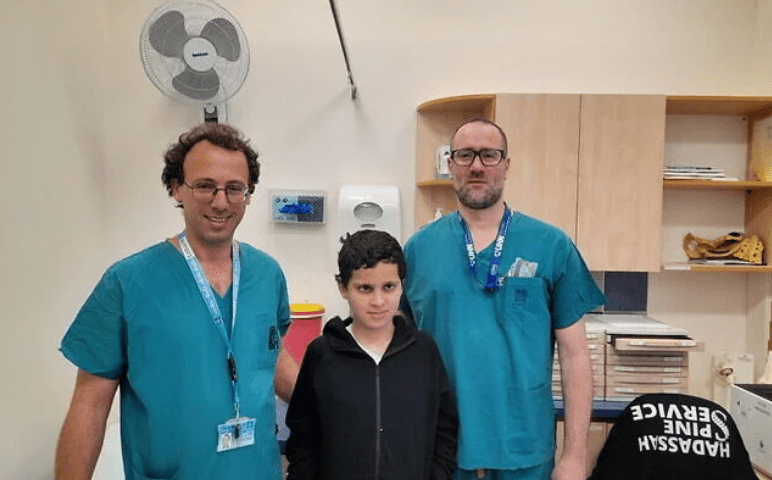
In 2023, 12-year-old Suleiman Hassan was riding his bicycle when he was struck by a vehicle. The impact caused what doctors call an internal decapitation, also known as an atlanto-occipital dislocation. Unlike a complete external decapitation, the head remains attached by skin and muscle, but the ligaments connecting the skull to the upper spine are torn, making it one of the most severe injuries a person can suffer.
The injury is exceptionally rare and is often fatal before patients ever reach a hospital. Even when patients survive the initial trauma, the risk of permanent paralysis or severe neurological damage is extraordinarily high.
Simply arriving at the operating room alive was already against the odds.
A Race Against Time
When Suleiman arrived at Hadassah Medical Center in Jerusalem, doctors immediately understood the magnitude of the challenge before them. There was no room for hesitation. Every decision had to be made quickly, yet every action required extraordinary precision.
A multidisciplinary team of orthopedic surgeons, neurosurgeons, anesthesiologists, trauma specialists, nurses, and support staff came together with one shared objective: save a child’s life.
The surgery lasted for several hours. Using specialized implants and advanced spinal stabilization techniques, the surgeons carefully restored the connection between the skull and the upper cervical spine. Every movement had to be exact, because even the slightest error could have resulted in catastrophic neurological damage.
It was one of those moments where years of preparation, training, and experience came together in a single operation.
The Power of Human Knowledge
When we hear about remarkable surgeries, they can almost seem miraculous. In reality, they are the product of decades of scientific discovery and thousands of dedicated professionals who have contributed to medicine over generations.
This operation was possible because of advances in trauma care, diagnostic imaging, spinal surgery, anesthesia, biomedical engineering, and rehabilitation medicine. Every improvement built upon the work of those who came before.
Medical breakthroughs rarely belong to one person. They are a collective achievement, representing countless researchers, educators, engineers, nurses, technicians, and physicians working toward the same goal: improving the chances of saving a human life.
This is what progress truly looks like.
An Extraordinary Recovery
Perhaps the most remarkable part of Suleiman’s story was not simply surviving the operation—it was what happened afterward.
Against expectations, he recovered without significant neurological impairment. After rehabilitation, he regained mobility and was able to return to many of the activities that define a normal childhood.
For his family, it was nothing short of life-changing. For the medical team, it was a reminder that even the most devastating injuries can sometimes have outcomes that exceed every expectation.
Cases like this inspire doctors around the world to continue pushing the boundaries of what medicine can accomplish.
Beyond Politics and Borders
Stories like this naturally become associated with the country where they occurred, but perhaps that misses the larger point.
Inside an operating room, politics disappears.
Nationality disappears.
Religion disappears.
What remains is a team of human beings working together to preserve another human life.
Medicine has always been one of humanity’s greatest examples of cooperation. Knowledge crosses borders. Surgical techniques are shared internationally. Researchers collaborate across continents. Doctors learn from one another regardless of culture or language because illness recognizes no borders.
Perhaps there is a lesson in that.
Measuring Progress Differently
Modern society often measures progress by economic growth, technological innovation, military capability, or political influence.
Those achievements certainly matter.
But perhaps the greatest measure of civilization is something much simpler.
Can we protect life?
Can we reduce suffering?
Can we give people another chance when hope seems lost?
The successful treatment of a child with an injury once considered unsurvivable demonstrates that human progress is about far more than machines or markets. It is about using knowledge, compassion, and determination to improve the lives of others.
The Stories Worth Remembering
Negative news spreads quickly because it captures attention. Stories of healing often receive only a brief moment before disappearing from public conversation.
Yet these are the stories that deserve to endure.
Every breakthrough surgery, every life-saving innovation, every successful rehabilitation, and every dedicated healthcare professional represents another quiet victory for humanity.
The story of Suleiman Hassan reminds us that even in a world filled with conflict, there are still extraordinary examples of courage, cooperation, and hope.
Perhaps the headlines that inspire us most are not those that tell us how people fought one another.
Perhaps they are the ones that remind us how people came together to save a single life.
 The ChillX Zone
Leave a comment