How Administrative Decisions, Classroom Experiences, and Perceived Unequal Treatment Left Lasting Questions
June 22, 2023
For decades, students graduated from elementary school after completing sixth grade. Then, educational restructuring changed that familiar path. Fifth grade became the final year of elementary school, and middle schools expanded to include another grade level. While administrators described these changes as modernization, many students experienced them as a sudden disruption to routines, friendships, and traditions.
At the time, few students understood why the changes were being made. They simply adapted to a new system that had been decided for them. Looking back, those decisions marked more than a change in grade levels—they altered the rhythm of student life.
A Teacher I Remembered for Excellence
Among the teachers who left a lasting impression on me was my drafting instructor in sixth grade. His class emphasized accuracy, discipline, and craftsmanship. I worked hard and earned two grades of 99 on major drafting assignments, accomplishments I still remember because they reflected genuine effort and careful attention to detail.
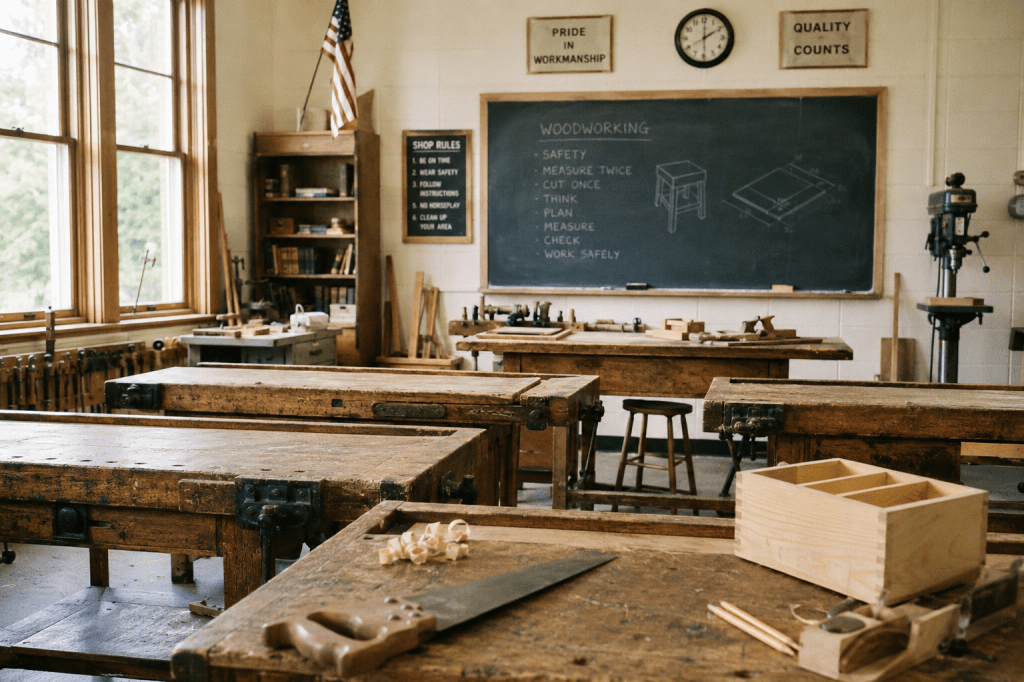
When I reached eighth grade, I was pleased to discover that the same teacher would also be teaching my woodworking class. I expected another opportunity to develop practical skills under someone whose instruction I respected.
The semester, however, unfolded very differently than I had anticipated.
The Woodworking Project That Never Came Together
During my second semester, a woman entered the woodworking classroom with an unusual request. She offered to pay me fifty dollars to construct a small quilting design board that she could use to sketch quilt patterns on paper.
The assignment seemed simple enough, and I accepted it.
Almost immediately, problems appeared. The materials provided did not fit together properly. Measurements conflicted. Components seemed incompatible, and every adjustment created another obstacle. Instead of completing a woodworking project within a reasonable period, I spent nearly the entire semester trying to make pieces work that never seemed designed to fit together.
Looking back, I still wonder why this particular project became part of a middle school woodworking class. Whether it was simply a special request, an outside commission, or something arranged through the school, I cannot say. What I do know is that it consumed months of instructional time and became one of the most memorable experiences of my school years—not because of what I built, but because I never seemed to receive the materials necessary to complete it successfully.
Policies That Shaped Student Behavior
Some of the school’s policies also produced consequences that may never have been intended.
Students were generally not allowed inside the building before classes began, even during the coldest winter mornings. Rather than standing outside in freezing temperatures, many students tried to reach the schoolyard as early as possible. Once there, they stayed warm by playing handball, basketball, or simply keeping active while waiting for the first bell.
Over time, that policy created its own culture. Students hurried to secure space in the yard, and to outside observers it could sometimes appear as though students were trying to leave class early or position themselves ahead of others. In reality, many were simply responding to the environment created by school policy. When students are left with few practical options, they often develop their own solutions.
More Than Buildings and Schedules
Educational reforms are often measured by budgets, enrollment numbers, or administrative reports. Students measure them differently.
They remember the teachers who encouraged them, the assignments that challenged them, the policies that affected everyday life, and the moments that never quite made sense. Those memories become part of how they judge whether a school system truly served its students.
Looking back today, I remember earning two near-perfect drafting grades under a respected teacher, only to spend much of my woodworking semester attempting to solve an assignment that seemed impossible with the materials provided. I remember structural changes that altered the path students followed through school. I remember policies that unintentionally shaped student behavior in unexpected ways.
These memories do not answer every question about why those decisions were made. They do, however, illustrate an important point: educational policy is never experienced only in board meetings or administrative offices. Its real impact is felt in classrooms, workshops, hallways, and schoolyards, where students live with the consequences long after the decisions themselves have been forgotten.
Looking Back
Time often provides perspective that is unavailable in the moment. Years later, what remains are not only report cards and transcripts, but memories of how schools functioned and how administrative decisions affected everyday life.
Every policy, no matter how routine it appears on paper, influences the experience of students. Whether through grade restructuring, classroom assignments, or rules governing daily routines, those decisions become part of the educational story students carry with them for the rest of their lives.
 The ChillX Zone
Leave a comment