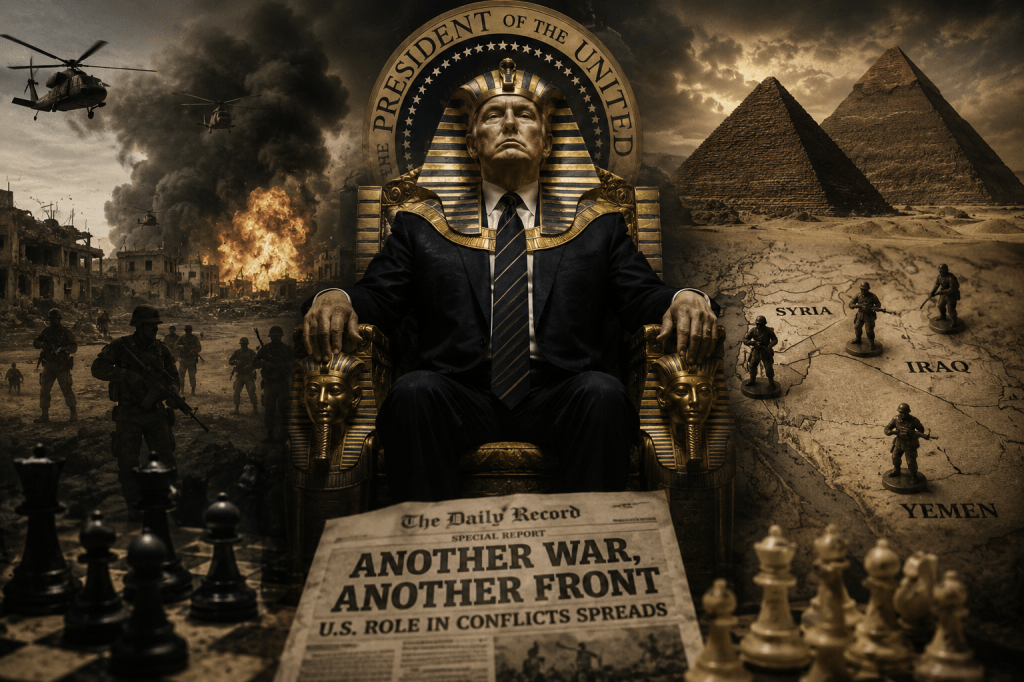
How Modern Leaders Have Come to Resemble Ancient Rulers in an Era of Endless Conflict
June 24, 2026
There was a time when kings ruled by divine right and pharaohs were believed to possess authority granted by the heavens themselves. Their commands could determine the fate of nations, the lives of soldiers, and the future of entire civilizations. To question their judgment was often to question the state itself.
Thousands of years later, democracies were founded on the principle that no individual should possess such unchecked authority. Constitutions, legislatures, courts, and elections were designed to prevent the concentration of power in a single office.
Yet modern politics raises an uncomfortable question: Have today’s executive leaders accumulated influence that increasingly resembles the centralized authority once reserved for ancient rulers?
The Rise of the Permanent Conflict
Unlike the great wars of the twentieth century, many of today’s conflicts are rarely declared in the traditional sense. Instead, they emerge through regional alliances, military assistance, intelligence operations, arms transfers, sanctions, and indirect intervention.
These are commonly described as proxy wars—conflicts in which outside powers support opposing sides without engaging in direct warfare against one another.
Such conflicts often persist for years or decades. Front lines shift, governments change, and generations grow up knowing little else but instability. While headlines change, the conflicts themselves rarely seem to end.
Decisions Made Far from the Battlefield
One of the defining characteristics of modern warfare is distance.
Decisions made in government offices thousands of miles away can influence events in regions most citizens will never visit. Military aid, intelligence sharing, economic pressure, and diplomatic strategy all become tools capable of shaping the course of distant conflicts.
Those making these decisions often do so without personally facing the dangers experienced by civilians and soldiers living within the war zones.
This distance can create the perception that military decisions have become increasingly detached from their human consequences.
The New Pharaohs
The comparison to the pharaohs is not literal but symbolic.
Ancient rulers commanded armies, directed vast national resources, and exercised extraordinary influence over the lives of their subjects. Today, democratic leaders remain accountable to constitutions, elections, and the rule of law. Even so, the modern presidency or executive office often commands military capabilities, intelligence networks, economic sanctions, and diplomatic influence unmatched at any other time in history.
The concern is not that modern presidents are monarchs.
It is whether the concentration of military and geopolitical authority has grown so substantial that citizens begin to view executive decisions as nearly unquestionable once national security becomes the justification.
The Economics of Endless War
War has always required enormous resources.
Modern conflicts involve defense industries, reconstruction contracts, intelligence operations, humanitarian assistance, logistics, cybersecurity, and global supply chains. Entire sectors of the economy become connected to prolonged international instability.
Critics argue that these conditions can reduce incentives for rapid diplomatic solutions, while supporters contend that military assistance is sometimes necessary to deter aggression or defend allies.
The debate is not whether nations should defend themselves, but whether prolonged proxy conflicts can become self-sustaining once political, economic, and strategic interests become deeply intertwined.
The Human Cost
Behind every strategic objective are ordinary people.
Families displaced from their homes.
Children growing up amid uncertainty.
Communities rebuilding only to face renewed violence.
The language of geopolitics often speaks of influence, deterrence, alliances, and security. Those living within conflict zones experience those same events through loss, displacement, and survival.
The greatest cost of proxy wars is rarely measured in political victories. It is measured in lives interrupted.
Lessons from History
History repeatedly demonstrates that concentrated power carries profound responsibilities.
Ancient civilizations eventually learned that rulers who believed themselves beyond accountability often left behind instability rather than lasting peace.
Modern democracies were built to distribute authority, encourage debate, and subject leaders to public oversight. Those principles remain essential, particularly when decisions involve military force or long-term international commitments.
Looking Ahead
The world faces increasingly complex security challenges that rarely fit simple narratives. Some interventions have prevented wider conflicts. Others have become prolonged struggles with no clear conclusion.
Citizens need not reject national defense to ask difficult questions.
How long should indirect wars continue?
What defines success?
How should democratic societies balance security with accountability?
And how can nations pursue peace without surrendering legitimate responsibilities to defend themselves and their allies?
These questions deserve careful public debate, because history suggests that when war becomes routine, scrutiny becomes more—not less—important.
Final Thoughts
The image of the pharaoh endures because it reminds us of the dangers of concentrating immense power in the hands of a few. Whether in ancient kingdoms or modern republics, decisions affecting life, death, and war demand transparency, accountability, and informed public discussion.
The challenge for modern democracies is not merely avoiding the mistakes of the past. It is ensuring that the institutions created to limit power remain strong enough to prevent any office from becoming larger than the principles it was designed to serve.
 The ChillX Zone
Leave a comment