Why Hidden Spaces Have Become Symbols of Fear in Crime, Folklore, and Popular Culture
June 23, 2026
Every home has its forgotten places. Attics collect memories, garages store yesterday’s projects, but basements occupy a different place in the human imagination.
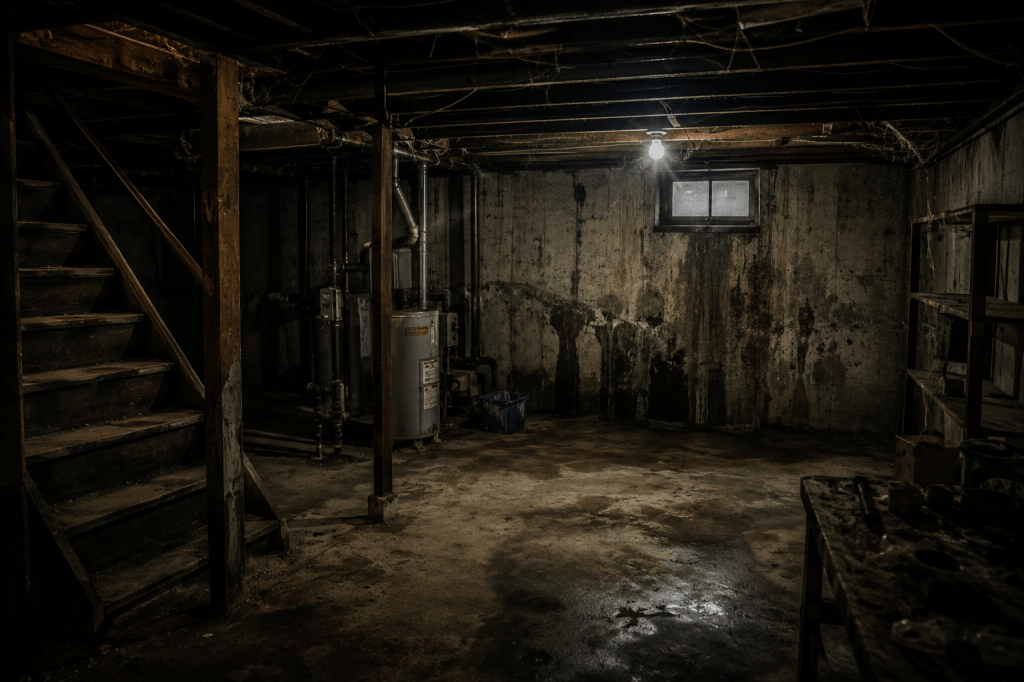
Cold, damp, poorly lit, and separated from the rest of the house, basements have long represented the unknown. They are places where old furniture gathers dust, forgotten belongings remain untouched for decades, and mechanical systems quietly operate beneath our feet. Yet despite their ordinary purpose, basements continue to appear in ghost stories, horror films, urban legends, and some of history’s most disturbing criminal investigations.
The question is simple.
Why the basement?
Built Below the Surface
Unlike the upper floors of a home, basements are literally surrounded by earth.
Concrete foundation walls absorb moisture from the surrounding soil, creating naturally cooler temperatures throughout the year. Water intrusion, leaking foundations, damp concrete, and poor ventilation often produce musty odors and persistent humidity. Dust settles more heavily. Cobwebs accumulate in forgotten corners. Insects, spiders, centipedes, crickets, and occasionally rodents thrive in undisturbed spaces.
Even an unfinished basement can feel different from every other room in the house.
The silence is heavier.
The shadows are deeper.
Every sound seems amplified.
The Psychology of Isolation
Psychologists have long understood that environment influences perception.
Dim lighting, confined spaces, unfamiliar noises, and limited escape routes naturally increase feelings of uncertainty and anxiety. A furnace cycling on, a pipe expanding, or a floor joist settling can produce unexpected sounds that seem mysterious when heard in an otherwise quiet basement.
The human brain is wired to search for explanations when something feels unfamiliar. In darkness, ordinary experiences can seem extraordinary.
This does not prove paranormal activity, but it helps explain why so many people report feeling uneasy below ground.
Hidden Spaces Have Long Attracted Hidden Secrets
Throughout history, secluded spaces have been used to conceal valuables, preserve food, shelter families during storms, or store supplies.
Unfortunately, privacy can also be misused.
When law enforcement investigates certain high-profile criminal cases, hidden rooms, concealed evidence, or unlawful confinement sometimes become part of the story. Those cases receive enormous media attention, reinforcing the public perception that basements are places where terrible secrets are hidden.
The basement itself is not responsible for those crimes.
Rather, its isolation and limited visibility make it a location capable of concealing activity from immediate view.
Folklore and the Paranormal
Long before modern horror films, many cultures viewed underground spaces with caution.
Cellars, caves, tunnels, and underground chambers often appeared in folklore as places connected to spirits, forgotten histories, or unseen forces. As literature evolved, those stories moved beneath ordinary homes.
Novelists, filmmakers, and television producers transformed the basement into one of horror’s most recognizable settings.
The flickering light bulb.
The creaking wooden stairs.
The cold concrete floor.
The single door separating safety from uncertainty.
Generation after generation, audiences learned to associate basements with fear long before they ever entered one.
The Real Dangers
While stories of hauntings continue to fascinate audiences, the greatest risks found in basements are often entirely physical.
Water intrusion can weaken foundations and promote mold growth.
Poor ventilation can allow dangerous gases, including carbon monoxide or radon, to accumulate if homes are not properly maintained.
Electrical hazards increase in damp environments.
Old staircases, exposed nails, low ceilings, unstable shelving, and poor lighting create genuine safety risks.
Insects and rodents are more likely to occupy areas that remain undisturbed for long periods.
These hazards are far more common than anything supernatural.
Fear Begins in the Mind
Fear does not always require danger.
Sometimes it requires only uncertainty.
A basement combines many of the environmental conditions that naturally heighten awareness: darkness, silence, isolation, unfamiliar sounds, cool temperatures, and the feeling of being separated from the rest of the home.
Whether one believes in ghosts or not, these conditions make the basement unlike any other room in the house.
Perhaps that is why it continues to occupy such a powerful place in our imagination.
Final Thoughts
Most basements are nothing more than storage rooms, workshops, laundry areas, or recreation spaces. Millions of families use them every day without incident.
Yet the basement remains one of architecture’s most enduring symbols of mystery.
Maybe it is because it lies beneath everything else.
Maybe it is because so much is forgotten there.
Or maybe it is because every house keeps a few secrets, and the basement has always been the place where we imagine those secrets waiting in the dark.
 The ChillX Zone
Leave a comment