A housing crisis, unexplained illnesses, and growing concerns about what modern materials may be releasing into the spaces we live in.
June 21, 2026
For years, concerns about pollution focused on factories, highways, and industrial waste. Yet one of the most significant environmental health controversies of recent decades began inside people’s homes.
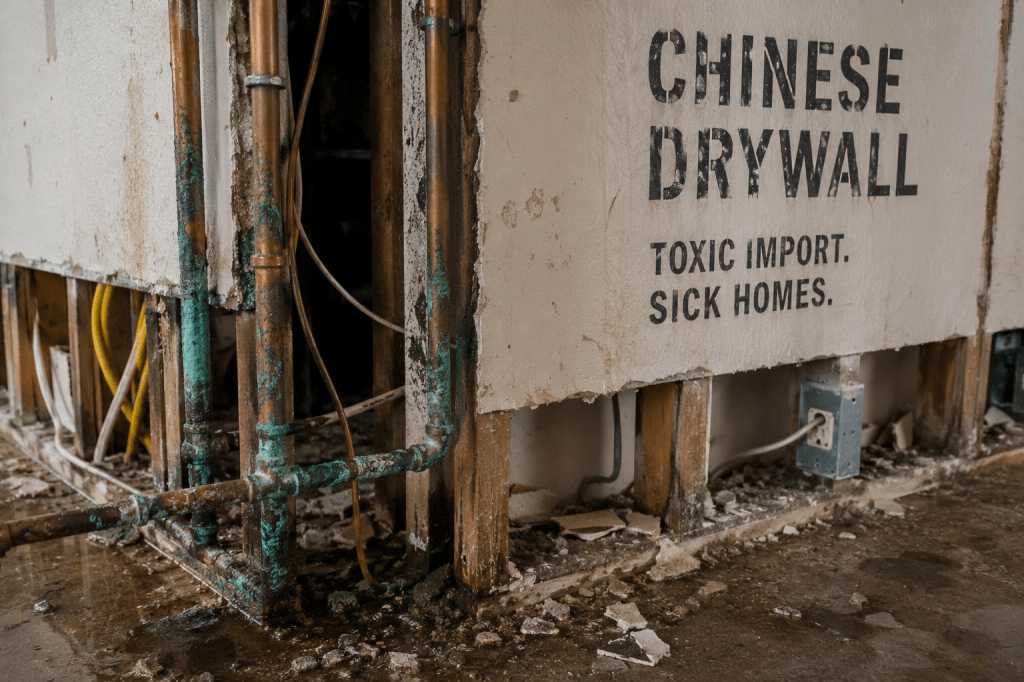
The incident became known as the Chinese drywall crisis. Homeowners in multiple states reported strange sulfur-like odors, blackened copper wiring, failing air-conditioning systems, persistent headaches, respiratory irritation, and unexplained health complaints. Investigations eventually traced many of the problems to imported drywall used during a construction boom in the early 2000s.
A Problem Hidden Inside the Walls
What made the case remarkable was not simply the presence of a defective product. It was the realization that the material itself was acting as a source of contamination.
The gases released by the drywall did not stay trapped within the walls. They moved throughout homes, infiltrating air systems, reaching electrical components, and affecting occupants room by room. The structure itself became a delivery system.
When Buildings Become Chemical Environments
The episode raised broader questions about modern construction materials and indoor environments.
Many contemporary products—including paints, engineered wood, adhesives, synthetic flooring, insulation, and composite materials—contain volatile organic compounds and other chemical ingredients that can slowly migrate into indoor air. Most people experience little or no noticeable effect. Others appear far more sensitive.
The Mystery of Chemical Sensitivity
Researchers have long studied individuals who report strong reactions to paints, solvents, fragrances, plastics, and newly manufactured materials. Some develop headaches, dizziness, respiratory irritation, fatigue, cognitive difficulties, or skin reactions after exposures that others barely notice.
While scientists continue to debate the precise biological mechanisms involved, the phenomenon has drawn increasing attention as homes become more tightly sealed and energy efficient. A substance released from a wall panel, flooring system, or coating no longer easily escapes outdoors. Instead, it can circulate repeatedly through living spaces.
More Than Simple Off-Gassing
Building scientists often describe this process as off-gassing, but the term may not fully capture what occupants experience. To residents, it can feel as though chemicals are passing through materials, coatings, and barriers, gradually permeating the indoor environment.
Particularly concerning are lower-quality materials manufactured with less stringent controls. Small differences in raw ingredients, contaminants, storage conditions, or production methods can dramatically alter what a product emits over time.
Why Some People React First
Environmental physicians and indoor-air specialists note that some individuals appear unusually sensitive to these exposures. Whether due to genetics, immune responses, neurological factors, previous toxic exposures, or other causes, their bodies may react to concentrations that remain below levels typically considered hazardous.
The result is an ongoing challenge for both medicine and building science. A material may pass standard safety tests and still produce noticeable effects in a subset of the population.
Lessons From a Housing Crisis
The lesson from the drywall crisis is not that modern materials are inherently dangerous. Rather, it is that buildings are complex chemical environments. Materials interact with temperature, humidity, ventilation, and time. What appears solid and inert may, under certain conditions, release substances that spread throughout an entire structure.
In an age increasingly focused on sustainability and energy efficiency, indoor air quality may prove just as important as what a building keeps out. The next frontier in healthy construction may not be stronger materials, but cleaner ones.
 The ChillX Zone
Leave a comment