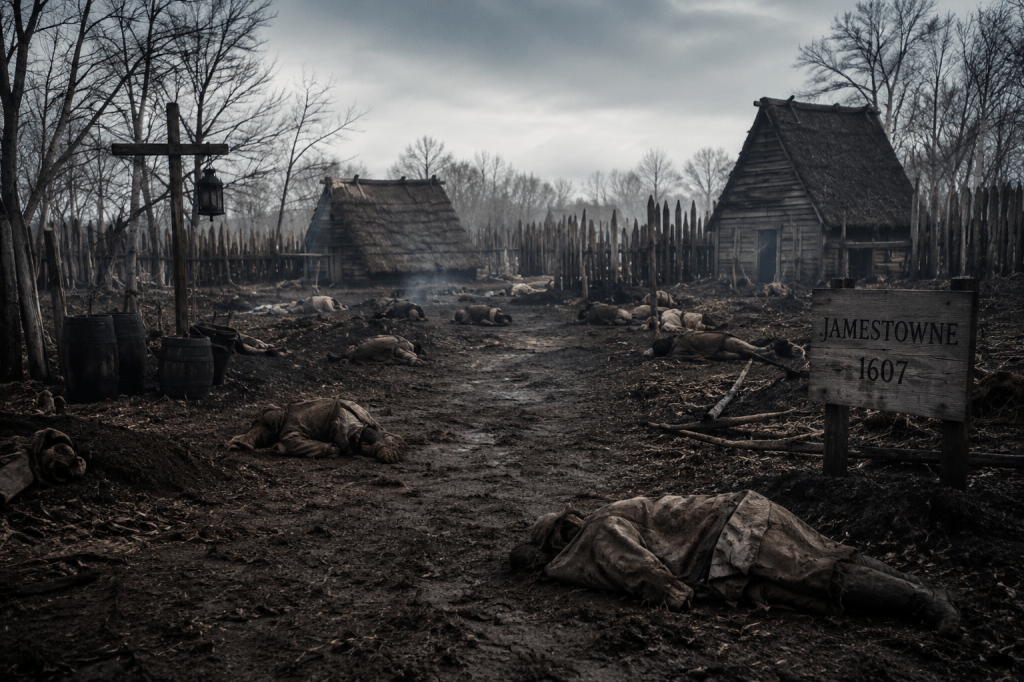
During Jamestown’s “Starving Time,” The Colonists Faced A Horror Worse Than Anything They Imagined
June 20, 2026
By the winter of 1609, the dream was already dying.
Jamestown had been established only two years earlier, but the promise of a thriving English settlement in the New World was collapsing under the weight of disease, conflict, and starvation.
The colony sat isolated on the edge of an unfamiliar wilderness.
Supplies were dwindling.
Relations with surrounding tribes had deteriorated.
Winter was approaching.
And help was nowhere in sight.
What followed would become one of the darkest chapters in American history.
The Last Outpost
Today, it is difficult to understand just how alone the colonists were.
There were no highways.
No railroads.
No telephones.
No emergency services.
Beyond the wooden walls of Jamestown stretched forests, rivers, swamps, and thousands of square miles of territory the settlers barely understood.
When food became scarce, leaving the settlement was dangerous.
Staying inside was equally dangerous.
Every decision carried consequences.
Every day became a struggle for survival.
The Hunger
As winter tightened its grip, the situation deteriorated rapidly.
Food stores vanished.
Livestock disappeared.
Trade collapsed.
The colonists began consuming anything they could find.
Dogs.
Cats.
Rats.
Leather.
Boiled scraps.
Accounts from survivors describe a community slowly unraveling under the pressure of starvation.
The hunger was constant.
Relentless.
It dominated every waking thought.
The Woods Beyond The Walls
At night, the wilderness surrounding Jamestown became a source of terror.
The forests were unfamiliar.
The sounds were unfamiliar.
Everything beyond the settlement felt unknowable.
Colonists recorded fears of attack, disappearance, and death beyond the safety of the fortifications.
People vanished.
Some fled.
Some never returned.
Others were found dead.
The boundary between the settlement and the wilderness became more than a physical barrier.
It became a psychological one.
Inside the walls was desperation.
Outside the walls was uncertainty.
The Discovery
For centuries, historians debated the darkest stories emerging from Jamestown.
Some believed they were exaggerations.
Others suspected the truth was even worse.
Then archaeology provided an answer.
Excavations uncovered the remains of a teenage girl who became known as “Jane.”
Forensic analysis revealed cut marks on her bones and skull consistent with postmortem butchering.
The evidence strongly suggested that during the Starving Time, colonists resorted to cannibalism in order to survive.
The discovery shocked historians.
Yet for many researchers, it confirmed what the surviving records had hinted at all along.
The colony had crossed a line few societies ever reach.
When Reality Becomes A Nightmare
The horror of Jamestown is not merely what happened.
It is how quickly civilization disappeared.
These were not ancient people living in caves.
These were settlers carrying the hopes of an empire.
Within months, starvation reduced them to conditions almost impossible to imagine.
Rules collapsed.
Certainties vanished.
Survival became the only priority.
The transformation was swift.
And terrifying.
America’s First Haunted Place
Long before ghost stories surrounded abandoned hospitals and forgotten asylums, Jamestown possessed all the ingredients of a haunting.
Death.
Isolation.
Fear.
Loss.
Entire lives erased by circumstances beyond human control.
Even today, visitors and historians often describe the site as carrying a unique emotional weight.
Perhaps that feeling comes from understanding what occurred there.
Or perhaps it comes from knowing that beneath the foundations of modern America lies a story most people would rather forget.
The Winter That Never Ended
By the spring of 1610, roughly eighty percent of the colony had died.
The survivors emerged from the Starving Time forever changed.
Jamestown would eventually recover.
America would eventually grow.
The colony itself would survive.
But something else survived as well.
The memory.
A reminder that the earliest chapters of American history were not stories of triumph.
They were stories of endurance.
And few were more frightening than the winter when hunger, isolation, and fear transformed a hopeful settlement into one of the darkest places in the New World.
Sometimes the most terrifying stories are not legends.
Sometimes they are history.
 The ChillX Zone
Leave a comment