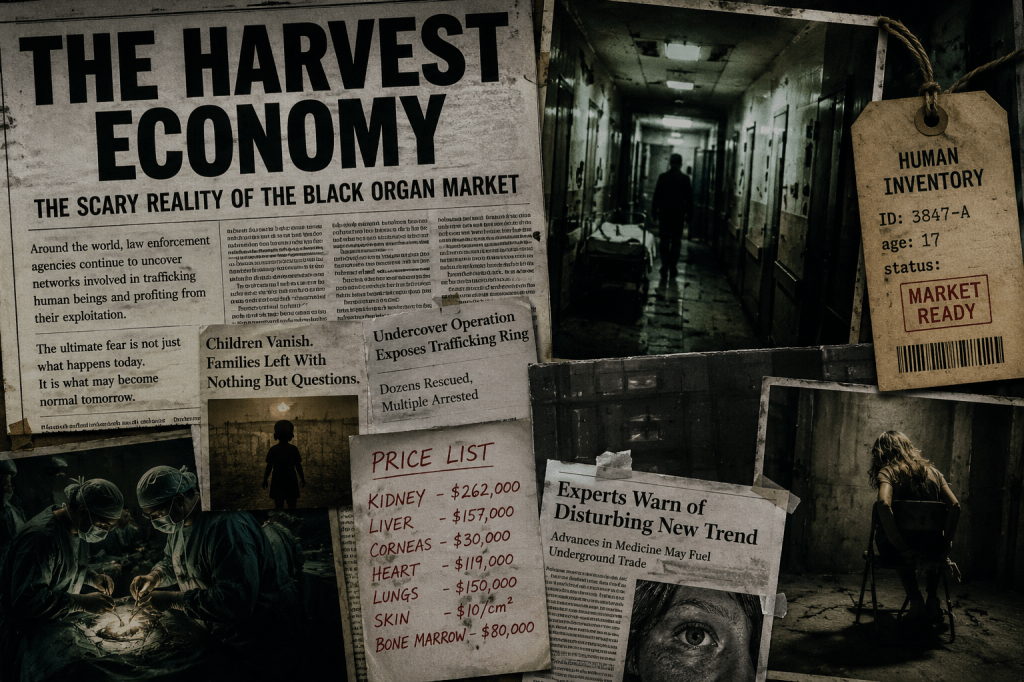
The Scary Reality of the Black Organ Market
June 16, 2026
If you had told Americans thirty years ago that criminals would one day traffic human organs across international borders, many would have dismissed the idea as science fiction.
Today, nobody laughs.
The black market exists because demand exists.
When there are not enough kidneys, criminals see opportunity.
When there are not enough organs, someone begins asking what a human life is worth in parts.
That is the uncomfortable reality behind one of the world’s most disturbing underground industries.
The Body as Inventory
For most of human history, the body was considered sacred.
Today, medicine can replace failing hearts, transplant kidneys, graft skin, restore vision, and reconstruct faces.
These advances are miracles.
They save lives every day.
Yet every miracle creates a market.
Every shortage creates an incentive.
And every incentive attracts predators.
Somewhere in the shadows of the modern world, criminal networks understand a simple fact:
Human beings possess valuable components.
The language itself becomes chilling.
Donor.
Recipient.
Compatibility.
Inventory.
Supply.
Demand.
Words once reserved for commerce slowly migrate into discussions about the human body.
The Children Who Vanish
Perhaps the darkest reality is not organ trafficking itself.
It is vulnerability.
Around the world, law enforcement agencies continue to investigate cases involving missing children, human trafficking networks, exploitation rings, and organized criminal groups that profit from the powerless.
Every missing child poster represents a family trapped in uncertainty.
Every trafficking investigation reveals a market most people would rather pretend does not exist.
The details vary.
The victims vary.
The crimes vary.
The common factor is exploitation.
Criminals seek people who are isolated, vulnerable, forgotten, or difficult to trace.
The younger the victim.
The poorer the victim.
The more vulnerable the victim.
The greater the danger.
The Black Market Beneath the Black Market
Most people imagine criminal organizations dealing in drugs, weapons, or stolen goods.
Yet beneath those markets exists another category entirely.
The market for human beings.
Not metaphorically.
Literally.
People bought.
People sold.
People transported.
People exploited.
The twenty-first century was supposed to eliminate such horrors.
Instead, globalization often made criminal networks faster, wealthier, and more difficult to track.
Technology connected the world.
It connected criminals too.
The Price of a Kidney
The disturbing truth is that scarcity drives everything.
A patient waits for a transplant.
A family desperately searches for options.
Time runs out.
Someone offers a solution.
That is where ethical medicine ends and criminal opportunity begins.
Most doctors spend their lives helping people.
Most medical institutions operate under strict ethical standards.
The danger emerges when desperation collides with money.
History has repeatedly shown that whenever something becomes valuable enough, somebody will attempt to steal it.
A Future Where Nothing Is Sacred
Now imagine the future.
Imagine biotechnology becoming more advanced.
Artificial organs.
Facial reconstruction.
Tissue engineering.
Genetic enhancement.
Regenerative medicine.
Wonderful possibilities.
Terrifying possibilities.
What happens when eyes become replaceable?
What happens when skin becomes marketable?
What happens when entire faces can be reconstructed?
What happens when every component of the human body acquires measurable economic value?
The future horror may not be a man stealing a wallet.
It may be a system assigning prices to pieces of human identity.
The Harvest Economy
Perhaps that is the ultimate fear.
Not the criminal in the alley.
Not the shadowy broker.
Not the illegal surgeon.
The real fear is cultural.
A society that gradually learns to view human beings as collections of assets.
A kidney worth this much.
Corneas worth that much.
Genetic material worth even more.
At what point does a person stop being a person and become a collection of valuable components?
The question sounds absurd.
Until markets begin answering it.
The Last Commodity
Every era has its defining commodity.
Gold.
Oil.
Land.
Information.
Perhaps the darkest possibility of all is that the next great commodity is the human body itself.
Not because medicine is evil.
Not because science is evil.
But because scarcity has always attracted exploitation.
And wherever demand exceeds supply, someone will inevitably attempt to profit.
The black organ market reminds us of a truth that modern civilization prefers to ignore:
The distance between medical miracle and criminal opportunity is often far smaller than we would like to believe.
The future may bring extraordinary advances in medicine.
The question is whether our ethics will advance just as quickly.
Because if they do not, humanity may discover that the most valuable resource on Earth was never oil, gold, or data.
It was people.
 The ChillX Zone
Leave a comment