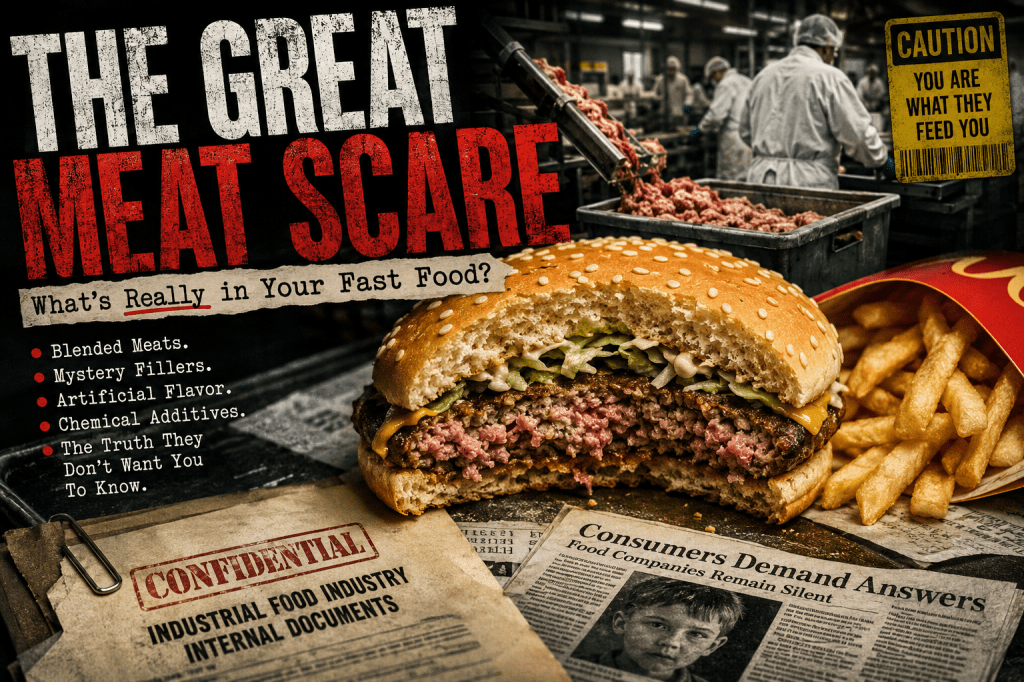
A Dispatch From America’s Synthetic Dinner Table
June 14, 2026
America has a strange problem.
The menus haven’t changed.
The food has.
Walk into any fast-food restaurant in the country and you’ll see the same burgers, the same meatball subs, the same chicken sandwiches, and the same fries that have been advertised for decades. Yet behind the bright signs and smiling mascots, something unsettling is happening.
The ingredients are changing.
The recipes are changing.
The definitions are changing.
And most consumers have no idea.
The Meatball That Changed Everything
Once upon a time, a meatball was a meatball.
Then came the era of industrial food production.
Today, consumers increasingly discover that products marketed under familiar names often contain blended meats, reformulated recipes, and ingredients that would surprise the average customer. Beef becomes beef-and-pork. Chicken becomes processed chicken. Simple recipes become proprietary formulas.
Perhaps there is nothing inherently wrong with blending meats.
The question is why the industry seems so eager to do it quietly.
If consumers demanded mixed meat products, restaurants would advertise them proudly. Instead, many food companies appear more comfortable emphasizing tradition while gradually altering what lies beneath.
The menu remains the same.
The contents do not.
The Great Protein Shuffle
The modern food industry is obsessed with efficiency.
Every ounce of meat must be used.
Every scrap must be monetized.
Every ingredient must justify its cost.
This has given rise to a new philosophy of food production: substitution.
Cheaper proteins replace expensive ones.
Fillers extend valuable ingredients.
Flavorings compensate for what has been removed.
The result is a system where food is no longer defined by what it is, but by what it can successfully imitate.
Consumers are buying a promise.
Manufacturers are selling a formula.
Menus That Never Change
The most fascinating part of the modern food industry is that consumers rarely notice the transformation.
A burger sold in 1997 may not be made the same way as a burger sold in 1977.
A meatball sold today may not resemble one sold twenty years ago.
Yet the branding remains untouched.
The same names.
The same photographs.
The same advertising.
Only the ingredients evolve.
It is like watching a building slowly replaced brick by brick while retaining the same address.
Flavor Without Food
Perhaps the greatest trick ever performed by the food industry is convincing consumers that flavor comes from food.
Increasingly, flavor comes from laboratories.
Smoke flavor without smoke.
Butter flavor without butter.
Fruit flavor without fruit.
Beef flavor without a cut of beef in sight.
Food scientists spend years studying how consumers experience taste, aroma, texture, and appearance. Their goal is not necessarily to improve food.
Their goal is to recreate the memory of food.
At some point, the imitation becomes more important than the original.
Reconstructing the Animal
The industrial age transformed livestock into components.
Muscle became one product.
Fat became another.
Trimmings became another.
Nothing is wasted.
Everything is processed.
Everything is repurposed.
Modern food production has become less about butchering animals and more about reconstructing them into forms that maximize consistency and profit.
The customer sees a nugget.
The factory sees a manufacturing process.
The Economics of Substitution
The food industry insists these changes are driven by innovation.
Critics argue they are driven by economics.
As costs rise, companies face a simple choice.
Charge more.
Or alter the recipe.
Most choose the latter.
A small substitution here.
A reformulation there.
A different supplier.
A different blend.
A different ratio.
Each change appears insignificant on its own.
Collectively, they create an entirely different product.
The Food Doppelgänger
In folklore, a doppelgänger is an identical copy that replaces the original.
It looks the same.
It sounds the same.
But something about it feels wrong.
Modern food increasingly resembles a doppelgänger.
The burger still looks like a burger.
The fries still look like fries.
The meatball still looks like a meatball.
Yet many consumers sense that something fundamental has changed.
The appearance remains.
The substance slowly drifts away.
Ghosts in the Supply Chain
The average American has no idea where dinner comes from.
A hamburger may pass through multiple suppliers, processors, distributors, warehouses, and manufacturing facilities before reaching a tray.
The journey is invisible.
The process is hidden.
The complexity is staggering.
Consumers trust labels because they have little alternative.
But the greater the distance between the farm and the plate, the more opportunities exist for substitution, reformulation, and transformation.
The supply chain becomes a black box.
Food enters one end.
A product emerges from the other.
Few people understand what happened in between.
The Mimic Meal
The paranormal has always warned humanity about imitation.
Shapeshifters.
Doppelgängers.
False appearances.
Creatures that wear familiar faces.
Perhaps those stories endure because they reflect a timeless fear.
The fear of not knowing what something truly is.
Modern food does not need to be haunted to be unsettling.
It merely needs to become unfamiliar while pretending to remain the same.
A burger that is still called a burger.
A meatball that no longer matches the customer’s expectation.
A menu that never changes while everything beneath it does.
The End of Knowing What You’re Eating
The Great Meat Scare is not really about meat.
It is about trust.
Consumers trust that a product is what it claims to be.
Consumers trust that food remains food.
Consumers trust that familiar names still mean familiar things.
The food industry asks Americans to place that trust in an increasingly complex and opaque system.
Perhaps that trust is justified.
Perhaps it isn’t.
But one thing is certain.
The further food moves from the farm and into the laboratory, the more difficult it becomes to answer a question that once seemed simple:
What exactly are we eating?
 The ChillX Zone
Leave a comment