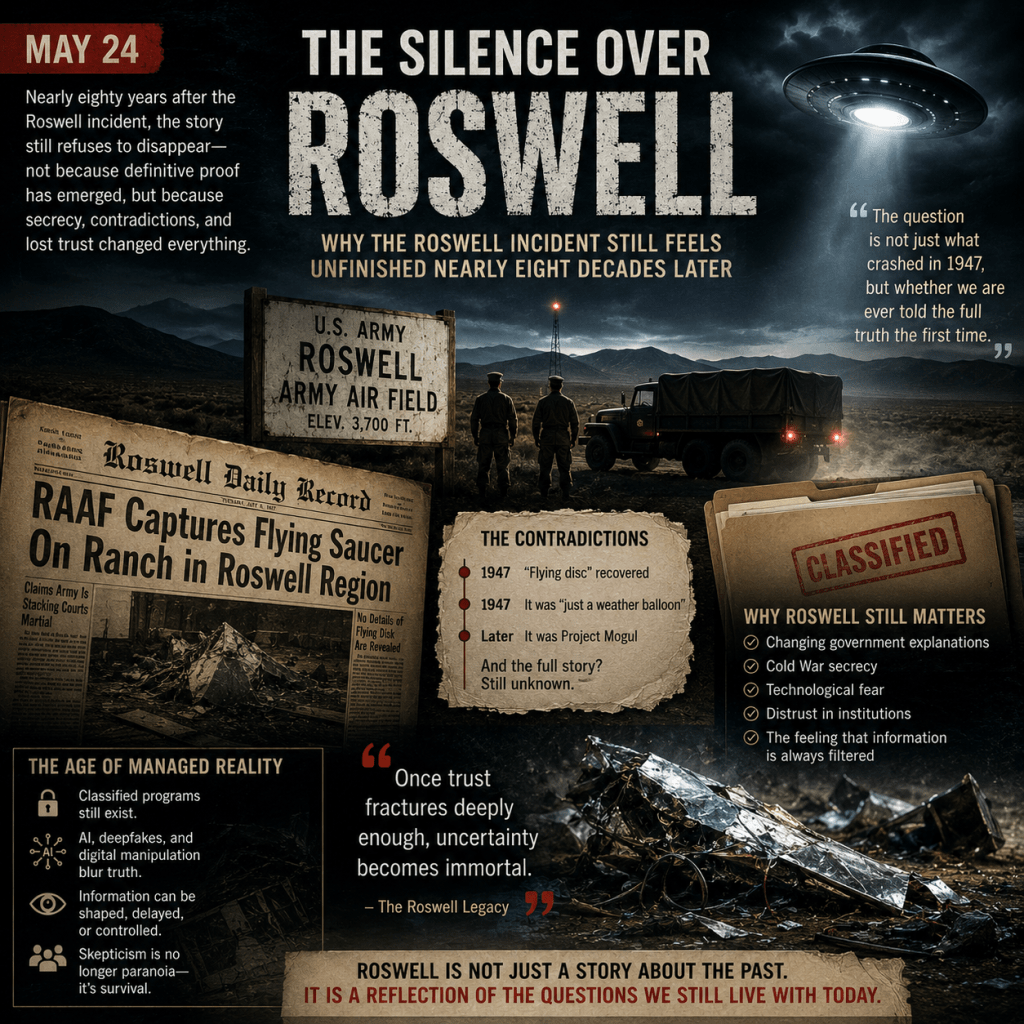
Why the Roswell Incident Still Feels Unfinished Nearly Eight Decades Later
May 24, 2026
nearly eighty years after the Roswell Incident, the story still refuses to disappear from public consciousness.
Not because definitive proof of extraterrestrials has emerged, but because Roswell permanently altered the relationship between the public, secrecy, and official explanations. In an era increasingly shaped by classified technology, artificial intelligence, deepfakes, and collapsing trust in institutions, Roswell feels less like an isolated Cold War mystery and more like the beginning of modern uncertainty itself.
That may explain why the silence surrounding it still feels unfinished.
The Incident That Never Fully Settled
In July 1947, reports emerged that strange debris had crashed near Roswell, New Mexico. The Roswell Army Air Field initially issued a statement claiming recovery of a “flying disc.” Shortly afterward, officials reversed the announcement, stating the debris belonged to a weather balloon.
Decades later, additional explanations connected the event to Project Mogul, a classified surveillance balloon program designed to detect Soviet nuclear testing during the Cold War.
Officially, the case was resolved.
Publicly, it never fully was.
The problem was not only the object itself, but the sequence of contradictory explanations:
first one story,
then another,
then later revisions decades afterward.
Even if the final explanation were entirely accurate, the changing narrative permanently damaged confidence in official transparency.
Why Roswell Still Matters
Most historical events eventually stabilize into accepted history.
Roswell did not.
Instead, it evolved into a cultural symbol representing something larger than a crash site in the desert. It became associated with hidden information, military secrecy, Cold War paranoia, technological fear, and the suspicion that governments do not always disclose the full truth immediately.
That suspicion continues into modern life.
Today, people live in a world shaped by classified defense programs, algorithmic information control, artificial intelligence, edited media, and deepfake technology capable of manufacturing convincing realities artificially. Under those conditions, public skepticism becomes easier to understand.
Roswell survives partly because modern society increasingly recognizes that information itself can be managed.
The UFO Phenomenon and the Psychology of Uncertainty
The UFO phenomenon occupies an unusual psychological space between history, speculation, science, and mythology.
Some people interpret unidentified aerial phenomena as misunderstood technology. Others suspect military experimentation, atmospheric anomalies, or intelligence operations. Still others believe non-human explanations remain possible.
But regardless of interpretation, UFO stories consistently produce the same effect:
they destabilize certainty.
Witnesses disagree.
Authorities contradict themselves.
Evidence remains incomplete.
Rumors multiply faster than verification.
Roswell became the defining modern example of this phenomenon.
It created a lasting cultural atmosphere where many people began questioning whether official explanations always reflected the complete picture.
The Paranormal Connection
The paranormal aspect of Roswell may not necessarily involve aliens alone.
It may involve the deeper human attraction to unresolved mysteries.
Throughout history, people have always been drawn toward hidden knowledge, forbidden rooms, classified documents, unexplained lights in the sky, and stories suggesting reality contains unseen layers beneath ordinary life.
Ancient civilizations looked toward the heavens searching for signs and meaning. Modern civilization does something remarkably similar through the language of UFOs, advanced technology, and disclosure.
The symbolism changed.
The psychological impulse remained.
Roswell became modern mythology precisely because it exists in an unresolved space between official history and collective imagination.
The Age of Managed Reality
Roswell also arrived at the beginning of the modern information age.
Since then, governments, corporations, media systems, and digital platforms have all demonstrated the ability to shape narratives, suppress information, manipulate public perception, and influence belief at massive scale.
That changes how people interpret Roswell today.
The question becomes less:
“Was it extraterrestrial?”
And more:
“How much of reality reaches the public unfiltered?”
In a world where information can be curated, edited, delayed, classified, or algorithmically controlled, unresolved mysteries naturally become larger than themselves.
Roswell became a symbol of that uncertainty.
The Final Silence
Perhaps the reason Roswell still lingers after nearly eighty years is not because definitive evidence remains hidden somewhere in a vault.
It is because the incident exposed something psychologically permanent about modern civilization:
once public trust fractures deeply enough, uncertainty itself becomes immortal.
Roswell stopped being only about debris in the desert long ago.
It became a symbol of the uneasy feeling that official reality may never fully reveal everything happening behind it.
 The ChillX Zone
Leave a comment