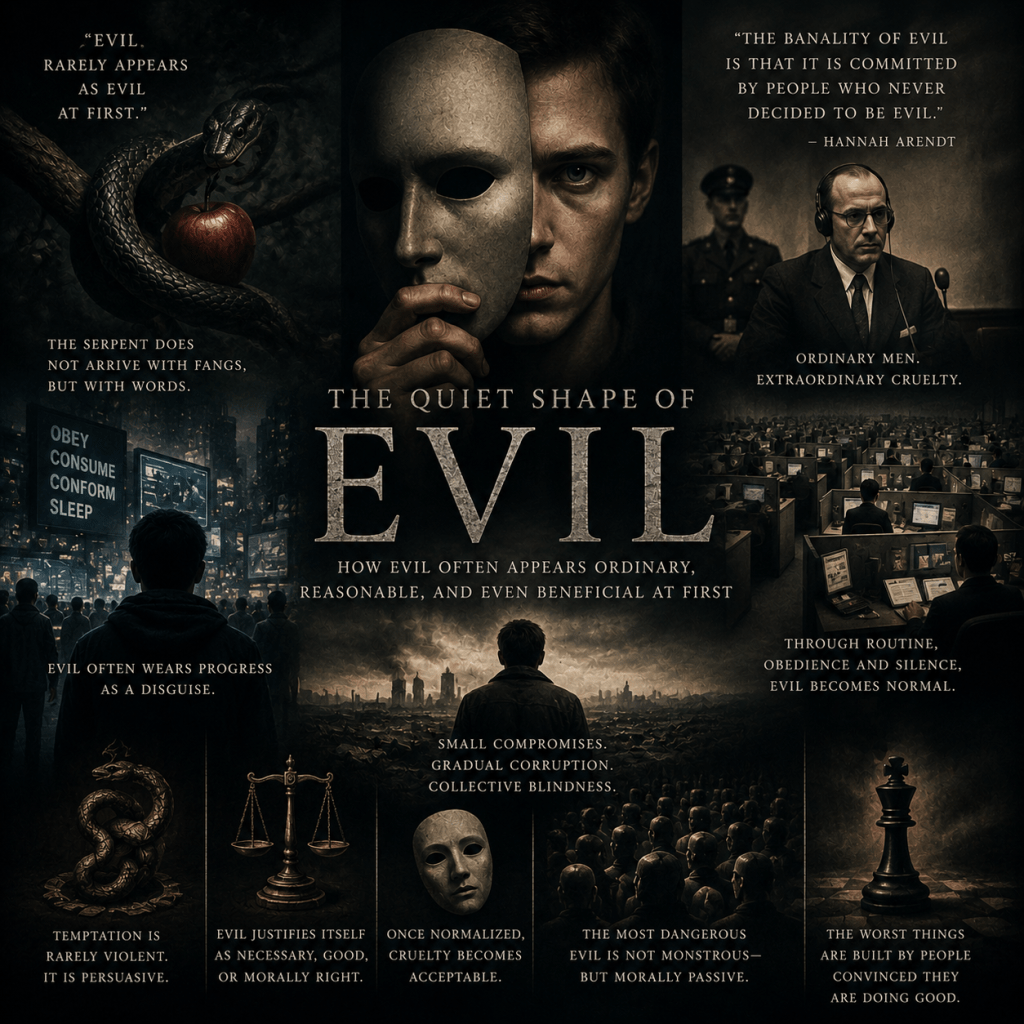
How Evil Often Appears Ordinary, Reasonable, and Even Beneficial at First
May 22, 2026
Most people imagine evil dramatically.
They picture violence, cruelty, dictators, murderers, monsters, demonic figures, or catastrophic acts openly recognized as wrong. But history suggests something far more unsettling:
evil is often subtle long before it becomes obvious.
It rarely announces itself honestly.
It disguises itself.
It rationalizes itself.
It often arrives appearing useful, efficient, intelligent, pleasurable, or even morally justified.
And that may be what makes it dangerous.
The Banality of Evil
One of the most disturbing observations about evil emerged after World War II during the trial of Adolf Eichmann, one of the bureaucratic organizers of the Holocaust.
Observers expected to encounter a visibly monstrous individual. Instead, many described something stranger:
an ordinary-looking man,
administrative,
calm,
even dull.
Philosopher Hannah Arendt later described this phenomenon as “the banality of evil” — the terrifying realization that immense evil can emerge not only through hatred, but through obedience, routine, bureaucracy, ambition, conformity, and the refusal to think deeply about consequences.
Evil may not always begin with sadism.
Sometimes it begins with convenience.
Evil Rarely Thinks of Itself as Evil
Perhaps the most dangerous aspect of evil is that it usually believes itself justified.
History repeatedly shows harmful systems presenting themselves as necessary, progressive, protective, efficient, patriotic, scientific, or morally righteous. Entire societies can participate in destructive behavior while sincerely believing they are improving the world.
That is why evil often appears subtle at first.
A lie told for stability.
A manipulation justified as protection.
A cruelty defended as necessity.
A corruption excused as pragmatism.
Individually, each compromise may appear small.
Collectively, they reshape civilization.
The Gradual Corruption of Perception
Evil often works through normalization.
What once felt shocking slowly becomes ordinary through repetition. Language changes first. Boundaries soften gradually. People adapt psychologically to conditions they would once have rejected immediately.
This is why many oppressive systems throughout history did not arise overnight. They emerged incrementally:
small compromises,
small silences,
small rationalizations.
The process resembles moral anesthesia.
Human beings become accustomed to what previously disturbed them.
The Serpent and the Subtlety of Temptation
Religious traditions often understood this psychological structure symbolically.
In Genesis, evil does not initially appear through violence. The serpent speaks persuasively. The temptation arrives intellectually and subtly. The forbidden fruit appears desirable, enlightening, even beneficial.
The warning is profound:
evil rarely introduces itself honestly.
It often presents itself as wisdom,
advancement,
knowledge,
freedom,
or improvement.
Only afterward does the deeper consequence become visible.
Modern Evil
Modern forms of evil often appear less theatrical than ancient imagery suggested.
A manipulative algorithm maximizing addiction.
A corporation profiting from psychological harm.
A government normalizing surveillance.
A crowd destroying someone publicly for entertainment.
A machine reducing human beings into data points.
None of these necessarily resembles traditional horror imagery. Yet each may contain forms of dehumanization hidden beneath efficiency and normalization.
Modern civilization often associates evil only with extreme acts while ignoring systems that slowly erode empathy, truth, dignity, and human perception over time.
That erosion may be more dangerous precisely because it feels ordinary.
The Most Dangerous Kind
The most dangerous form of evil may not be openly monstrous people.
It may be morally passive people.
People who surrender judgment to systems.
People who stop questioning.
People who accept cruelty because it becomes culturally normalized.
People who prioritize comfort, status, obedience, or convenience above conscience.
Because once enough people disconnect morally from their actions, evil no longer requires villains.
It simply requires participation.
The Final Irony
Most people believe they would recognize evil immediately if it appeared before them.
History suggests otherwise.
Evil often enters quietly,
speaks reasonably,
looks ordinary,
and adapts itself to the values of the time.
It does not always arrive looking dark or terrifying.
Sometimes it arrives looking intelligent,
efficient,
safe,
progressive,
or beneficial.
And perhaps that is the most disturbing realization of all:
the worst things humans create are often built gradually by people convinced they are doing something necessary or good.
 The ChillX Zone
Leave a comment