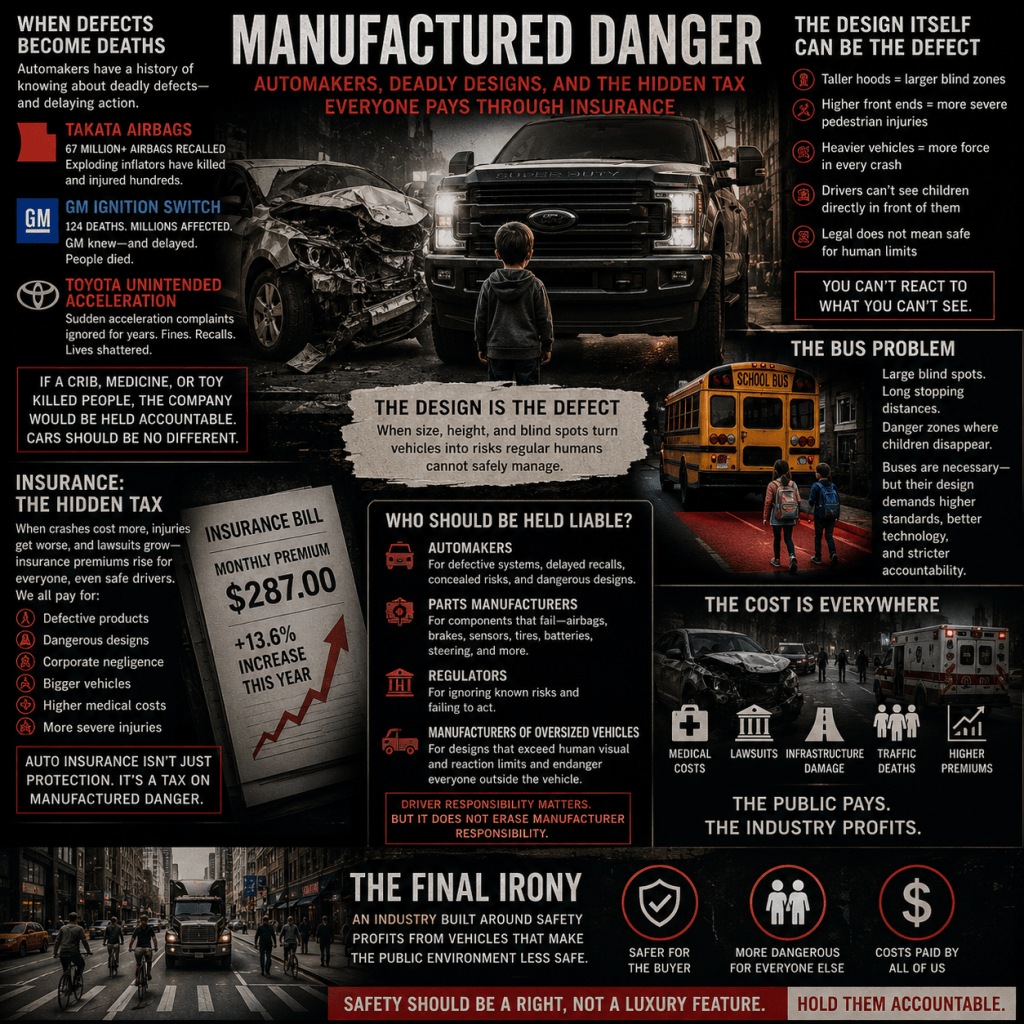
Automakers, Deadly Designs, and the Hidden Tax Everyone Pays Through Insurance
May 23, 2026
When a product causes death or injury, society usually asks who made it, who sold it, who knew about the danger, and who failed to fix it.
Cars should not be exempt from that question.
Automobiles are not natural disasters. They are engineered products. Every hood height, blind spot, airbag, ignition switch, touchscreen, bumper, mirror, pillar, brake system, and weight increase is a design choice. When those choices create foreseeable harm, responsibility should not fall only on the driver or victim.
It should also reach the companies that built the danger into the machine.
When Defects Become Deaths
There is precedent for this.
Takata airbags became one of the largest recalls in U.S. history, with about 67 million airbags recalled because defective inflators could explode and send shrapnel into occupants, causing serious injury or death. General Motors faced massive fallout over faulty ignition switches linked to disabled airbags and fatal crashes. Toyota faced scrutiny and penalties over sudden unintended acceleration complaints and recalls.
These incidents show the basic principle clearly:
when a manufacturer sells a product that can foreseeably kill people through defect, concealment, poor design, or delayed correction, liability is not radical.
It is ordinary product responsibility.
If a crib, medicine, appliance, toy, or food product repeatedly injured people, the manufacturer would be investigated, sued, recalled, regulated, or punished.
Cars should be treated with the same moral seriousness.
The Design Itself Can Be the Defect
The deeper problem is that not all automotive danger comes from a broken part.
Sometimes the danger is the design itself.
Modern trucks and SUVs have become larger, taller, heavier, and harder to see out of. High, blunt front ends create larger blind zones and strike pedestrians higher on the body, increasing the risk of severe or fatal injury. Safety research has found that vehicles with taller, more vertical front ends are more dangerous to pedestrians than lower, sloped vehicles.
This means a vehicle can function exactly as designed and still be dangerous by design.
That raises a different kind of liability question. What happens when the product is not defective because it failed, but because it was allowed to become physically unreasonable for normal human perception?
A driver cannot safely react to what the vehicle physically prevents them from seeing.
At that point, blaming only the driver becomes convenient but incomplete.
Vehicles Too Large for Human Limits
There is a point where size itself becomes a safety failure.
A massive pickup may protect the person inside while making everyone outside less safe. A tall hood can hide a child directly in front of the vehicle. A heavier frame can transfer more force into smaller cars, cyclists, and pedestrians. A large blind zone can turn ordinary parking lots, driveways, and school zones into danger zones.
The machine may be legal.
The driver may be licensed.
The marketing may call it powerful, rugged, safe, or family-friendly.
But if the design exceeds human visual and reaction limits, then society has normalized a product that ordinary humans cannot fully control.
That is not freedom.
That is manufactured risk.
The Bus Problem
School buses reveal the issue even more clearly.
Buses are necessary and often safer for passengers than individual car trips, but they also have large blind spots, wide turning needs, long stopping distances, and danger zones around the vehicle where children can disappear from the driver’s view. Safety agencies warn that school buses must be treated differently because their size creates risks that ordinary cars do not.
That does not mean buses are evil products.
It means large vehicles require stricter design responsibility.
If children can vanish into blind spots around a vehicle designed to transport children, then manufacturers, regulators, districts, and operators should all be asking whether cameras, sensors, mirrors, automatic braking, exterior alerts, and visibility standards are strong enough.
A child should not have to be perfectly visible to survive near a vehicle built for children.
Insurance as a Hidden Tax
The cost of automotive danger does not stay with the company that designed the vehicle.
It spreads.
When crashes become more expensive, injuries more severe, repairs more complex, lawsuits larger, and medical claims higher, insurers raise premiums. Those increases hit millions of people, including careful drivers who never caused the original design problem.
In that sense, auto insurance becomes a hidden tax on manufactured danger.
Everyone pays for:
larger vehicles,
more expensive repairs,
more severe injuries,
medical claims,
liability payouts,
and defective products that should have been safer in the first place.
The public pays monthly for private design choices.
That is the quiet economic injustice beneath the road system.
Who Should Be Held Liable?
Liability should follow responsibility.
Automakers should be held accountable when they knowingly sell defective systems, delay recalls, conceal safety risks, or design vehicles with foreseeable dangers that could have been reduced through safer engineering.
Parts manufacturers should be liable when components such as airbags, brakes, sensors, tires, batteries, or steering systems fail dangerously.
Regulators should also face scrutiny when known risks remain unaddressed for years.
And manufacturers of oversized vehicles should not be allowed to hide behind the phrase “driver error” when the vehicle’s own design makes safe driving harder than human beings can reasonably manage.
Driver responsibility still matters.
But driver responsibility does not erase manufacturer responsibility.
The Final Irony: Safety Became a Product Instead of a Public Condition
The auto industry sells safety as a feature.
Larger vehicles are marketed as protection. Advanced technology is marketed as intelligence. Luxury screens, sensors, cameras, and automated features are presented as progress.
Yet the roads grow more expensive, more dangerous for pedestrians, more hostile to children, and more financially punishing for everyone forced to insure against the damage.
The machine becomes safer for the buyer while becoming more dangerous for the public.
That is the moral contradiction.
If a product kills people, injures people, blinds its own operator, raises costs for everyone, and hides its danger behind marketing, then the question should not be whether manufacturers can be blamed.
The question should be why they are not blamed more often.
 The ChillX Zone
Leave a comment