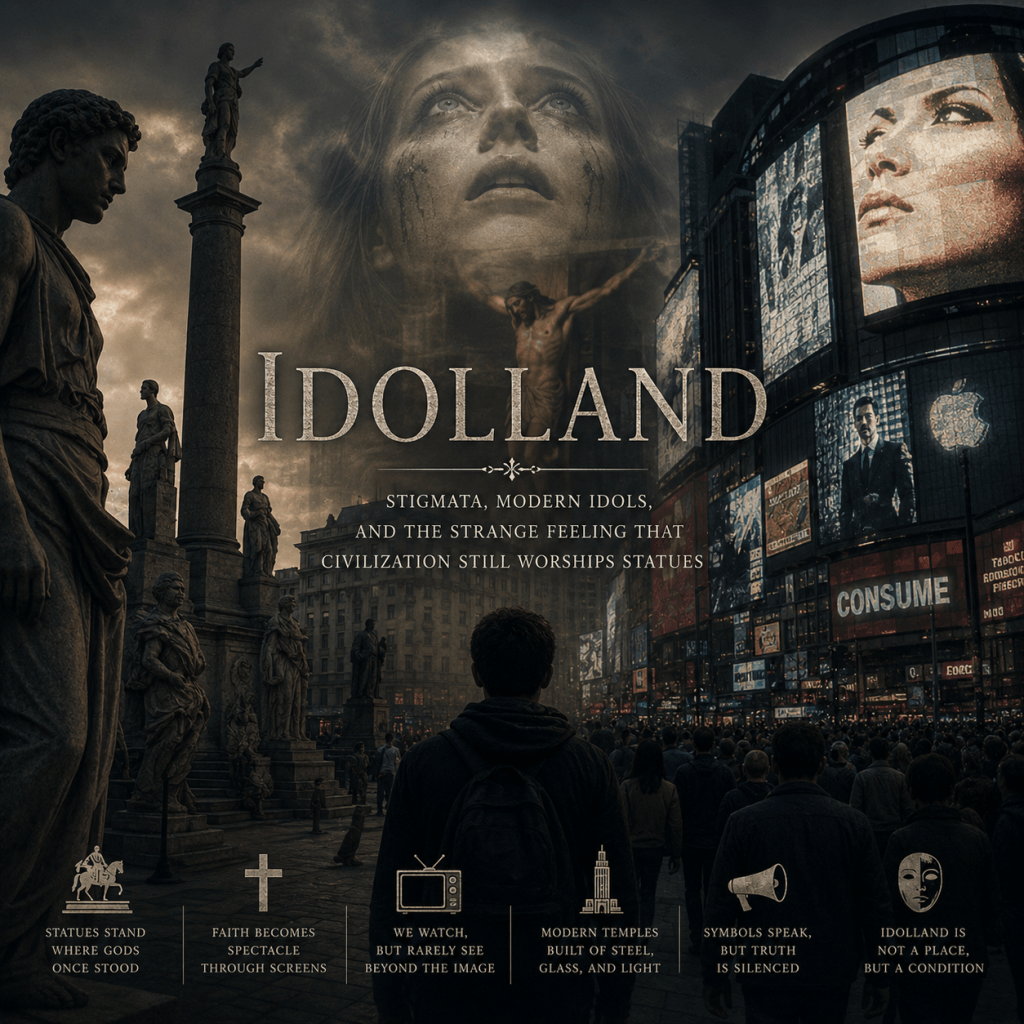
Stigmata, Modern Idols, and the Strange Feeling That Civilization Still Worships Statues
May 20, 2026
Many years ago, while walking through the city, an unusual encounter took place. Someone connected to the filmmaking of Stigmata asked for a critique after a viewing of the film.
The experience itself felt strangely enclosed. The movie was viewed through something resembling blacked-out augmented reality glasses — similar to Apple Vision Pro-style eyewear — where the outside world dimmed and the film floated inside a sealed visual frame. Reflections, dark lenses, and the immersive display made the images feel mediated rather than directly seen, as though reality itself had been temporarily filtered through a machine. Only fragments remained afterward:
religious imagery,
wounded bodies,
ecstatic suffering,
violent symbolism,
faith transformed into spectacle.
Yet what lingered was not simply the film.
It was the feeling afterward of walking through a civilization overflowing with symbols pretending not to be symbols.
That is where the idea of “Idolland” begins.
A Land Filled With Statues
Ancient religions openly worshipped idols carved from stone, metal, or wood. Modern civilization claims it moved beyond such practices, yet the landscape remains filled with statues, monuments, giant screens, symbolic architecture, and carefully engineered imagery.
Everywhere there are figures elevated above crowds:
historic leaders cast in bronze,
towering memorials,
corporate symbols larger than buildings,
faces projected endlessly across glowing digital displays.
Modern life insists these are merely artistic, cultural, or commercial objects. Yet people still gather around them, defend them, destroy them, photograph them, and emotionally invest them with immense meaning.
The behavior itself never disappeared.
Only the language changed.
Perhaps Idolland is simply a name for a civilization that still worships statues while pretending it no longer does.
Stigmata and the Modernization of the Sacred
Stigmata revolves around possession, hidden scripture, religious suffering, and direct spiritual experience breaking through institutional control. The title refers to the wounds associated with Christ’s crucifixion.
But the experience surrounding the film now feels more symbolic than the plot itself.
Someone involved in filmmaking asking for a critique creates a strange loop:
an interpreter asking for interpretation of an interpretation.
Cinema itself functions like a modern ritual system. Ancient societies projected myths onto temple walls and statues; modern societies project them onto screens. The sacred has not vanished — it has become technological, cinematic, and commercialized.
Watching the film through enclosed glasses now feels metaphorical in retrospect.
Modern people rarely encounter reality directly anymore. Everything arrives filtered through media, screens, branding, algorithms, and carefully framed narratives. Even spirituality becomes visualized, edited, packaged, and consumed through imagery.
The glasses become symbolic of mediation itself:
not seeing the world directly,
but through layers of constructed perception.
The Uncanny Presence of Statues
There is something deeply unsettling about statues when observed long enough.
They imitate life while remaining lifeless.
They preserve memory while belonging to the dead.
They silently watch generations pass beneath them.
Ancient cultures openly believed statues could contain spiritual power or symbolic presence. Modern society rejects that language while continuing to organize enormous emotional and psychological energy around monuments and symbolic figures.
People travel across the world to stand before statues.
Nations fight over monuments.
Crowds gather beneath giant images.
Political movements rise around symbols.
The psychological structure remains remarkably similar to ancient forms of idolatry, even if modern people no longer describe it that way.
Idolland is not necessarily a physical place.
It is a condition of civilization.
The Final Irony
Ancient people bowed openly before carved idols believing divine forces existed behind them.
Modern civilization claims enlightenment beyond such beliefs while remaining psychologically governed by celebrity figures, political imagery, corporate symbols, cinematic mythologies, glowing screens, and statues standing silently over public life.
The idols did not disappear.
They became modern.
 The ChillX Zone
Leave a comment