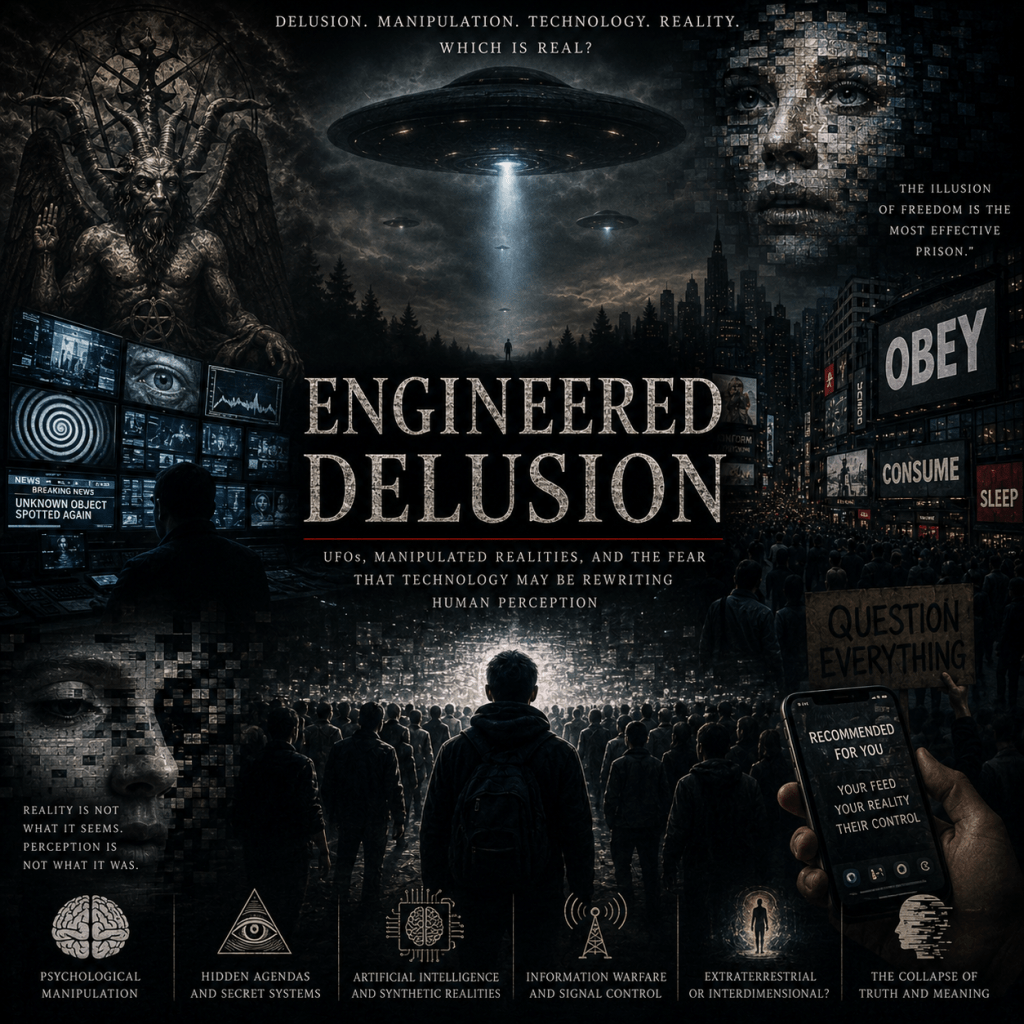
UFOs, Manipulated Realities, and the Fear That Technology May Be Rewriting Human Perception
May 21, 2026
Modern civilization increasingly lives inside manufactured realities.
Screens shape memory. Algorithms shape emotion. News feeds shape political truth. Artificial intelligence generates voices, faces, images, and conversations that never physically existed. At the same time, psychology continues cataloging delusion, paranoia, hallucination, dissociation, and mass suggestion as conditions of the human mind.
Somewhere between mental illness, propaganda, spiritual fear, and technological mediation, a darker question begins to emerge:
What happens when reality itself becomes difficult to verify?
Delusion in the Age of Artificial Perception
Traditional psychology defines delusion as a fixed belief maintained despite contradictory evidence. Historically, delusions often involved religion, persecution, hidden forces, or supernatural influence.
But modern life complicates the boundary between irrational belief and manipulated perception.
Governments conduct psychological operations.
Corporations engineer behavioral addiction.
Social media algorithms selectively distort information.
Artificial intelligence fabricates convincing realities instantly.
Deepfakes erase confidence in visual evidence itself.
The modern mind now exists inside overlapping systems designed specifically to influence attention, emotion, and belief.
In earlier centuries, a person claiming unseen forces manipulated perception may have been considered irrational. Today, recommendation algorithms, targeted advertising, surveillance systems, and machine-generated realities openly perform exactly that function.
The paranoia becomes partially real.
The UFO Phenomenon and the Collapse of Certainty
The UFO phenomenon occupies a strange position within this confusion.
For decades, unidentified aerial phenomena existed at the edge of conspiracy, mythology, military secrecy, psychological projection, and spiritual speculation. Some interpret UFOs as extraterrestrial technology. Others see psychological archetypes, classified military systems, mass hallucination, interdimensional symbolism, or modern myth-making.
What matters psychologically is not merely whether UFOs are objectively real.
It is that they destabilize certainty itself.
Objects appear without explanation.
Witnesses describe impossible movement.
Governments deny, then partially acknowledge.
Information leaks slowly through contradictory narratives.
The phenomenon creates an atmosphere where reality feels negotiable.
And once reality becomes negotiable, the line between revelation and delusion becomes increasingly difficult to define.
Demonic Technologies
Throughout history, demons represented forces that deceived perception, distorted truth, manipulated desire, and fragmented human consciousness.
Modern technology increasingly performs strangely similar functions.
Infinite distraction.
Synthetic identity.
Algorithmic emotional control.
Artificial intimacy.
Reality filtering through devices.
The phrase “demonic technology” does not necessarily imply literal demons inhabiting machines. It may instead describe technologies that systematically separate people from stable perception, direct experience, authentic relationships, and coherent reality.
A person stares into glowing screens for hours each day while artificial systems continuously compete for psychological influence. Attention itself becomes harvested.
Ancient religions warned about possession.
Modern civilization calls it engagement.
The Manufactured World
Perhaps the deeper fear beneath modern culture is not technological takeover alone, but epistemological collapse:
the destruction of confidence in what is real.
Images can be generated.
Voices can be cloned.
Events can be manipulated.
Memories can be reframed algorithmically.
Reality becomes increasingly mediated through systems humans neither fully understand nor control.
At the extreme edge of this condition lies a terrifying possibility:
a civilization capable of generating collective delusion at planetary scale.
Not through magic,
but through networks,
media systems,
psychological engineering,
and immersive technologies powerful enough to reshape perception continuously.
The Good Incident
Yet not every strange experience produces despair.
Sometimes people emerge from altered states, near-death experiences, visionary moments, dreams, or unexplained encounters describing the opposite effect:
greater clarity,
renewed meaning,
heightened awareness,
a feeling that reality contains more depth than material systems alone can explain.
That possibility matters.
Because if technology can distort consciousness negatively, consciousness itself may also possess the ability to resist manipulation through self-awareness, skepticism, spiritual grounding, or direct human connection.
The same civilization capable of manufacturing delusion may accidentally reveal how fragile artificial realities actually are.
The Final Fear
Ancient people feared demons entering the mind.
Modern civilization built machines capable of entering nearly every human mind simultaneously.
The UFO phenomenon, simulation theory, artificial intelligence, psychological manipulation, and collapsing trust in reality all converge into the same unsettling question:
If perception itself can be engineered, how does anyone fully know when they are seeing the world clearly?
And perhaps the most disturbing possibility is this:
the technologies capable of manufacturing delusion may already feel completely normal to the people living inside them.
 The ChillX Zone
Leave a comment