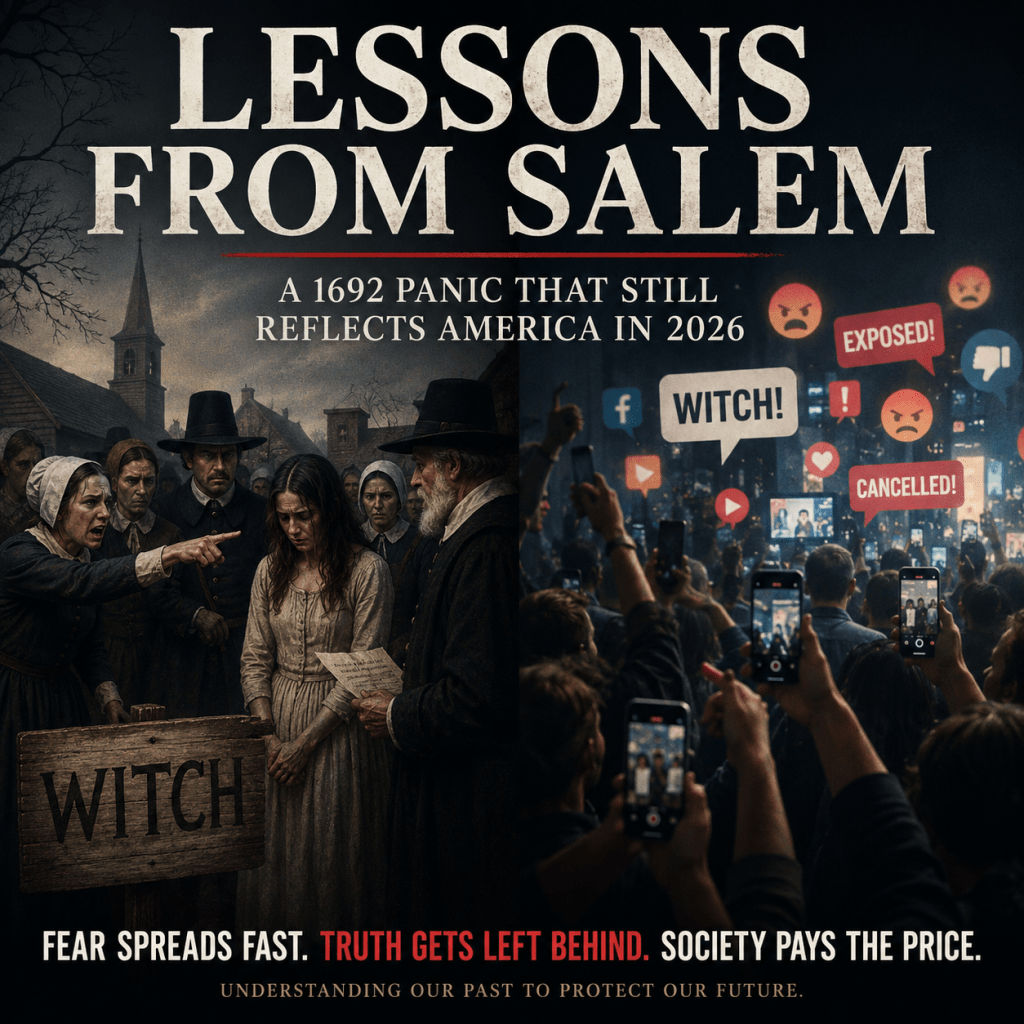
Why America’s Oldest Panic Still Feels Familiar in 2026
May 17, 2026
By mid-May 1692, fear in Salem, Massachusetts, was no longer isolated rumor or small-town suspicion. Arrests were increasing, accusations were spreading, and panic was hardening into social certainty.
What began earlier that year with strange behavior and allegations among several young girls had evolved into a full public crisis. Neighbors accused neighbors. Families turned against one another. Suspicion alone became enough to destroy reputations and lives.
The atmosphere in Salem reflected what happens when fear spreads faster than evidence.
New England’s Harsh Environment Intensified the Crisis
Colonial New England was isolated, cold, difficult, and psychologically demanding. Dense forests, rough terrain, harsh winters, poor harvests, disease, and economic hardship created constant pressure on tightly packed communities struggling to survive.
Salem existed inside that environment.
People depended heavily on social order, religion, and local reputation. But isolation also intensified suspicion. In small communities under stress, rumors spread quickly and fear became contagious.
Historians have long argued Salem was shaped not only by superstition, but by exhaustion, instability, uncertainty, and social tension throughout the region.
Fear Became Stronger Than Reason
One of the most disturbing aspects of Salem was how quickly accusations were accepted without proof. Emotional testimony, personal grudges, rumors, and public pressure became stronger than rational judgment.
As fear intensified, even questioning the accusations became dangerous.
Salem remains one of America’s clearest warnings about mass panic, social instability, and the collapse of reason during periods of fear.
Why Salem Still Feels Relevant in 2026
More than three centuries later, many observers believe similar patterns still exist today.
Fear and outrage now spread instantly through social media, politics, viral news, and nonstop public conflict. People are judged before facts emerge. Public humiliation has become entertainment. Anger spreads faster than patience or restraint.
The technology has changed since 1692.
Human behavior has not changed nearly as much.
Children Often Experience Society’s Contradictions First
Modern tensions also appear in how children are treated.
Many parents and educators continue debating whether children are disciplined too harshly for ordinary emotional behavior and childhood mistakes beginning at very young ages. Curiosity is often treated as disruption instead of part of development.
At the same time, adults frequently engage in dishonesty, cruelty, manipulation, harassment, and public dysfunction while facing little accountability themselves.
Critics argue this creates a society where children are expected to behave more responsibly than many adults.
Communities Can Still Turn Toxic
Salem also showed how ordinary neighbor conflicts can spiral into something destructive. Personal resentment, jealousy, social rivalry, gossip, and private grudges became intertwined with public accusations.
Even today, some communities experience similar tensions. Neighbors may intentionally provoke one another through harassment, manipulation, intimidation, noise, exclusion, or ongoing conflict designed to create stress and instability.
Some people describe these patterns spiritually, as forms of moral corruption or “demonic influence” — not necessarily as literal supernatural possession, but as the spread of negativity, hostility, obsession, and destructive behavior through groups of people.
Psychologists often explain the same behavior through stress, insecurity, trauma, social contagion, and group psychology.
Either way, the warning is similar: when manipulation, cruelty, and dysfunction become normalized, entire communities can become emotionally unstable.
The Culture of Chaos Keeps Expanding
Many Americans who grew up during the late 1980s and early 1990s remember a culture increasingly shaped by public humiliation, reckless behavior, bullying, and conflict-driven entertainment.
Today, online platforms amplify those same instincts continuously. Fear spreads rapidly. Outrage spreads rapidly. Public conflict becomes profitable.
And once chaos becomes normalized, restoring stability becomes far more difficult.
Rights and Responsibility Must Exist Together
America’s founding principles were built around liberty under law, not unlimited selfishness or disorder.
Freedom only survives when responsibility, restraint, and accountability survive with it. No society remains stable if intimidation, dysfunction, and destructive behavior are consistently rewarded or excused.
Communities depend on shared standards, public trust, and mutual respect.
Salem’s Lasting Warning
The Salem Witch Trials were not ultimately frightening because of witches.
They remain frightening because they revealed how quickly fear can reshape human behavior when societies stop valuing discipline, fairness, restraint, and reason.
As of May 17, 2026, the world continues facing growing division, distrust, hostility, and instability. The details may differ from 1692, but the warning remains familiar.
When outrage replaces judgment and panic replaces responsibility, societies often begin to unravel before people fully recognize the damage being done.
 The ChillX Zone
Leave a comment