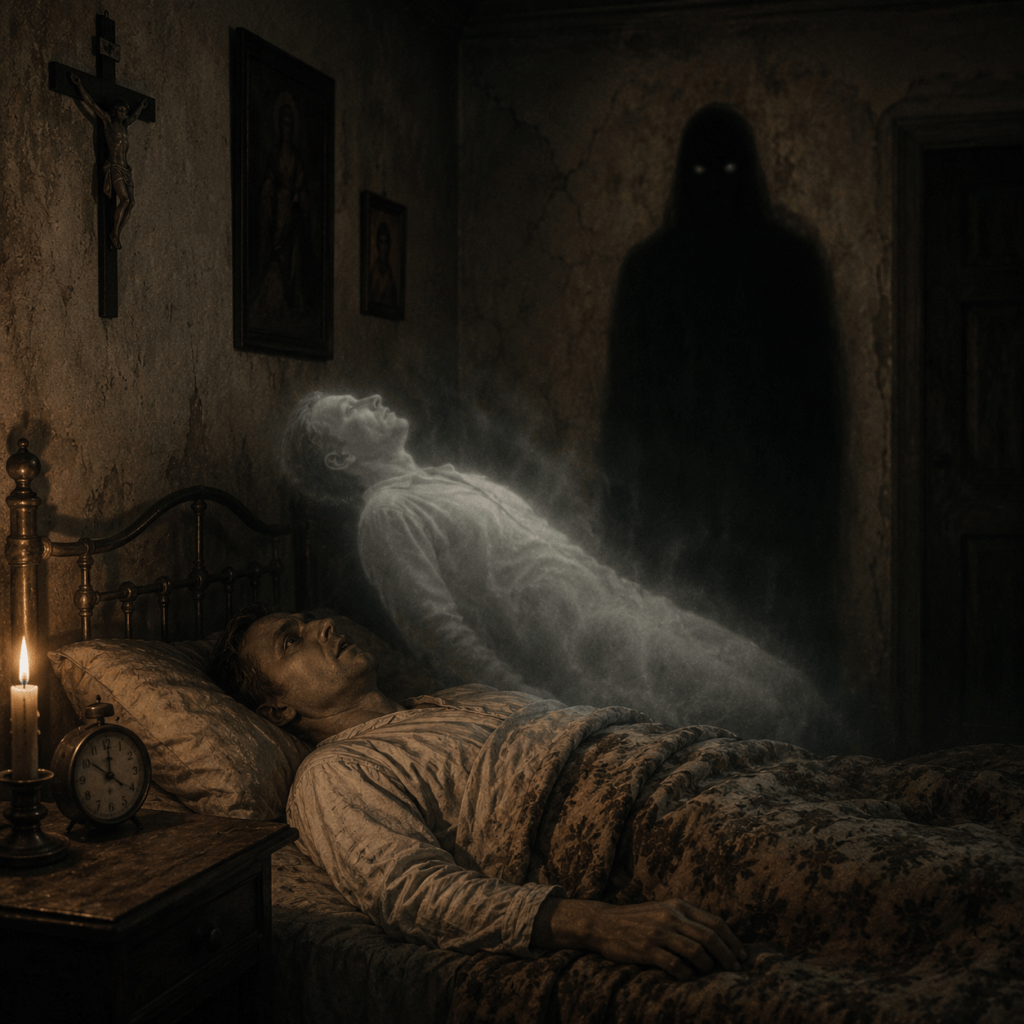
For centuries, people across completely different civilizations described the same terrifying experience:
Waking in the middle of the night unable to move while sensing a presence nearby.
Some heard whispers. Others saw shadow figures standing in corners, leaning over beds, or pressing down on their chest. Many believed they were witnessing spirits, demons, or entities crossing into the physical world while the body remained trapped between sleep and consciousness.
Long before modern medicine existed, these experiences became woven into religious belief, folklore, and fear surrounding death itself.
The “Old Hag” and the Fear of Spiritual Attack
In Newfoundland during the 18th and 19th centuries, people described nighttime attacks known as visits from the “Old Hag.”
Victims reported waking completely conscious yet unable to move while sensing an evil figure in the room. Some believed the entity attempted to suffocate them or steal part of their spirit during sleep.
Similar stories appeared worldwide:
- Scandinavian cultures blamed the “Mare”
- Japanese traditions described “Kanashibari”
- Middle Eastern folklore linked the experience to jinn
- European Christians often viewed it as demonic oppression
What disturbed people most was not simply paralysis itself.
It was the overwhelming feeling that something intelligent was present nearby.
Why Sleep Paralysis Became Connected to Death
Historically, many cultures believed sleep resembled a temporary form of death.
The body became motionless. Awareness faded. Dreams transported the mind elsewhere. In some traditions, people believed the soul partially separated from the body during deep sleep before returning upon waking.
This idea appears repeatedly throughout ancient religions and spiritual systems. Egyptian beliefs, certain forms of mysticism, shamanic traditions, and early Christian writings all contained variations of the idea that consciousness could exist independently from the physical body.
Because sleep paralysis occurs in the strange boundary between sleeping and waking, many believed it represented a dangerous moment where the soul had not fully returned yet.
Some traditions warned that evil entities targeted vulnerable souls during these transitional states.
Religious Figures and Nighttime Visions
Throughout history, many religious figures described intense spiritual encounters occurring during sleep, fasting, isolation, or altered states of consciousness.
Saints, monks, mystics, and prophets often reported:
- shadow figures
- voices
- paralysis
- floating sensations
- visions of heaven or hell
- overwhelming presences
- sensations of leaving the body
Modern psychology may interpret some experiences neurologically, yet religious traditions frequently viewed them as genuine contact with spiritual realms.
In medieval Christianity, sleep paralysis was sometimes interpreted as demonic oppression. Some clergy believed prayer, holy objects, or faith could protect the sleeper from nighttime attacks.
Meanwhile, mystical traditions viewed certain altered states as evidence that the soul could temporarily separate from ordinary physical awareness.
The Soul Leaving the Body
One reason sleep paralysis remains so psychologically powerful is because many people report sensations resembling death itself:
- inability to move
- slowed breathing
- floating sensations
- tunnel-like perception
- intense fear
- feeling detached from the body
Near-death experience reports often contain similar descriptions. Individuals revived after cardiac arrest sometimes describe hovering above themselves, observing their bodies externally, or sensing an overwhelming presence beyond physical reality.
This overlap has led some paranormal researchers and spiritual thinkers to speculate that consciousness may enter unusual states during sleep paralysis — states where awareness partially disconnects from ordinary sensory control.
Science generally explains these sensations through REM sleep disruption and neurological hallucinations. However, others argue humanity still understands very little about consciousness itself.
Why Shadow Figures Appear Repeatedly
One of the strangest aspects of sleep paralysis is the consistency of shadow figure reports across centuries and cultures.
Even people unfamiliar with the phenomenon often describe:
- dark humanoid forms
- figures standing silently nearby
- glowing eyes
- silhouettes near doors or windows
- entities watching from corners
Psychologists believe the brain creates these figures while trying to explain overwhelming fear during partial dream states.
Others question why the descriptions remain so similar across unrelated societies separated by geography and time.
Some paranormal theories suggest humans may occasionally perceive things normally hidden from ordinary awareness during altered states between sleep and waking consciousness.
Whether psychological or spiritual, the fear feels undeniably real to those experiencing it.
The Interconnection Between Fear, Consciousness, and Mortality
Sleep paralysis sits at a crossroads between several of humanity’s deepest fears:
- death
- helplessness
- the unknown
- loss of bodily control
- spiritual vulnerability
- unseen observers
This is why the experience has survived in religious stories, folklore, and paranormal accounts for centuries. It touches something primal inside the human mind.
When people awaken unable to move while sensing another presence nearby, the experience does not merely feel frightening.
It feels existential.
Final Thoughts
Science explains much of sleep paralysis through REM sleep interruption and neurological overlap between dreaming and waking states.
Yet the experience continues haunting human culture because it resembles something far older and deeper:
the fear that consciousness may exist beyond the body — and that during certain moments, the boundary between worlds becomes dangerously thin.
For thousands of years, humans have wondered the same thing during the darkest hours of the night:
When the body sleeps, where does the soul go?
 The ChillX Zone
Leave a comment