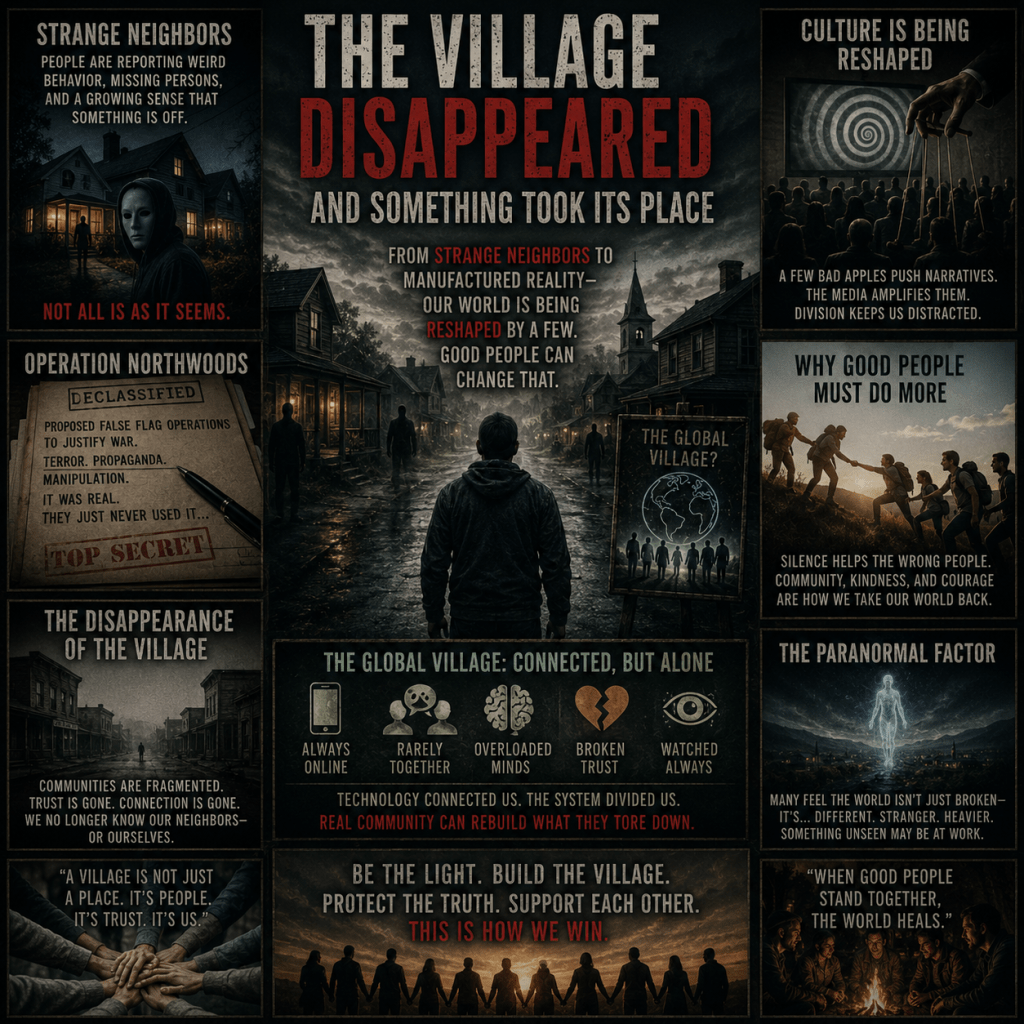
From distrust between neighbors to fears of manipulation, surveillance, and social fragmentation, many people feel modern society has drifted far from the communities humans were built to live in.
May 7, 2026
As social distrust, loneliness, and political division continue rising across much of the world in 2026, many sociologists and cultural critics argue modern society is experiencing the collapse of something ancient and deeply human: the village.
For most of human history, survival depended on tight-knit communities built around shared responsibility, trust, local identity, and direct human interaction. Families knew one another. Neighbors relied on each other. Problems were handled face-to-face rather than through algorithms, institutions, or distant systems.
Today, many people report the opposite experience — isolation inside crowded cities, distrust between neighbors, online tribalism, and a growing sense that communities are becoming emotionally disconnected despite constant digital communication.
Critics argue the “global village” promised by the internet often replaced real-world communities with fragmented digital echo chambers shaped by outrage, fear, and manipulation.
The Fear of Manufactured Narratives
Public distrust toward governments, media institutions, corporations, and digital platforms has intensified dramatically in recent years.
Historical revelations involving covert operations, propaganda campaigns, and surveillance programs continue fueling suspicion that powerful institutions sometimes manipulate public perception more aggressively than citizens realize.
One frequently referenced example is Operation Northwoods — a declassified Cold War-era proposal involving staged incidents that was ultimately never carried out. Although rejected at the time, the existence of the proposal continues fueling debate about the lengths institutions may consider during periods of geopolitical tension.
For many observers, revelations like these contribute to a broader fear that modern societies are increasingly shaped by psychological operations, media engineering, and manufactured division.
Strange Neighbors in the Age of Isolation
At the same time, everyday social trust appears to be weakening.
People increasingly describe feeling disconnected from those living around them. Neighbors may rarely interact beyond brief exchanges, while digital identities often replace genuine local relationships.
Urban researchers note that modern housing patterns, remote work, social media dependency, and economic stress have all contributed to declining civic participation and weakening neighborhood bonds.
Paranormal and conspiracy communities frequently interpret this emotional distance through darker theories involving “strange neighbors,” hidden agendas, or the feeling that society itself has become emotionally unfamiliar.
Psychologists often attribute these experiences to social isolation, anxiety, political polarization, and overstimulation. Yet the emotional reality remains powerful: many people no longer feel surrounded by community, even when living among millions of others.
The Disappearance of the Village Mindset
Critics argue modern systems increasingly reward competition, individual branding, outrage, and self-promotion over cooperation and mutual support.
Historically, villages survived because people depended on one another directly. A struggling family received help. Elders passed down knowledge. Communities developed collective identities rooted in place and shared experience.
Today, digital systems often reward visibility rather than character, influence rather than wisdom, and conflict rather than understanding.
As economic pressure rises, many people feel forced into survival-focused lifestyles that leave little time for building meaningful community relationships.
The result, according to social researchers, is a society where loneliness, distrust, and psychological exhaustion continue spreading despite unprecedented technological connectivity.
Why Good People Feel Increasingly Silent
Another growing concern involves the perception that destructive voices increasingly dominate public life while compassionate, grounded individuals withdraw from participation altogether.
Community organizers and mental health advocates often warn that many decent people become discouraged, exhausted, or fearful of speaking openly in highly polarized environments.
This creates a vacuum where outrage-driven narratives, manipulation, extremism, and sensationalism gain disproportionate influence.
Critics argue societies become unstable when ordinary people stop actively supporting one another at the local level. The weakening of real communities leaves populations more vulnerable to fear, division, misinformation, and social fragmentation.
The Paranormal Fear That “Something Changed”
Alongside political and social anxiety, many people describe a strange emotional sensation difficult to fully explain — the feeling that society itself somehow changed beneath the surface.
Online paranormal communities frequently discuss feelings of unreality, emotional detachment, or living inside a world that feels increasingly artificial and psychologically fragmented.
Some frame this through supernatural theories, simulation concepts, or collective spiritual decline. Others interpret it through psychology and sociology, pointing toward chronic stress, digital overstimulation, and social alienation.
Regardless of interpretation, the emotional pattern appears widespread: people increasingly miss a sense of grounded reality, authentic human connection, and belonging.
Can the Village Be Rebuilt?
Sociologists, psychologists, and community advocates increasingly argue that rebuilding trust may require returning to more human-centered forms of life — local relationships, shared spaces, mutual aid, environmental connection, and direct community participation.
The modern world may never fully return to village life as it once existed. But many researchers believe humans still require the same core things they always have: belonging, trust, purpose, and meaningful connection with others.
Whether viewed through politics, psychology, or paranormal symbolism, one message continues emerging from the growing social unease of modern life:
societies weaken when good people stop building strong communities together.
 The ChillX Zone
Leave a comment