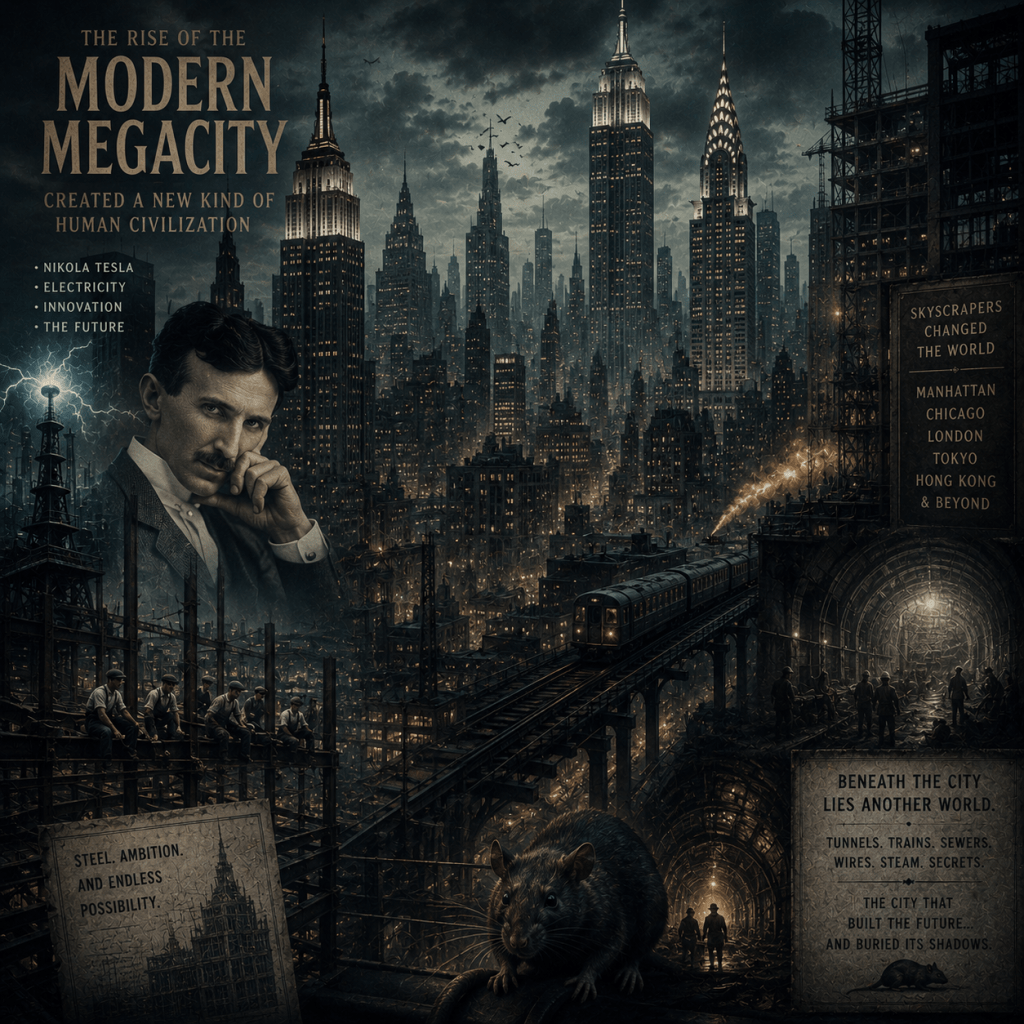
From Nikola Tesla’s electric dreams to freezing steel skyscrapers and underground tunnel systems, historians say the modern metropolis reshaped humanity in ways still haunting society today.
May 4, 2026
As fascination with urban decay, megacities, and technological culture continues growing in 2026, historians and cultural critics are once again revisiting the explosive rise of skyscraper cities during the early 20th century — especially in places like New York City and the rapidly transforming skyline of Manhattan.
During the 1920s and 1930s, towering steel structures began reshaping major cities across the world. Massive buildings rose above crowded streets as electric power, industrial wealth, and modern engineering accelerated urban expansion at unprecedented speed.
The era became deeply associated with inventors such as Nikola Tesla, whose work with electricity and wireless energy helped define the technological imagination of the modern city.
What emerged was not simply architecture — but an entirely new human environment built vertically rather than horizontally.
Manhattan Became the Blueprint for the Vertical World
By the 1930s, Manhattan had become the symbolic center of the skyscraper age. Buildings such as the Empire State Building and Chrysler Building transformed the skyline into a monument to industrial ambition and financial power.
Other cities soon followed. Chicago expanded vertically alongside New York, while cities like Hong Kong, Tokyo, and later Dubai embraced dense high-rise development as symbols of economic growth and modern identity.
Critics argue this shift fundamentally changed human psychology and social structure. Communities once organized around neighborhoods, public squares, and local interaction increasingly became stacked systems of isolation — millions of people living above and below one another inside controlled industrial environments.
Frozen Steel, Wind Tunnels, and the Brutal Reality of Vertical Cities
Despite the glamour often associated with skyscrapers, life inside early high-rise cities could be physically brutal.
Workers constructing skyscrapers endured freezing temperatures, dangerous winds, unstable steel frameworks, and harsh winter conditions high above city streets. Historians describe the era as a collision between industrial ambition and human endurance.
At street level, the dense concentration of concrete and steel created harsh wind corridors, limited sunlight, and overcrowded living conditions. Beneath the streets, another hidden world expanded simultaneously: tunnels, subway systems, steam pipes, electrical infrastructure, and sewer networks.
As cities grew upward, they also expanded downward into vast subterranean systems rarely seen by the public.
The Paranormal Myths Beneath the Megacity
The underground infrastructure of major cities has long fueled paranormal legends and urban myths.
Stories involving hidden tunnel societies, abandoned subway stations, ghost workers, and unexplained underground noises became common throughout cities like New York, London, and Paris. Reports of shadowy figures appearing in subway tunnels and maintenance corridors have persisted for decades.
One of the most enduring urban legends involves massive rat populations thriving beneath modern cities. In places like New York City, the subterranean ecosystem became almost mythological — a hidden world operating beneath the visible metropolis.
Paranormal researchers and conspiracy theorists have often portrayed underground transit systems as symbolic “underworlds” beneath modern civilization, where isolation, darkness, and industrial decay create an atmosphere filled with psychological tension and folklore.
Some theories even connect Tesla’s unfinished experiments and the electrification of cities to strange electromagnetic phenomena reportedly experienced in older subway systems and abandoned industrial buildings.
The Birth of the “Machine Civilization”
Cultural critics increasingly argue that the rise of skyscraper cities marked the beginning of a new type of civilization centered around machines, finance, and industrial efficiency rather than direct human connection.
Electric lighting erased natural darkness. Elevators redefined physical movement. Massive office towers concentrated economic power into dense urban cores controlled by corporations and institutions.
At the same time, critics say the modern metropolis introduced new forms of alienation, anxiety, and social fragmentation. Millions of people became dependent on systems they neither controlled nor fully understood — electricity grids, transit systems, financial markets, and industrial supply chains.
The towering skyline became both a symbol of progress and a warning about the growing separation between humanity and nature.
Why the Megacity Still Fascinates and Haunts Us
More than a century after the skyscraper boom began, megacities continue dominating modern life. Yet fascination with abandoned subway tunnels, haunted hotels, forgotten underground infrastructure, and decaying industrial districts remains stronger than ever.
Films, documentaries, paranormal investigations, and urban exploration communities continue revisiting the hidden layers beneath modern cities — places where history, technology, isolation, and myth intersect.
Whether viewed through architecture, sociology, or paranormal folklore, the rise of the modern megacity created more than taller buildings. It created an entirely new human reality — one still shaping society today.
 The ChillX Zone
Leave a comment