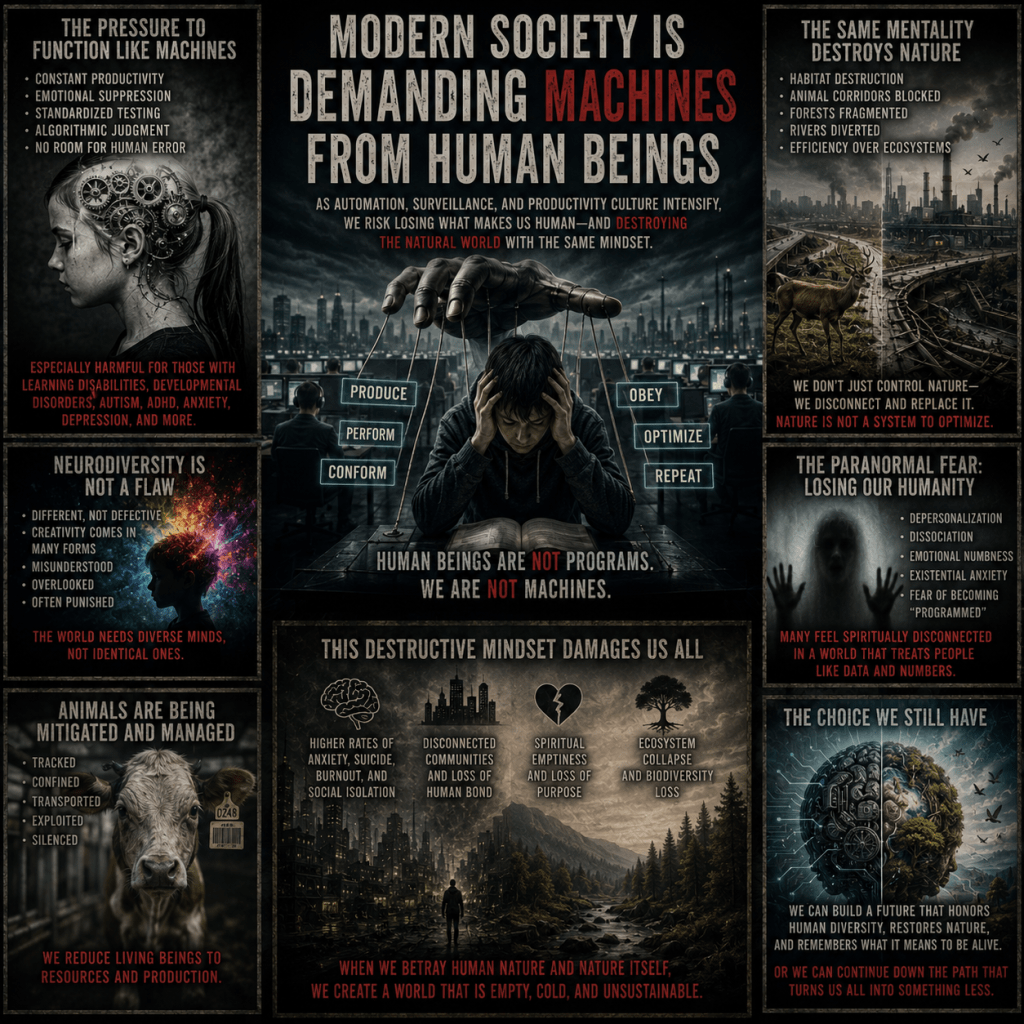
As automation, surveillance, and productivity culture intensify, critics warn that modern systems increasingly punish natural human behavior while reshaping both people and the natural world around them.
May 6, 2026
As conversations surrounding mental health, neurodiversity, and burnout continue expanding this May, psychologists, disability advocates, and social critics are raising concerns about the increasingly mechanical expectations placed on human beings in modern society.
Schools, workplaces, algorithms, and digital systems often reward speed, consistency, productivity, emotional control, and nonstop availability — standards many people struggle to maintain naturally.
For individuals living with learning disabilities, developmental disorders, autism spectrum conditions, ADHD, anxiety disorders, depression, or other mental health challenges, modern systems can feel especially unforgiving.
Critics argue that instead of adapting environments to support human variation, society increasingly pressures individuals to function more like machines.
Human Nature Doesn’t Operate Like Software
Human beings are inconsistent by nature. Attention fluctuates. Emotions change. Energy levels vary. Trauma, stress, grief, sensory overload, and biological differences all affect how people think and behave.
Yet many institutions continue relying on rigid systems designed around standardized performance and measurable productivity.
Disability advocates have repeatedly warned that modern environments often pathologize natural human differences while rewarding robotic conformity. Students who struggle with attention or communication may be labeled disruptive. Workers experiencing burnout may be viewed as inefficient rather than overwhelmed.
Critics say the result is a culture where people increasingly feel pressured to suppress individuality, emotion, and vulnerability simply to survive economically and socially.
The Same Mentality Is Reshaping Nature Itself
Environmental researchers argue this mindset extends beyond human society and into the treatment of the natural world.
Urban expansion, highways, industrial agriculture, and large-scale development projects often prioritize efficiency and economic growth over ecosystems and animal behavior.
Wildlife migration routes are disrupted by roads, fencing, suburban sprawl, and industrial infrastructure. Forests become fragmented. Rivers are redirected. Natural environments are reshaped into controlled systems optimized for commerce rather than ecological balance.
Conservationists frequently refer to disappearing “animal corridors” — natural pathways species rely on for migration, reproduction, and survival.
As human systems become increasingly rigid and artificial, critics argue nature itself is being forced into unnatural patterns of survival.
Neurodiversity and the Fear of Social Erasure
Advocates for neurodivergent individuals increasingly warn that society often misunderstands cognitive differences as defects rather than natural variations of human experience.
Historically, many artists, inventors, musicians, scientists, and writers believed to have exhibited traits associated with autism, ADHD, dyslexia, or other neurological differences contributed enormously to human creativity and innovation.
Critics fear modern hyper-standardized environments may unintentionally suppress the very diversity of thought that drives cultural and intellectual progress.
The pressure to constantly perform, optimize, and conform can also intensify feelings of alienation, especially among people who already feel disconnected from dominant social expectations.
The Paranormal Fear of Becoming “Less Human”
Alongside psychological concerns, modern technological culture has generated growing paranormal and existential anxieties surrounding identity itself.
Many people increasingly describe feelings of emotional numbness, depersonalization, dissociation, or detachment from reality in highly digitized environments. Paranormal communities often frame these sensations as evidence that humanity is becoming spiritually disconnected from both nature and itself.
Online discussions frequently reference fears of becoming emotionally “programmed” — trapped inside systems driven by algorithms, surveillance, productivity metrics, and artificial intelligence.
Some conspiracy and paranormal theories portray modern civilization as slowly transforming human beings into passive components within larger technological systems.
Psychologists generally interpret these fears through stress, burnout, overstimulation, and social isolation. Yet the emotional weight of these experiences continues resonating with millions of people navigating increasingly artificial environments.
What Happens When Both Humanity and Nature Are Forced to Conform?
Critics argue modern society increasingly treats both people and ecosystems as systems to optimize rather than living environments requiring balance, unpredictability, and diversity.
Children are expected to sit still for unnatural periods of time. Workers remain connected to digital systems around the clock. Animals lose migration pathways. Forests are divided into economic zones. Rivers become industrial assets.
The same cultural obsession with efficiency, control, and productivity may ultimately be reshaping life itself into something colder, more fragmented, and less human.
A Civilization Struggling Against Its Own Nature
Mental health professionals, environmental scientists, and social researchers continue warning that societies disconnected from human and ecological realities often experience rising anxiety, alienation, burnout, and instability.
Human beings evolved within communities, ecosystems, and natural rhythms — not constant digital monitoring, endless productivity demands, and industrial environments disconnected from the natural world.
Whether viewed through psychology, environmental science, or paranormal symbolism, one message continues emerging: systems that ignore the realities of human nature and the natural world may ultimately become destructive to both.
 The ChillX Zone
Leave a comment