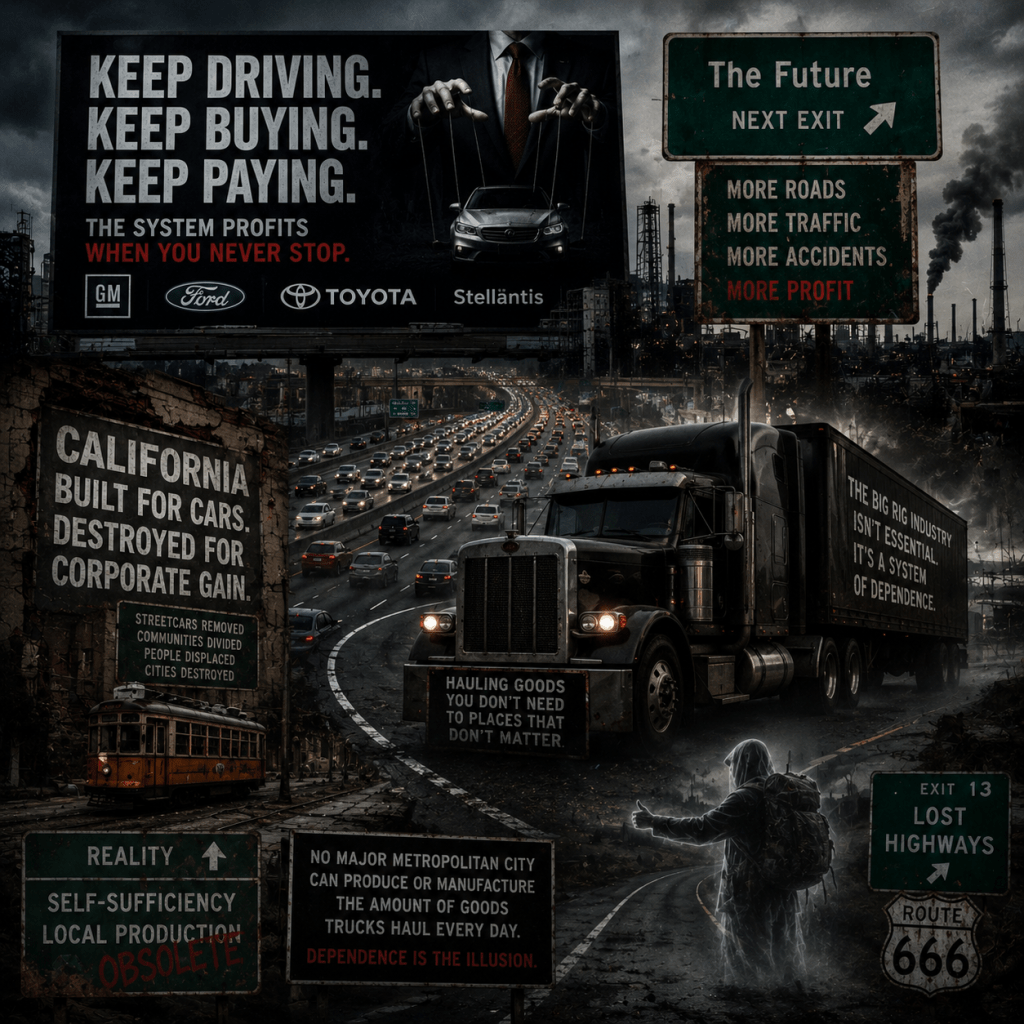
From car dependency to endless trucking networks, critics argue modern transportation systems were designed around corporate profit, environmental damage, and public dependence.
May 2, 2026
As debates over infrastructure, pollution, and urban collapse continue into May, critics of the modern auto industry are once again questioning whether America’s transportation system was ever truly designed for efficiency or public well-being.
Consumer advocates, historians, and urban planners have long argued that automobile manufacturers and related industries benefited enormously from a society built around car dependency — even when that dependency contributed to traffic deaths, pollution, and environmental destruction.
Road accidents generate massive revenue streams tied to insurance companies, vehicle repairs, replacement parts, medical systems, legal industries, and new car sales. While there is no verified evidence that manufacturers intentionally engineer vehicles to cause crashes, critics argue the industry historically prioritized speed, sales volume, and planned obsolescence over long-term public safety and sustainable urban planning.
The result, according to transportation researchers, is a society financially dependent on constant vehicle turnover and perpetual road expansion.
How Car Culture Reshaped California
Few places symbolize America’s automobile transformation more than California.
During the mid-20th century, sprawling freeway systems rapidly expanded across Los Angeles and surrounding regions. Entire neighborhoods were demolished to make room for highways, while public rail systems that once connected cities gradually disappeared.
Urban historians have repeatedly pointed to the dismantling of electric streetcar networks — including the famous Pacific Electric Railway system — as a turning point that intensified car dependency throughout Southern California.
As highways expanded, so did suburban sprawl, traffic congestion, air pollution, and fossil fuel consumption. Critics argue that what was marketed as freedom and mobility ultimately created some of the most congested urban regions in the world.
Environmental researchers now cite transportation emissions as one of California’s largest long-term pollution sources.
The Endless Flow of Trucks and Consumer Dependency
Modern economies rely heavily on massive trucking networks that move goods continuously across highways and industrial corridors. But some critics argue the scale of the system itself reveals a deeper contradiction.
Major metropolitan areas consume staggering quantities of products every day — food, electronics, clothing, fuel, construction materials, and consumer goods — yet few large cities actually manufacture most of what they consume locally.
Instead, products often travel thousands of miles through ports, warehouses, rail hubs, and trucking routes before reaching consumers.
Transportation analysts note that many urban economies are now heavily dependent on globalized supply chains rather than regional self-sufficiency. The result is a logistical system requiring constant fuel consumption, road maintenance, and industrial expansion simply to sustain daily life.
Critics describe the process as economically fragile and environmentally unsustainable.
Why Some Researchers Call the “Big Rig Economy” an Illusion
While trucking remains essential for modern commerce, critics argue the industry also reflects a larger illusion of endless economic growth.
Large-scale freight systems create the appearance of abundance and constant availability, but the underlying infrastructure depends on enormous fossil fuel consumption, debt-driven expansion, and international manufacturing networks vulnerable to disruption.
Supply chain breakdowns during recent global crises exposed how quickly shortages can emerge when transportation systems stall.
Some economists and environmental observers argue modern consumer economies have become psychologically conditioned to expect unlimited products delivered instantly — even when the system supporting that expectation creates pollution, traffic deaths, labor exploitation, and environmental strain.
The Paranormal Side of America’s Endless Highways
Alongside the social and environmental criticism, America’s highways have also become deeply connected to paranormal folklore.
Truck drivers and late-night travelers have reported ghost sightings, phantom hitchhikers, mysterious lights, and unexplained radio transmissions on isolated roads for decades. Some of the country’s most famous paranormal legends emerged directly from highway culture.
Urban legends surrounding haunted highways, spectral truck stops, and abandoned roadside towns continue spreading online, especially among long-haul drivers who spend countless hours traveling remote routes overnight.
Psychologists often explain these experiences through fatigue, isolation, sleep deprivation, and sensory distortion. Paranormal researchers, however, argue that highways saturated with stress, accidents, and tragedy may accumulate emotional energy over time.
A System Too Big to Escape?
Transportation experts increasingly warn that modern cities were designed around systems requiring constant expansion, fuel consumption, and consumer dependence.
Critics argue America’s infrastructure no longer serves communities as much as it serves industries built around perpetual movement — automobiles, oil, insurance, logistics, and commercial development.
Whether viewed through economics, environmental science, or even paranormal folklore, one reality remains difficult to ignore: modern transportation systems shape nearly every aspect of daily life, even as many people question whether the system itself was ever truly sustainable.
 The ChillX Zone
Leave a comment