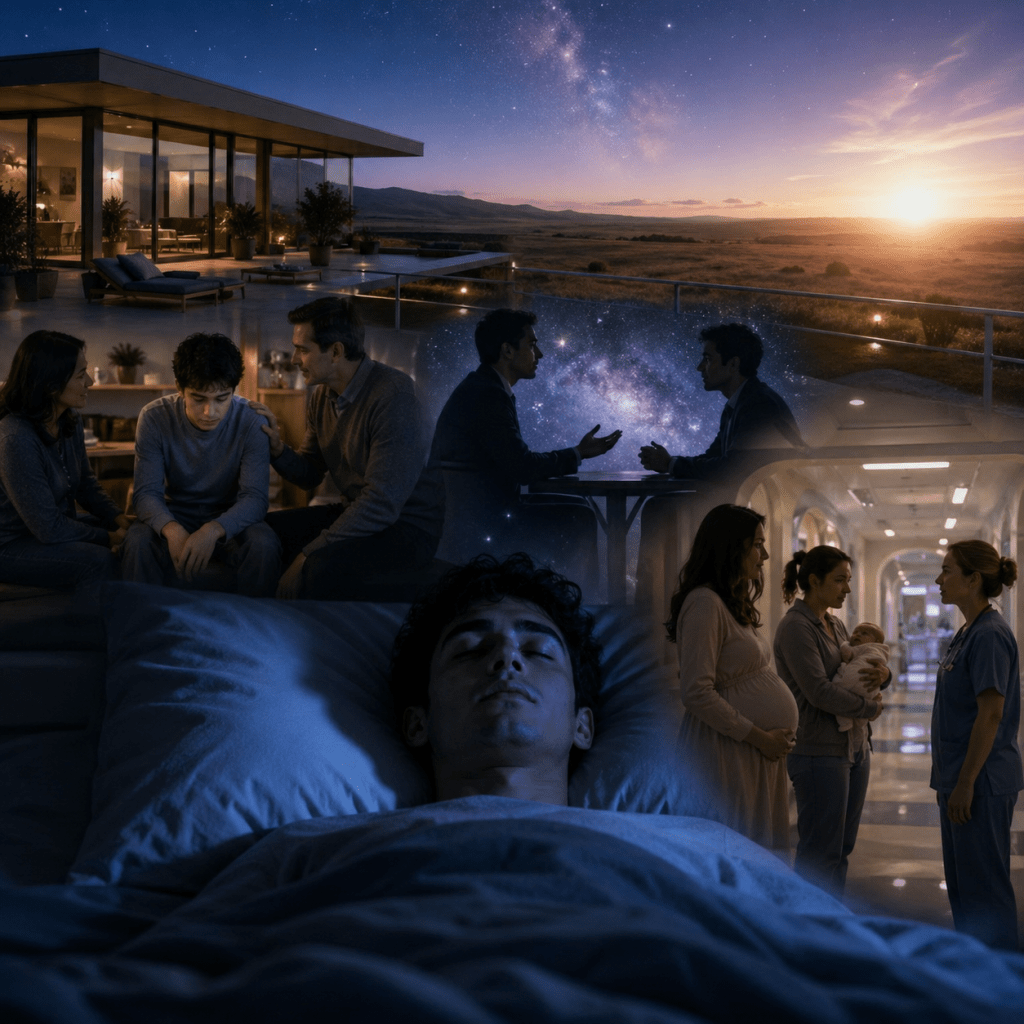
Dreams That Feel Like Places We Have Been
April 26, 2026
For generations people have described dreams as fleeting illusions—nighttime stories that vanish when morning arrives. Yet many dreamers insist the experience is far more vivid than imagination. In certain cases the mind appears to move through scenes and conversations that feel structured, emotional, and strangely real.
This phenomenon is often called lucid dreaming, a state in which the dreamer becomes aware they are dreaming while still inside the dream itself. During these moments the environment can feel detailed and coherent, almost like stepping into another world.
Some people report entire narratives unfolding: encounters with familiar friends, meaningful conversations about life struggles, and meetings with strangers whose stories feel deeply personal. These dreams are not chaotic fragments but experiences with themes—responsibility, relationships, morality, and reflection.
Whether these scenes originate purely from the brain or from something less understood has been debated for centuries.
A Rooftop Penthouse Standing Alone
One dream begins in a rooftop penthouse, but not above a crowded city. Instead the residence stands almost alone. The surrounding land stretches outward with very few other buildings nearby, giving the place a quiet and isolated feeling. It feels as if the penthouse is the only home in the area, a solitary structure standing above open space.
Inside lives a family whose life revolves around caring for their son, a young man living with autism or another developmental condition.
The dream unfolds like a first day on the job. The parents are welcoming but clearly worn down from years of responsibility. Their relief at having someone there to help is visible in small ways: careful explanations, gentle conversations about routines, and quiet gratitude.
The young man is calm and observant. Sometimes he repeats certain phrases or focuses on patterns outside the windows. His behavior reflects the different ways people with autism can experience the world—often noticing details others overlook while struggling with social or sensory complexity.
The dream does not portray him as a problem. Instead, it highlights the patience required in caregiving and the humanity of a family adapting to daily challenges.
Across the real world, families caring for individuals with developmental disorders often rely on support workers and structured routines. The dream reflects that reality in a simple way. Caregiving becomes less about dramatic moments and more about steady presence.
A Conversation With an Old Friend
Another part of the dream shifts suddenly. An old friend appears, someone familiar from earlier years. The setting is less defined, but the conversation feels serious and reflective.
The two talk about life’s struggles. There are discussions of separation, personal hardships, and the strain that emotional stress can place on the body. Health problems, aging, and the difficulty of maintaining relationships all come into focus.
Dream researchers have long suggested that sleep allows the brain to sort through unresolved emotions. Conversations that never happened in real life may unfold in dreams as the mind attempts to find closure.
The moment ends strangely but peacefully. Both individuals appear dressed in formal attire, as if preparing for an event or ceremony. The meaning is unclear—perhaps a symbolic acknowledgment that something important has been discussed or resolved.
Moments later, the scene fades.
A Hospital That Feels Like a Hotel
The dream continues in a third setting, a massive building that resembles both a hospital and a hotel. The hallways are wide and polished, filled with soft lighting and the quiet movement of nurses and visitors.
Here a new acquaintance appears, someone unfamiliar yet instantly comfortable to speak with. The conversation turns to childbirth and family.
They discuss the responsibility of bringing a child into the world and the role of surrogacy. A woman who appears to be carrying a child as a surrogate is seen moving through the building, calm and composed. Her presence becomes a quiet symbol of the biological miracle of human life.
The dream emphasizes the beauty of procreation when it is connected to care, responsibility, and the intention to create a new life.
Yet the conversation also touches on modern concerns. Casual dating culture, alcohol-driven nightlife, and the influence of the adult entertainment industry are mentioned as forces that can complicate relationships and reduce intimacy to something less meaningful.
Within the dream, these topics appear as warnings—reminders that creation and responsibility can easily be overshadowed by distraction or indulgence.
The Mystery of Lucid Dreaming
Lucid dreaming itself has been studied scientifically for decades. Researchers have confirmed that some dreamers can recognize when they are dreaming and even influence the direction of the dream.
These experiences occur during REM sleep, when the brain is extremely active while the body remains physically still.
What fascinates many dreamers is the sense of realism.
Inside a lucid dream, people often report:
- environments that feel physically present
- conversations with emotional depth
- the sensation of time passing normally
- memories that feel similar to waking life
Upon waking, the dream can feel like a real experience, even though details may begin fading quickly.
Scientists generally believe dreams are the brain organizing memories, emotions, and unresolved questions.
But not everyone agrees that the explanation is purely neurological.
The Paranormal Question
Beyond scientific research lies another perspective. For centuries, spiritual traditions have treated dreams as more than internal imagination.
Some believe dreams represent a space where consciousness can explore deeper layers of reality. Paranormal researchers have suggested possibilities such as shared dreaming, precognitive dreams, or the idea that consciousness might briefly move beyond the physical body during sleep.
These ideas remain controversial and largely unproven.
Yet the intensity of lucid dreams continues to fuel speculation. When the mind walks through a place that feels real, speaks with people who feel present, and remembers the experience upon waking, it challenges the simple notion that dreams are meaningless illusions.
Where Dreams Meet Waking Life
What can be said with certainty is that dreams influence waking life in powerful ways.
They help people process emotional conflicts, explore personal values, and imagine solutions to problems. Artists, scientists, and writers have long credited dreams for ideas that later appeared in the real world.
Whether dreams are entirely internal or something more remains unanswered.
But one fact remains clear to those who experience them.
During a lucid dream, the world inside the mind does not feel fake. It feels like a place.
And when morning comes, the memory remains—like a journey that happened somewhere between imagination and reality.
 The ChillX Zone
Leave a comment