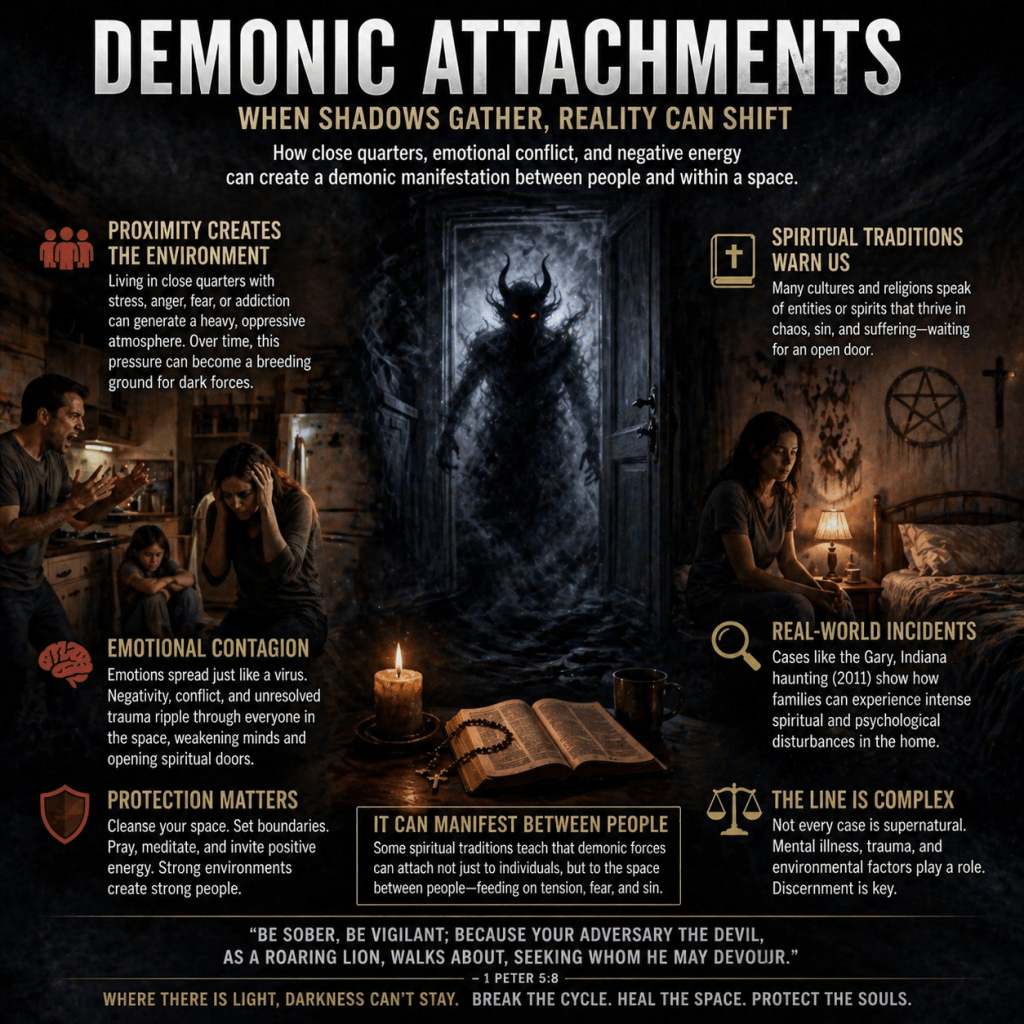
Close Quarters and Shared Energy
April 22, 2026
Throughout history, cultures across the world have described a phenomenon sometimes referred to as demonic attachment—the belief that negative spiritual forces can influence individuals or environments.
One idea frequently mentioned in folklore and spiritual traditions is that proximity matters. When people live in close quarters—families, roommates, crowded communities—the emotional atmosphere within that space can intensify dramatically. Stress, anger, fear, addiction, or unresolved conflict can build pressure inside a home much like steam inside a sealed container.
In spiritual language, some traditions describe this pressure as creating an opening where darker forces can manifest between people rather than within one individual.
Whether interpreted spiritually or psychologically, the concept points toward the powerful influence that shared environments can have on human behavior.
The Power of Emotional Environments
Modern psychology acknowledges something similar, though it explains it differently.
When individuals live together in high-stress environments—crowded apartments, unstable households, or emotionally volatile relationships—the tension can spread rapidly from one person to another. Anger triggers anger. Fear triggers fear. Anxiety spreads.
This phenomenon is sometimes referred to as emotional contagion, where moods and behaviors ripple through a group almost like an invisible current.
Over time, these emotional patterns can make a place feel heavy, oppressive, or chaotic.
In older spiritual traditions, such conditions were sometimes described as attracting negative entities or spirits that feed on conflict and suffering.
Folklore and Spiritual Warnings
Many religious traditions contain warnings about spiritual attachments.
In Christianity, accounts of demonic influence appear throughout scripture and later spiritual literature, often describing individuals who become overwhelmed by destructive impulses or voices.
In Islamic traditions, the concept of jinn includes both benevolent and harmful beings that can interact with human environments.
In Tibetan Buddhism and various shamanic traditions, negative spirits are sometimes believed to attach themselves to places where suffering or imbalance has accumulated.
Although interpretations vary widely, the underlying message is often the same: environments filled with chaos, addiction, or intense emotional conflict can become spiritually unhealthy.
Real-World Incidents and Cultural Interpretations
Several widely publicized incidents have fueled public fascination with the idea of spiritual attachment.
Cases of alleged hauntings, possession claims, or extreme psychological disturbances have occasionally drawn attention from investigators, religious leaders, and mental health professionals.
One often-discussed example is the 2011 case in Gary, Indiana, where a family reported disturbing events in their home, including unexplained voices and behavioral changes. The story drew attention from clergy, police, and social workers, though interpretations of the events varied widely between spiritual and psychological explanations.
Situations like these highlight how complex such experiences can be. What one person interprets as supernatural activity, another may explain through trauma, mental health struggles, or environmental stress.
The Boundary Between Spiritual and Psychological
Today, most scientists and mental health professionals approach these topics cautiously.
Experiences described as spiritual attachments are often linked to conditions such as severe stress, sleep disturbances, trauma, or psychiatric illness. Environmental factors—including poor sleep, substance abuse, and family conflict—can also intensify these experiences.
However, spiritual traditions continue to interpret some of these events through a metaphysical lens.
The debate remains unresolved. Some see purely psychological explanations, while others believe there are layers of reality that science has not yet fully explored.
Protecting the Human Environment
Regardless of interpretation, one lesson appears consistently across cultures: healthy environments matter.
Homes that encourage communication, emotional stability, and mutual respect tend to create safer psychological spaces for the people living within them.
Practices such as prayer, meditation, counseling, conflict resolution, and community support have long been used to restore balance in households experiencing turmoil.
Whether described as protecting mental health or guarding against spiritual harm, the goal is similar—to prevent darkness from taking root where people live.
When Darkness Is Only a Metaphor
The language of demons and spiritual attachments often reflects humanity’s attempt to describe internal struggles.
Fear, anger, addiction, and trauma can feel overwhelming, almost as if an outside force has taken control.
In that sense, the metaphor of demonic attachment may represent something deeply human: the experience of losing control over one’s own thoughts or emotions.
Understanding these experiences requires both compassion and caution.
The mind, the environment, and the human spirit are closely connected. When one becomes unstable, the others often follow.
And sometimes what appears to be a supernatural shadow may simply be the weight of unresolved human pain.
 The ChillX Zone
Leave a comment