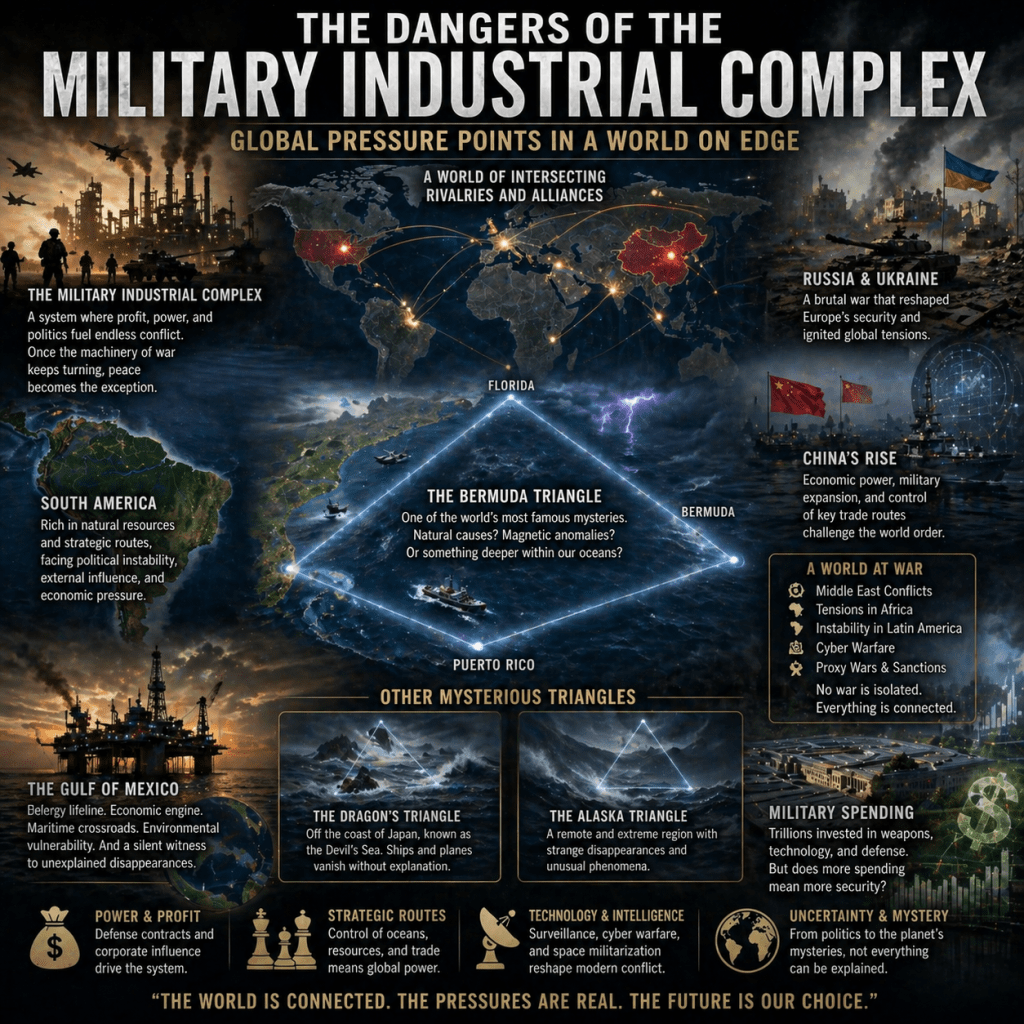
The Military-Industrial Complex and a World Under Strain
April 21, 2026
For decades analysts have warned about the growing influence of the military-industrial complex, a term popularized during the Cold War to describe the powerful relationship between governments, armed forces, and defense industries. When national security becomes intertwined with corporate profit and geopolitical rivalry, the result can be a world constantly balanced on the edge of conflict.
Modern military systems are no longer simply about defending borders. They involve massive global supply chains, advanced weapons technologies, intelligence networks, and economic alliances that stretch across continents.
The danger, critics argue, is that the machinery of defense can develop its own momentum. Once industries, jobs, and political influence become tied to military spending, reducing tensions becomes more difficult.
At the same time, global pressures continue to rise.
South America and the Quiet Strategic Pressure
Much of the public conversation about world conflict focuses on Europe or the Pacific. Yet analysts increasingly point to South America and the Gulf regions as areas of growing strategic importance.
Natural resources, shipping routes, and political instability make the broader Atlantic and Gulf regions key pressure points in global power dynamics. Energy routes, narcotics trafficking corridors, and maritime security concerns all intersect there.
The Gulf of Mexico and nearby waters sit at the crossroads of international trade, energy production, and environmental vulnerability. At the same time, the region is close to the infamous area often referred to as the Bermuda Triangle, a stretch of ocean that has long captured public imagination due to reports of unusual navigational incidents and disappearances.
While most scientists attribute these events to natural causes such as weather patterns, magnetic anomalies, or human error, the area remains one of the most discussed maritime mysteries in modern folklore.
In a world already filled with geopolitical tension, mysterious locations tend to attract even more speculation.
Global Rivalries in the 21st Century
The modern strategic landscape is shaped by several overlapping rivalries.
The ongoing war between Russia and Ukraine has reshaped European security and forced nations across the world to reconsider military alliances and defense spending.
Meanwhile, the rapid rise of China as a technological and economic power has created new tensions in the Pacific and beyond. Disputes over trade routes, military presence, and global influence continue to shape international relations.
Conflicts in the Middle East, regional tensions in Africa, and political instability in parts of Latin America add further complexity to the global picture.
In the modern era, wars are rarely isolated. Economic systems, digital infrastructure, and international alliances mean that even distant conflicts can affect the entire planet.
The Mystery of Global “Triangles”
Beyond geopolitics, another unusual theme sometimes appears in discussions about global anomalies: the idea of mysterious triangular zones across the world.
The most famous is the Bermuda Triangle, located roughly between Florida, Bermuda, and Puerto Rico. For decades stories have circulated about ships and aircraft disappearing within this region.
Other areas sometimes mentioned in similar discussions include the so-called Dragon’s Triangle near Japan, also known as the Devil’s Sea, where unusual maritime events have occasionally been reported.
Researchers generally attribute these incidents to natural explanations—extreme weather, ocean currents, methane gas releases, and navigational challenges.
Still, the repeated appearance of triangular zones in maritime folklore has kept public curiosity alive.
Some observers even wonder whether certain regions of the planet may have unusual geological or magnetic characteristics that affect navigation and communication.
For now, most of these ideas remain speculative.
A World of Intersecting Pressures
What becomes clear when examining modern geopolitics is that pressure points exist everywhere.
Energy supply chains, shipping lanes, military alliances, economic rivalries, and even unexplained environmental phenomena intersect in ways that shape global stability.
The military-industrial complex operates within this landscape, responding to perceived threats while sometimes amplifying them.
Meanwhile, regions like the Gulf, South America, and the Atlantic remain strategic crossroads where commerce, security, and mystery converge.
Between Security and Stability
The challenge facing modern societies is balancing legitimate defense needs with the desire for long-term stability.
Technology has made warfare more powerful than at any point in human history. At the same time, communication networks allow information—and misinformation—to spread instantly across the globe.
Understanding the complex forces shaping global conflict requires examining not only military alliances and economic power but also geography, history, and the persistent mysteries of the planet itself.
Whether discussing geopolitical rivalries or strange maritime triangles, one truth remains clear.
The world is deeply interconnected, and the forces shaping it rarely operate in isolation.
 The ChillX Zone
Leave a comment