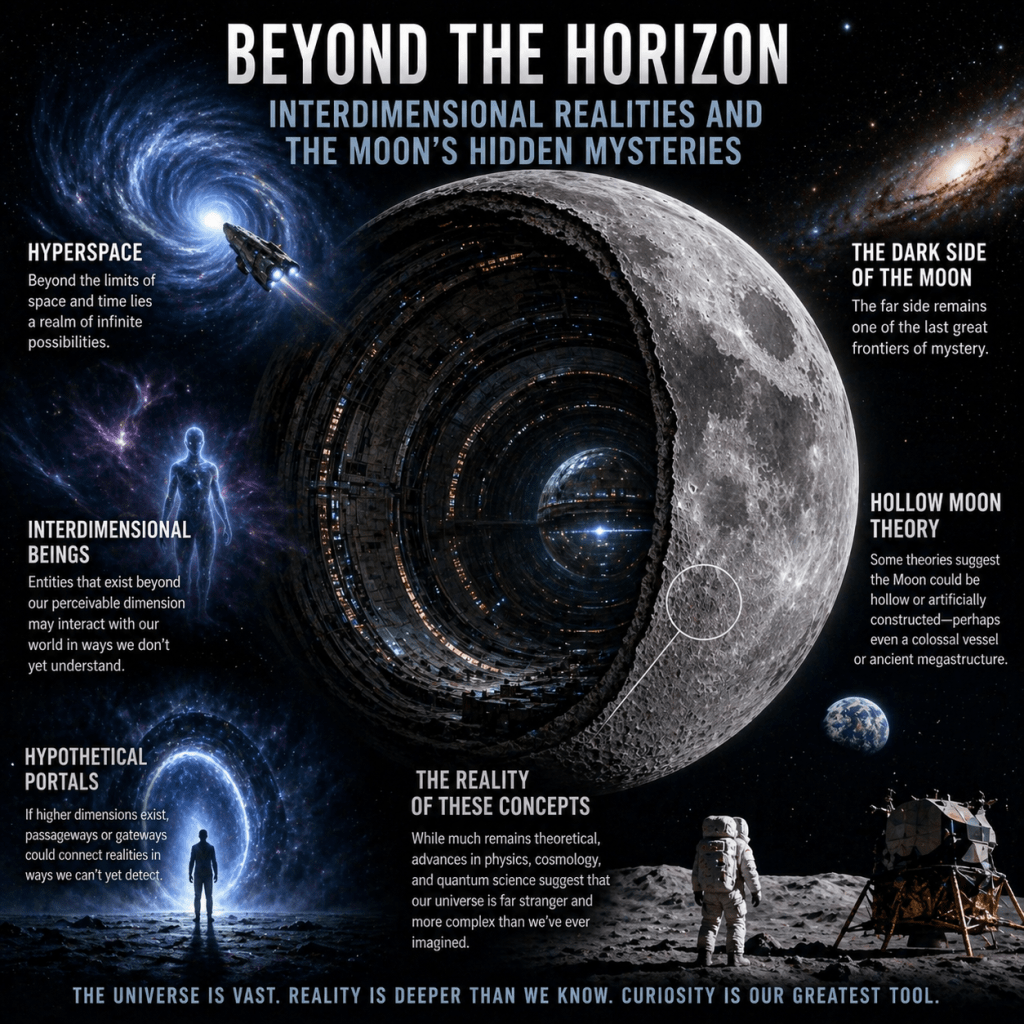
When Science and Speculation Meet
April 24, 20206
For decades, scientists, physicists, and curious observers have explored ideas that once sounded like pure science fiction: hyperspace, additional dimensions, and realities existing beyond the three dimensions we experience every day.
While many of these ideas remain theoretical, they are not purely imaginary. Modern physics increasingly acknowledges that the universe may contain more dimensions than the ones humans can directly perceive.
Concepts like higher dimensions and hyperspace appear in advanced theoretical frameworks such as string theory and cosmology. These models attempt to explain how gravity, space, and time behave at both the largest and smallest scales of the universe.
The idea is simple but profound: reality might be layered.
Hyperspace and Hidden Dimensions
Hyperspace is often described as a higher-dimensional space that exists beyond the familiar dimensions of length, width, height, and time.
In theoretical physics, hyperspace can refer to additional spatial dimensions that are folded or hidden within the fabric of the universe. These dimensions may be incredibly small or exist in ways that human senses cannot detect directly.
If such dimensions exist, they could potentially allow forms of movement or communication that operate differently from the physical limits we know.
Some researchers speculate that advanced civilizations—if they exist somewhere in the cosmos—might understand these dimensions far better than humanity does today.
The idea raises an intriguing possibility: what humans sometimes interpret as unexplained phenomena could involve interactions with dimensions not yet understood.
Interdimensional Beings: A Question of Perception
The concept of interdimensional beings often appears in paranormal discussions and speculative science.
These hypothetical entities would exist partially or entirely in dimensions outside the ones humans perceive. If such beings existed, they might appear and disappear from our perspective simply because they move through dimensions that we cannot observe.
While there is currently no confirmed scientific evidence for interdimensional life forms, the theory reflects a broader question: if reality contains more dimensions, could forms of life exist within them?
Scientists already acknowledge that life on Earth thrives in environments once thought impossible—deep ocean vents, extreme radiation zones, and frozen polar regions.
The universe may still hold surprises about where and how life can exist.
The Moon’s Strange Characteristics
Earth’s moon has long attracted speculation from scientists and observers alike.
The side of the moon that always faces away from Earth—the so-called far side of the Moon—remained unseen until spacecraft photographed it in the mid-20th century. Its landscape is dramatically different from the side visible from Earth.
Another curiosity involves the Moon’s internal structure. Some early seismic experiments conducted during the Apollo missions produced vibrations that lasted longer than expected when equipment or modules impacted the surface.
These results led to colorful descriptions that the Moon “rang like a bell,” though modern research generally explains the phenomenon through the Moon’s dry, rigid geology rather than suggesting it is hollow.
Still, the Moon’s formation and structure remain areas of active scientific study. The most widely accepted theory is that the Moon formed from debris after a massive collision between early Earth and another planetary body billions of years ago.
Yet mysteries remain—about its composition, its orbital stability, and its unique relationship with Earth.
Between Curiosity and Evidence
Speculation about hollow moons, hidden bases, or interdimensional gateways often appears in popular culture and conspiracy discussions. While these ideas capture imagination, they remain unverified.
What is certain is that the universe is far stranger than early scientists imagined.
Black holes bend space-time. Quantum particles appear to behave unpredictably. Entire galaxies move through cosmic structures that stretch across unimaginable distances.
In that context, curiosity about hyperspace, extra dimensions, and unknown forms of reality is not unreasonable.
Human understanding of the universe is still developing.
Touching the Edge of the Unknown
The discussion of hyperspace, interdimensional realities, and the deeper mysteries of the Moon reflects something fundamental about human nature.
People have always looked beyond the horizon—first across oceans, then across planets, and now across dimensions of possibility.
Whether these ideas eventually prove to be physical realities or simply stepping stones toward better scientific understanding, they remind us that the universe remains largely unexplored.
And sometimes, even a brief conversation about the unknown is enough to keep curiosity alive.
 The ChillX Zone
Leave a comment