From a Simple Code to a Worldwide Phenomenon
April 20, 2026
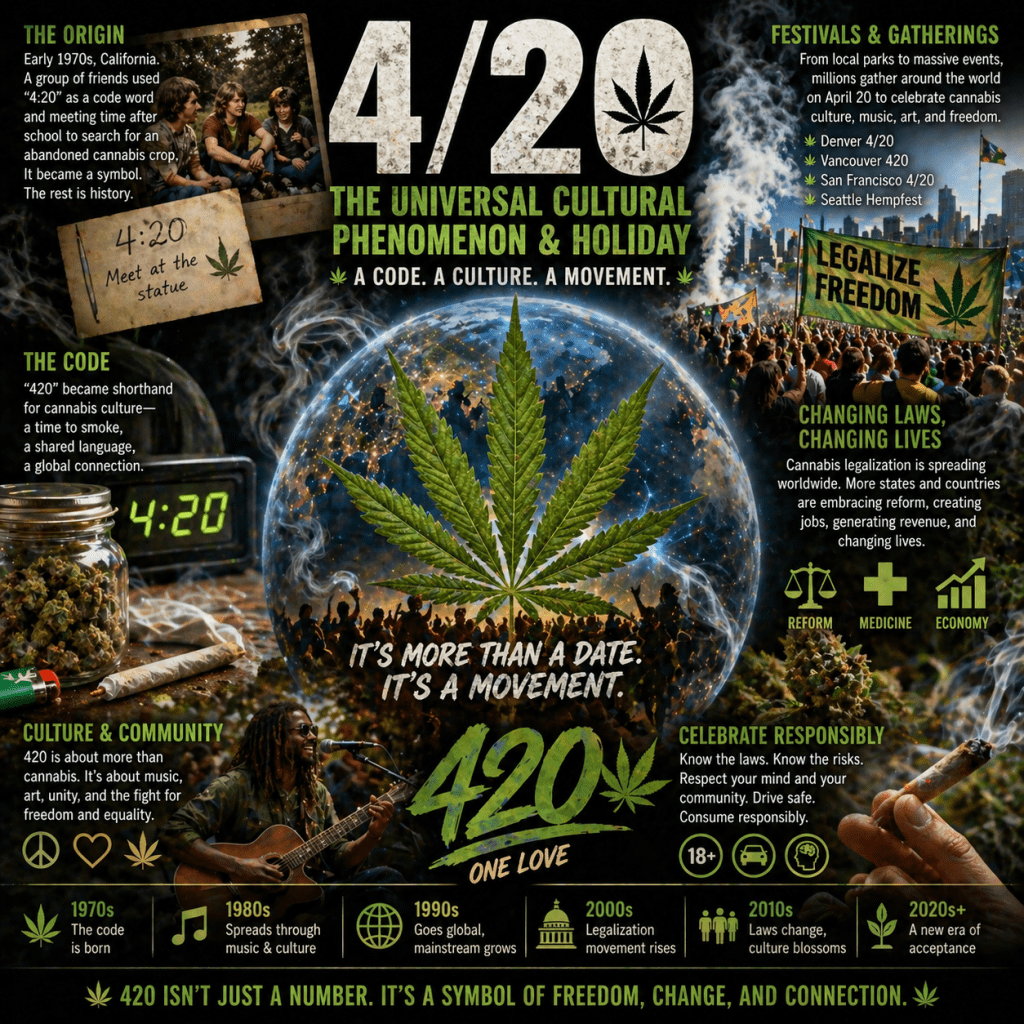
Every year on April 20, millions of people across the world recognize a date that began as a simple code between friends. Known universally as “420,” the number has grown into a cultural symbol tied to marijuana culture, legalization movements, music festivals, and social gatherings.
What started as a quiet inside joke eventually transformed into a widely recognized day of celebration. Today, parks, music venues, and public spaces in cities across North America and beyond host gatherings where cannabis enthusiasts mark the occasion together.
The phrase “420” has become shorthand for an entire cultural movement.
The Origins of the Code
The story most commonly linked to the origin of 420 traces back to the early 1970s in California. A group of high school students reportedly used the term “4:20” as a meeting time after school to search for an abandoned cannabis crop.
Although they never found the plants, the phrase stuck. Over time, it evolved into a code among friends that simply meant it was time to smoke.
As the phrase spread through music communities and counterculture circles, it eventually became linked with April 20 itself—4/20 on the calendar.
By the 1990s, the code had spread widely enough that it was recognized across the United States and eventually internationally.
Festivals, Gatherings, and Modern Celebrations
Today, 420 is celebrated in a variety of ways.
Large public gatherings often take place in cities where cannabis laws permit open consumption. Some of the most famous celebrations historically occurred in places like:
- Denver, Colorado
- Vancouver, Canada
- San Francisco, California
- Seattle, Washington
Events often include music, art, food vendors, and advocacy organizations promoting cannabis reform.
For many participants, the day is not only about consumption but also about community and political awareness. Activists frequently use 420 gatherings to discuss legalization policies, medical cannabis research, and criminal justice reform.
Changing Laws and Cultural Shifts
Over the past decade, cannabis laws have changed dramatically in many parts of the world.
Several U.S. states and countries have legalized recreational marijuana, while many others allow medical use under regulated systems. This shift has transformed what was once a hidden counterculture into a rapidly expanding legal industry.
Dispensaries, cannabis tourism, and regulated markets now generate billions of dollars in economic activity annually.
What was once a rebellious symbol has gradually entered the mainstream.
The Balance Between Celebration and Responsibility
Despite its popularity, the rise of cannabis culture also raises important questions.
Public health experts continue to study the effects of marijuana on mental health, memory, and long-term brain development. Concerns about impaired driving, youth access, and substance dependency remain part of the conversation.
Responsible use, age restrictions, and public education have become key topics as legalization spreads.
For supporters and critics alike, the rapid cultural shift surrounding cannabis represents a major social experiment unfolding in real time.
A Symbol of Cultural Change
What makes 420 unique is how a simple number evolved into a global cultural signal.
It represents decades of shifting attitudes about law, personal freedom, medicine, and social norms. It also shows how underground language can become part of everyday culture.
For some, 420 is a day of celebration.
For others, it represents political reform.
And for many, it is simply a reminder of how culture evolves in unexpected ways.
From a coded meeting time after school to a worldwide cultural date, 420 remains one of the most unusual holidays to emerge from modern counterculture.
 The ChillX Zone
Leave a comment