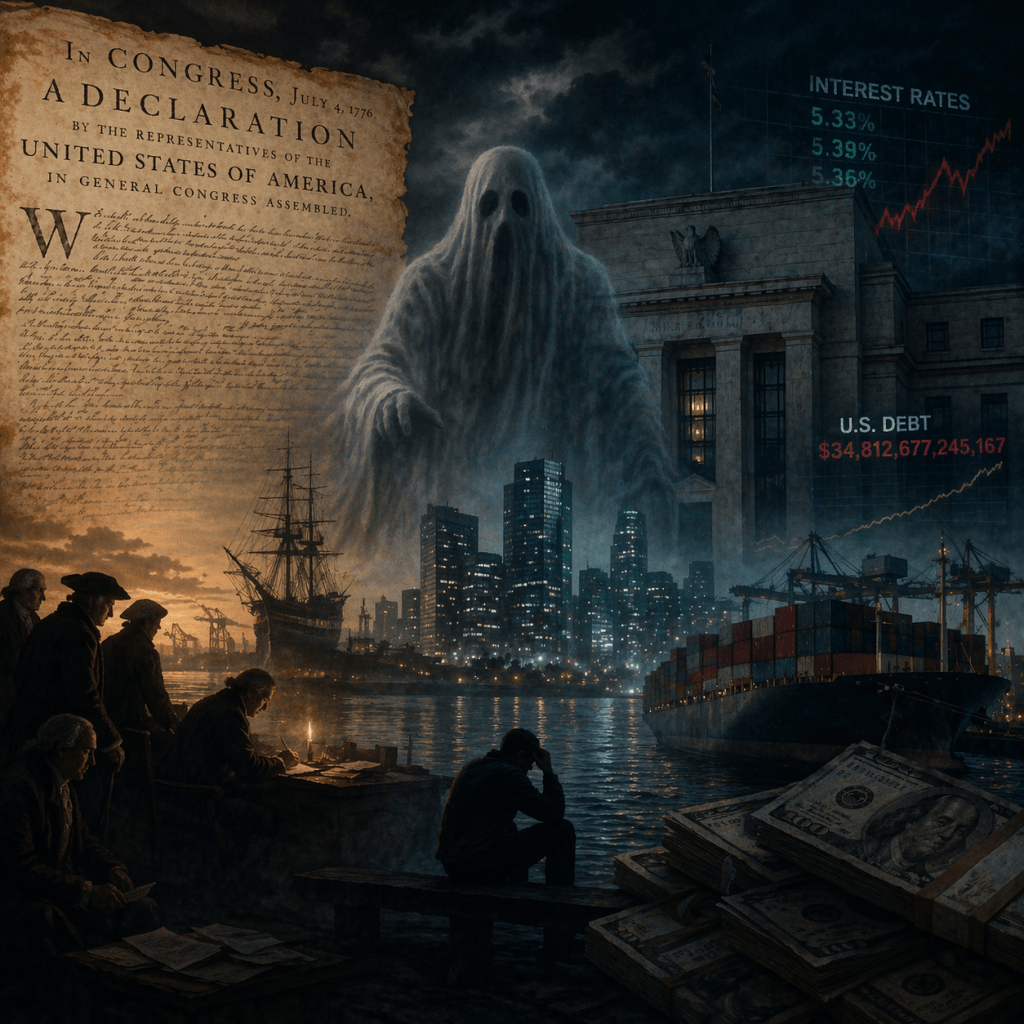
How high interest rates, overseas money flows, and the quiet erosion of founding ideals create a strange political haunting in the American economy.
April 14, 2026
Every era has its invisible pressures.
In the 18th century, they were imperial taxes and distant monarchs. Today they arrive as interest rates, capital flows, bond markets, and international debt structures. They are abstract forces—mathematical and financial—yet they shape everyday life as powerfully as armies once did.
For millions of Americans, the current economic moment carries a strange psychological tone. Mortgage payments rise. Credit becomes more expensive. Small businesses hesitate. At the same time, enormous sums of money circulate through global systems far removed from the people who produce the underlying wealth.
In political commentary this is simply called monetary policy.
But culturally, it produces something closer to a haunting.
A lingering sense that something fundamental about the American promise is being quietly contradicted.
The Interest Rate Apparition
High interest rates are typically explained as a tool to slow inflation. When borrowing becomes expensive, spending slows, and the economy cools.
Yet interest rates also operate as a kind of gravitational force in the financial world. They redirect enormous rivers of money toward lenders, bondholders, and financial institutions.
For ordinary citizens, the experience can feel uncanny. Money that once fueled local growth—homes, businesses, infrastructure—suddenly drains into financial channels that feel distant and abstract.
A mortgage payment becomes less about owning a home and more about feeding a system of compounding obligations.
The result is a subtle psychological shift. People feel as though their labor produces wealth that vanishes into invisible structures. Economists may describe this in charts and balance sheets.
But culturally, it resembles something older: tribute.
The Overseas Current
In a globalized financial system, capital rarely stays where it is created. Investment funds, sovereign debt holdings, military spending abroad, and multinational supply chains move trillions of dollars across borders every year.
On paper, these flows are simply the mechanics of international trade and finance.
But historically, Americans have been deeply sensitive to the idea of wealth extracted by distant power structures.
One of the grievances that fueled the American Revolution was precisely this phenomenon: colonists believed their labor and resources were being drained by imperial policies designed elsewhere.
Today the process is more complicated and far less visible. Money flows through international bond markets, multinational corporations, and global institutions rather than royal treasuries.
Yet the psychological echo remains.
To many observers, the system can feel like an empire operating without a visible emperor.
The Money We Do Not Make
Another strange feature of modern finance is how often nations borrow money rather than directly creating it for domestic development.
In theory, governments can generate economic activity through investment in infrastructure, manufacturing, science, and public works—projects that create real productivity.
When money is instead borrowed at high interest, a portion of future economic output is effectively pre-committed to repayment.
This creates a long shadow across the economy.
Businesses delay expansion. Public projects shrink. Citizens feel the pressure of rising costs without always understanding the mechanism behind them.
Economists debate these policies endlessly.
But culturally, the dynamic can feel like living inside a system designed to extract value rather than cultivate it.
The Declaration’s Ghost
The United States was born from a document that framed political power in moral language.
The Declaration of Independence did not merely complain about taxes or trade restrictions. It argued that governments exist to protect the natural rights of the people and derive their legitimacy from consent.
It also contained a deeper accusation: that a distant authority had constructed systems of control that operated without meaningful representation.
That accusation echoes strangely in modern debates about financial governance.
Interest rate decisions are made by central institutions. Global capital flows respond to forces few citizens can influence. International economic obligations shape domestic policy.
No monarch stands behind these systems. No empire formally claims them.
Yet the structure sometimes produces the same emotional reaction the colonists once described—rule by mechanisms that feel distant from the everyday lives of the people.
The Counter-Impact
The modern American system operates very differently from the world of 1776. It is a democratic republic embedded in a complex global economy.
But the tension between founding ideals and modern realities continues to surface.
The Declaration promised a government accountable to the people. Modern financial systems often operate at scales and speeds that seem to exceed ordinary democratic control.
This contradiction does not create literal ghosts.
But it does create a political haunting: the persistent return of the founding question.
Who ultimately benefits from the systems that govern economic life?
And who truly holds the power to change them?
The Paranormal Feeling of Economics
In the end, the word “paranormal” may describe not supernatural forces but the emotional experience of confronting systems too large to see clearly.
Interest rates move. Markets respond. Trillions of dollars shift through invisible networks.
People feel the effects in rent payments, grocery prices, and job security, but the mechanisms remain abstract.
Like a haunting, the influence is everywhere and nowhere at once.
And somewhere in the background, the words written in Philadelphia in 1776 continue to echo—reminding the country that the legitimacy of power ultimately depends on the consent and prosperity of the people it governs.
 The ChillX Zone
Leave a comment