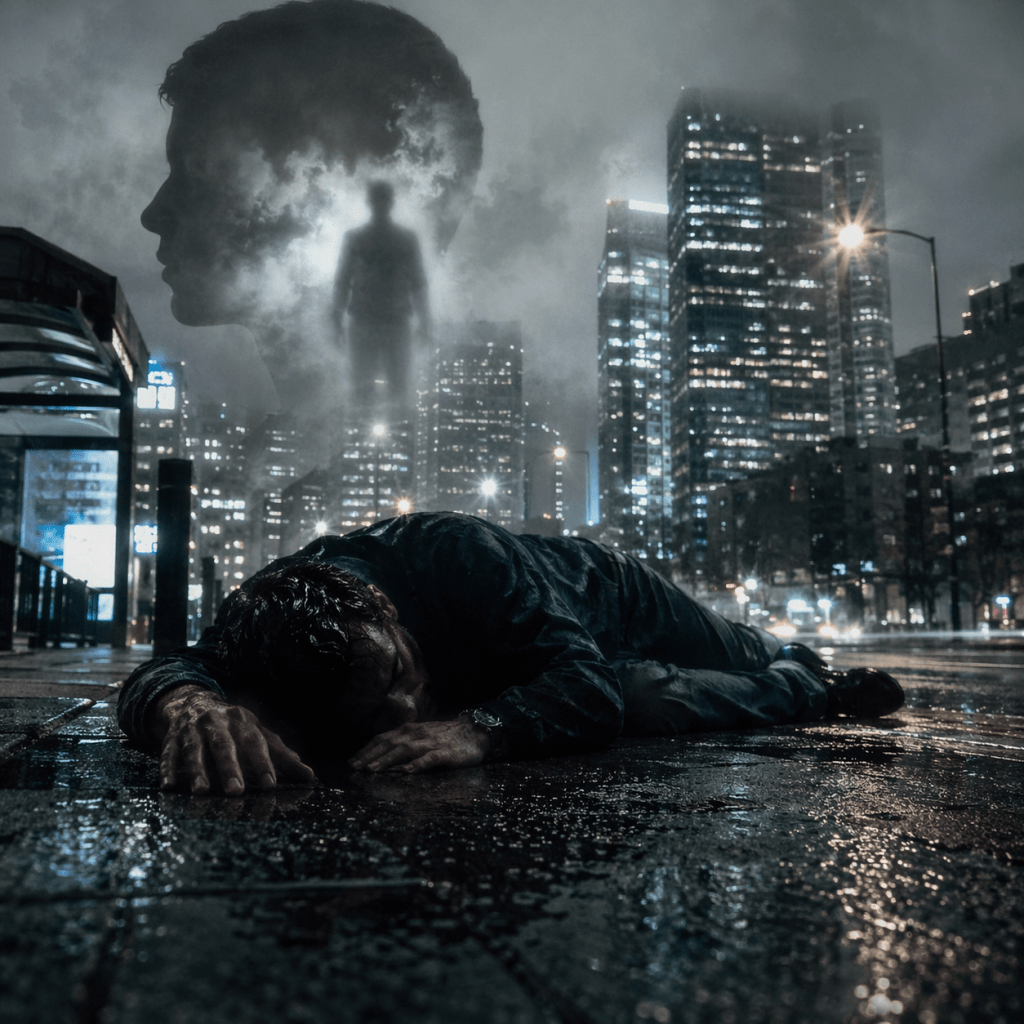
Humanity’s New Ground
April 15, 2026
Never before in human history has a species spent its entire life on surfaces this hard.
For most of the roughly 300,000 years that modern humans have existed, the ground beneath our feet was forgiving—soil, grass, sand, forest duff. Our bodies evolved to walk, run, fall, and heal in environments that absorbed impact. The modern city changed that in little more than a century. Today, billions of people spend nearly every waking moment on asphalt, concrete, steel, and tile.
The urban ground does not give way. It reflects force back into the body.
Orthopedic researchers have documented rising rates of stress fractures, spinal compression, joint deterioration, and repetitive-impact injuries in dense urban populations. But another pattern—less easily measured—has quietly followed the spread of the concrete metropolis: clusters of unexplained experiences reported after traumatic injury.
Across emergency rooms, rehabilitation clinics, and long-term recovery wards, patients sometimes describe moments that do not fit neatly within medicine. Apparitions. Voices. Premonitions. A sense of presence. The question is not whether such stories exist—they are surprisingly common—but why they appear most often at the intersection of injury, shock, and modern urban life.
Impact and the Body’s Electrical Storm
The human body is an electrical system as much as a mechanical one. Every thought, movement, and sensation is mediated by bioelectrical signals flowing through nerves and across synapses.
A sudden fall onto concrete delivers forces the body did not evolve to absorb. Even relatively minor accidents can produce concussive forces that ripple through the brain and nervous system.
Neurologists describe the aftermath as a “temporary electrical storm.” The brain releases surges of neurotransmitters, neural pathways fire erratically, and sensory processing becomes unstable. In most cases the system stabilizes quickly. In others, the disruption produces vivid perceptions that feel external and real.
Many emergency physicians quietly acknowledge the phenomenon. Patients recovering from head trauma sometimes report seeing figures standing at the foot of their bed, hearing footsteps in empty hallways, or sensing people who are not present.
Clinically, these experiences are categorized as post-traumatic hallucinations.
But culturally—and historically—they are often interpreted differently.
Injury and the Threshold State
Across cultures, bodily injury has long been associated with altered perception and paranormal encounters. Shamans in Siberia, prophets in ancient Greece, and visionaries throughout history frequently described life-changing revelations following illness or trauma.
Anthropologists call this the “threshold state”—a period when the mind is suspended between ordinary consciousness and something stranger.
Urban injury may produce a modern version of that threshold.
Emergency room case notes occasionally include accounts that read less like medical reports and more like ghost stories. Patients who have suffered concussions or severe fractures sometimes describe seeing deceased relatives in waiting rooms, hearing warnings moments before medical complications occur, or dreaming of events that later appear to unfold.
Doctors generally attribute these experiences to neurological stress. Yet the consistency of certain patterns—particularly the sensation of an unseen presence during recovery—has kept the subject quietly circulating among both medical professionals and paranormal researchers.
Concrete, Concussion, and the Modern Ghost Story
Urban legends often begin where trauma meets memory.
In cities across the world, clusters of paranormal stories frequently emerge around sites of repeated accidents—subway platforms, stairwells, parking garages, and long concrete corridors where falls and injuries occur with disturbing regularity.
Witness accounts sometimes follow a similar structure. A person slips on hard pavement or tumbles down stairs, suffers a brief loss of consciousness, and later recalls seeing someone nearby who helped them—someone who disappears when others arrive.
These figures are described with strange consistency: silent observers, shadowy helpers, or strangers who vanish before they can be thanked.
Skeptics argue these are simply the brain’s attempt to reconstruct fragmented memory during trauma. But believers see something else: moments when the boundary between worlds briefly thins.
Whether neurological artifact or genuine anomaly, the experience leaves a lasting imprint on those who report it.
The Body as a Paranormal Trigger
Paranormal researchers have long speculated that extreme physiological states—near-death experiences, severe injury, or intense stress—may alter human perception in ways that make unusual phenomena more likely.
Some theories suggest that trauma temporarily disrupts the brain’s normal filtering systems, allowing sensory information normally suppressed by the mind to surface. Others speculate that heightened electromagnetic activity in injured neural tissue could interact with environmental fields in unpredictable ways.
While these ideas remain speculative, one observation appears repeatedly in case reports: paranormal experiences tend to cluster around moments when the body is under extreme strain.
In that sense, the concrete metropolis may function as an unintentional laboratory. Hard surfaces increase the severity of falls, collisions, and concussions. Those injuries, in turn, create the neurological conditions under which strange perceptions sometimes occur.
The city becomes both the stage and the trigger.
Living on Unforgiving Ground
Urban planners rarely consider the psychological or neurological consequences of living entirely on hard surfaces. Their concerns are structural efficiency, drainage, traffic flow.
Yet the physical reality of the concrete metropolis subtly reshapes the human body. Joints absorb greater shock. Falls are harsher. Injuries more abrupt.
And occasionally, in the quiet hours after an accident—lying in a hospital bed, drifting between consciousness and sleep—people report experiences that feel profoundly real but remain difficult to explain.
Perhaps they are simply artifacts of a stressed brain recovering from impact.
Or perhaps the modern city, by forcing human bodies into constant collision with unforgiving ground, has unintentionally opened new thresholds in human perception.
Either way, the stories persist—echoing through emergency wards, rehabilitation centers, and the hidden folklore of urban life.
On the hardest surfaces humanity has ever known, the boundary between the physical and the mysterious sometimes feels thinner than expected.
 The ChillX Zone
Leave a comment