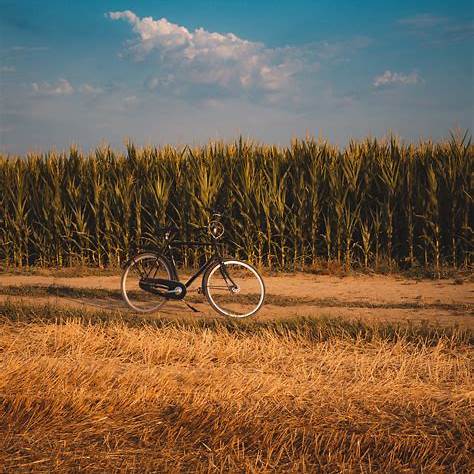
A Rift in the Cornfields?
FULTON COUNTY, Ohio (July 19, 2025) — It was nine years ago today.
On the evening of July 19, 2016, 20-year-old college student Sierah Joughin disappeared while riding her bicycle home along a quiet stretch of farmland in western Ohio.
It was a familiar route, not far from home.
She never made it home.
What followed was one of the most disturbing murder investigations in modern Ohio history. Investigators eventually identified James Worley as her killer. He was convicted of kidnapping and murdering Joughin and sentenced to death.
There is no unsolved mystery about who committed the crime.
And yet, even knowing the answer, something about what happened along County Road 6 feels almost inhuman.
But a human being did it.
A Scene Too Quiet
That evening, a passing motorist noticed Joughin’s bicycle beside County Road 6 and a man several rows inside the cornfield.
As the search unfolded, investigators found evidence of a violent encounter: disturbed corn, blood, sunglasses, motorcycle tracks, and other items later connected to the abduction. A bloodstained motorcycle helmet was also recovered along the road.
There was no mysterious disappearance into thin air.
Something terrible had happened in an otherwise ordinary patch of Ohio farmland.
Perhaps that is what makes the case so unsettling.
There was no abandoned mansion. No haunted forest. No forgotten ruin from an old folktale.
Just a country road.
A field of corn.
And darkness coming on.
The Barn
The investigation soon led authorities to Worley, who lived nearby and had previously been convicted of attempting to abduct another woman.
A search of his property uncovered restraints and other disturbing evidence. Forensic evidence connected him to Joughin and to the site of her abduction.
Three days after she disappeared, Joughin’s body was found.
Worley was eventually convicted of kidnapping and murdering her.
The evidence points to a human crime—calculated, brutal, and terribly real.
Yet crimes like this leave behind a question far older than any police investigation:
How does an ordinary place become the setting for something so inhuman?
Old Ground, Older Stories
There is no known old ghost story specifically attached to County Road 6.
But Fulton County has never been entirely without strange history—or strange stories.
Not far away, Winameg occupies ground with a history reaching far beyond the modern roads and cornfields. Old burial mounds there were investigated during the nineteenth century, their origins becoming part of the early historical record and speculation surrounding the area.
Then came the folklore.
Stories collected around Winameg tell of a phantom black dog appearing suddenly before motorists. According to the legend, drivers believe they have struck the animal, only to stop and discover nothing there.
Other tales describe a little girl appearing near the woods before vanishing.
Elsewhere in Fulton County, Goll’s Cemetery and Goll Woods have accumulated stories of their own—mysterious lights around old graves and apparitions reportedly glimpsed among the trees.
These are local legends, not established supernatural events.
And none has any documented connection to Sierah Joughin or her murder.
But they reveal something about the character of the landscape.
This is rural Middle America: old burial grounds and newer cemeteries, farms, woods, barns, crossroads, and endless fields occupying the same ground generation after generation.
History accumulates.
So does folklore.
A cemetery acquires a mysterious light. A phantom animal appears on a lonely road. A figure is glimpsed between the trees.
And when something genuinely terrible happens, an ordinary place can become something else.
A field becomes that field.
A barn becomes that barn.
A road becomes that road.
Something We Still Cannot Explain
There is an old belief that places can absorb what happens within them—that violence, fear, and death can somehow leave an impression behind.
Paranormal traditions have given that idea many names. Folklore speaks of cursed ground, restless spirits, possession, and places where something simply feels wrong.
There is no evidence that any supernatural force caused James Worley to murder Sierah Joughin.
Worley was human.
He made his choices.
He committed the crime.
But separating the human being from the nature of the act leaves an uncomfortable question.
We can identify who committed it. We can reconstruct how it happened. We can follow the evidence from a bicycle in a cornfield to a nearby property, a barn, an arrest, and finally a conviction.
Those things explain the crime.
They do not completely explain the act.
How does one human being cross that boundary?
How does something almost unthinkable occur on an ordinary summer evening, along an ordinary country road, between ordinary fields?
For centuries, people reached for words such as evil, possession, curse, or darkness when human behavior seemed to pass beyond comprehension.
Today we use different language.
But perhaps we should not confuse having better words with having every answer.
Something happened on County Road 6.
A human being caused it.
Nothing supernatural had to occur.
And yet something so profoundly inhuman did occur.
Why human beings are capable of crossing that line is a question we can describe psychologically, socially, and criminally—but perhaps not yet explain completely.
That unexplained space is where folklore has always lived.
Today
Tonight, as the sun sets over Fulton County, the cornfields will turn gold before disappearing into darkness.
Cars will travel County Road 6. Farmhouses will illuminate the horizon. The fields will move in the summer wind much as they did nine years ago.
There is no evidence of a rift in those cornfields.
No documented curse beneath the soil.
No known phantom waiting along County Road 6.
There was a man.
There was an act.
And perhaps understanding the first does not mean we completely understand the second.
Something terrible entered that cornfield on July 19, 2016.
It may have felt inhuman.
The person who committed it was not.
And perhaps that is the part we are still trying to understand.


Leave a comment