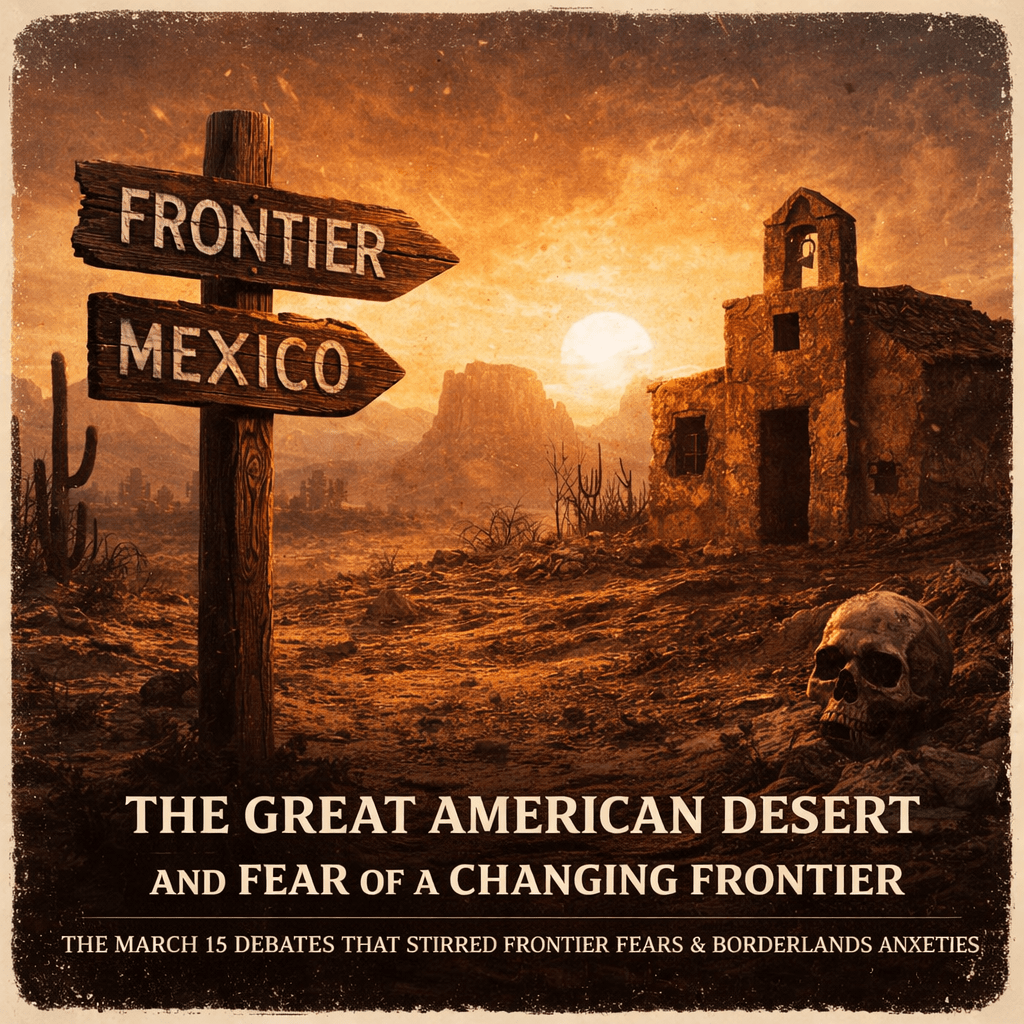
Debates That Fueled Fears About the Future of the American West
March 15, 2026
During the mid-1800s, the American frontier was often described as an endless wilderness stretching far beyond the Mississippi River. But by the late nineteenth century, many Americans began to worry that the frontier itself was disappearing. On March 15, 1893, historian Frederick Jackson Turner finalized key arguments that would soon appear in his influential frontier thesis, presented later that year at the World’s Columbian Exposition in Chicago.
Turner argued that the American frontier—the vast wilderness that had shaped the nation’s identity—was effectively gone. According to the United States Census Bureau, the 1890 census had already declared that the frontier line no longer existed.
For many Americans, this announcement was deeply unsettling. The frontier had long been seen as a symbol of opportunity, independence, and expansion. Its disappearance raised questions about what the country’s future identity would become.
The Shadow of the Borderlands
As settlers moved westward throughout the nineteenth century, they entered lands that had once been part of Mexico and earlier Spanish territories. After the Mexican–American War, the United States gained vast regions including California, Arizona, New Mexico, Nevada, and parts of Texas.
These areas were culturally complex borderlands where Spanish, Mexican, and Indigenous traditions blended with American settlement. Throughout the late 1800s, political writers and commentators sometimes warned about what they called the “Mexicanization” of certain frontier regions—an expression reflecting anxieties about shifting demographics, cultural influence, and border identity.
While the phrase was controversial and often exaggerated, it appeared in newspapers and political debates discussing immigration, land ownership, and the cultural transformation of the American Southwest.
A Region of Myth and Mystery
The borderlands of the American Southwest also developed a reputation for strange disappearances and unexplained events in remote wilderness areas. Travelers, prospectors, and settlers often vanished while crossing deserts, mountain passes, or vast stretches of uncharted land.
Stories circulated about ghost towns, lost mines, and mysterious disappearances in places like the Sonoran Desert and the Chihuahuan Desert. Some explorers simply became lost in the unforgiving terrain, while others were victims of bandits, harsh weather, or isolation.
Over time, these stories blended history with legend, giving the American frontier an aura of mystery long after the official frontier line had vanished.
The End of the Frontier Era
The declaration that the frontier had disappeared marked a turning point in American history. The era of constant westward expansion had ended, and the nation began shifting toward industrial growth and global influence.
Yet the myths of the frontier—its wilderness, its dangers, and its cultural crossroads—continue to shape American imagination. The deserts, borderlands, and remote wilderness areas where cultures once collided remain places where history, legend, and mystery often overlap.
 The ChillX Zone
Leave a comment