The Massive Calendar Stone Unearthed
March 12, 2026
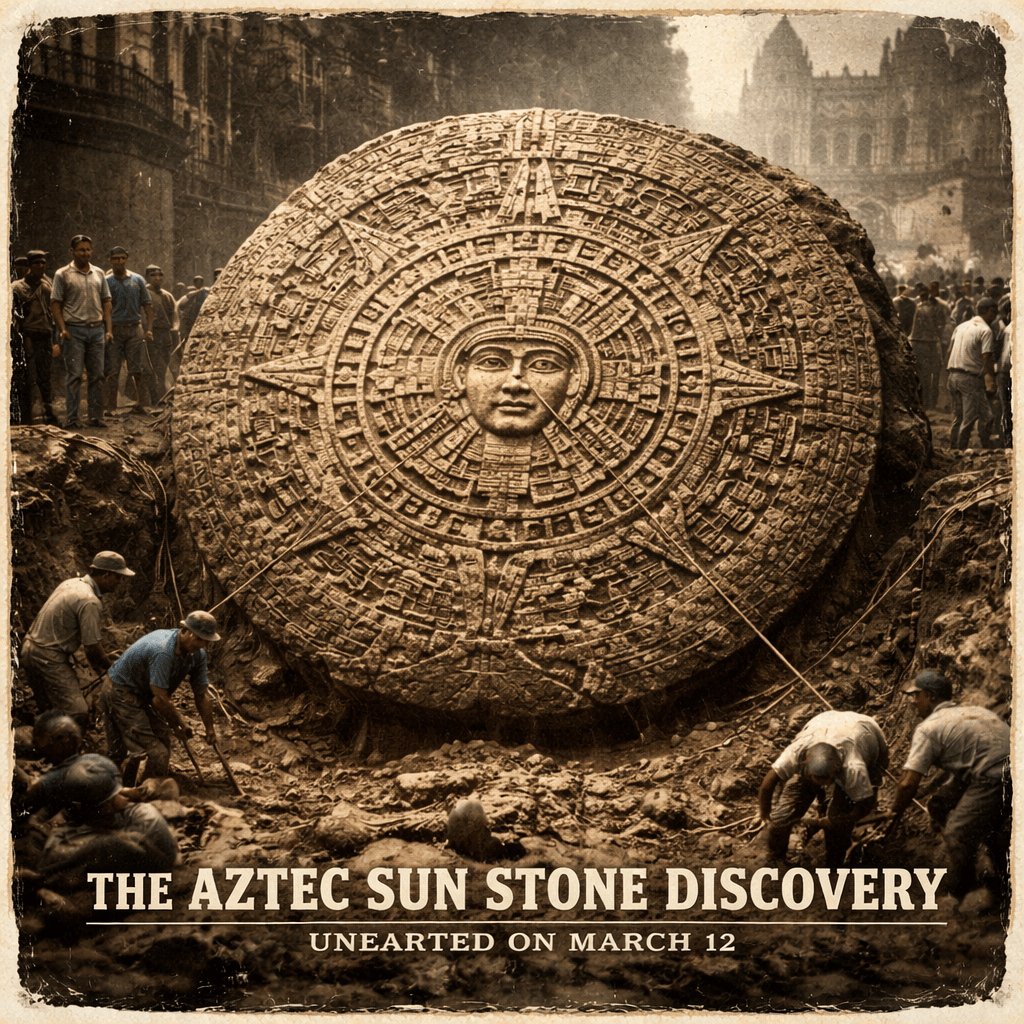
On March 12, 1790, workers in Mexico City made one of the most important archaeological discoveries in the history of the Americas. While repairing the main square of the city, known today as the Zócalo, laborers uncovered a massive circular stone buried beneath the ground. The enormous carving, weighing more than 24 tons and measuring nearly 12 feet in diameter, would later become known as the Aztec Sun Stone.
The discovery shocked historians and scholars of the time. The Spanish conquest of the Aztec Empire in the 1500s had led to the destruction or burial of many indigenous monuments, and for centuries much of Aztec culture remained hidden beneath the colonial city built on top of the former capital, Tenochtitlán.
A Calendar Carved in Stone
The Sun Stone is often mistakenly called the Aztec Calendar, but it is actually far more complex. The massive carving represents the Aztec understanding of time, the cosmos, and the cycles of creation and destruction that governed their worldview.
At the center of the stone is the face of the sun god Tonatiuh, surrounded by intricate symbols representing previous ages of the world. According to Aztec mythology, the universe had been created and destroyed several times before the current era. Each ring of carvings on the stone reflects these cycles and the sacred calendar used by the Aztec civilization.
The craftsmanship of the Sun Stone amazed researchers. Despite being carved centuries earlier, the level of detail and symmetry showed the advanced knowledge the Aztecs possessed in astronomy, mathematics, and religious symbolism.
A Window Into a Lost Civilization
The discovery on March 12 helped change how historians understood the Aztec Empire. Before the stone was uncovered, much of what Europeans believed about the Aztecs came from Spanish colonial accounts. The Sun Stone provided physical evidence of a highly sophisticated culture with deep spiritual traditions and complex scientific knowledge.
Today, the Aztec Sun Stone is one of the most famous artifacts of ancient Mesoamerica. It is displayed in the National Museum of Anthropology in Mexico City and remains a powerful symbol of Mexican heritage and indigenous history.
The moment workers uncovered the massive carving in 1790 revealed that beneath the streets of Mexico City lay the remnants of an entire civilization waiting to be rediscovered.
 The ChillX Zone
Leave a comment