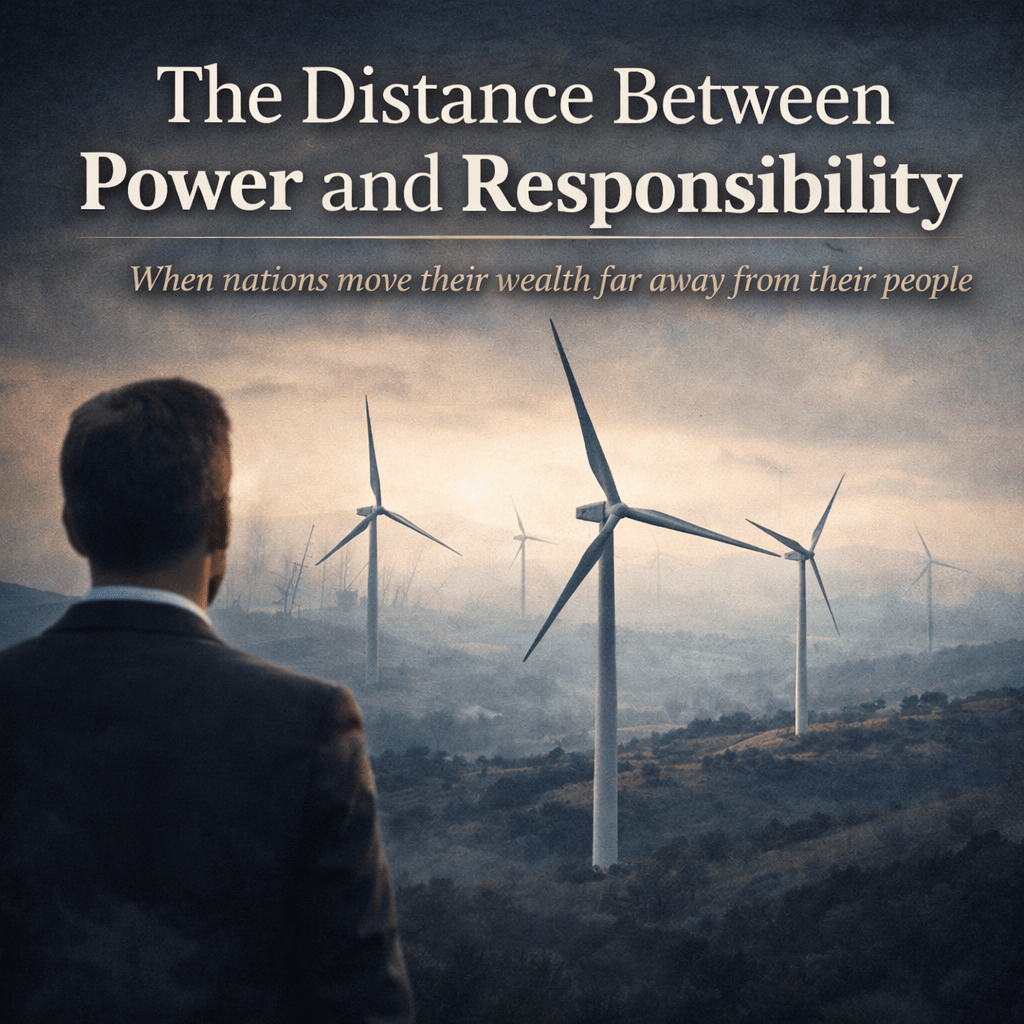
When nations move their wealth far away from their people
March 10, 2026
Every generation eventually asks the same question in different ways: who can we trust with power?
History shows that societies often begin with systems built to serve the people—laws, institutions, and economies designed to create stability and opportunity. Yet over time those same systems can drift further away from the everyday lives they were meant to support.
When wealth, influence, and decision-making concentrate in distant places, ordinary citizens begin to feel the gap.
And when that gap grows large enough, people start asking harder questions.
The Old Pattern of Power
Throughout history, powerful rulers—from ancient kings to modern dictators—have often centralized wealth and authority in ways that placed them beyond the reach of the people they governed.
Empires stored their gold in fortified treasuries. Monarchs controlled trade routes. Dictators managed economies through networks of loyal institutions.
The pattern is familiar: power gathers where it can best protect itself.
But in the modern world, the structure of power has become more complicated. It is no longer only about crowns or thrones. It often moves through financial systems, multinational corporations, and global supply chains.
The result is a kind of distance that earlier societies rarely experienced.
Money Without Borders
Today it is possible for a nation’s economic systems to stretch far beyond its own territory. Financial networks operate across continents, and businesses often hold assets, investments, or reserves in foreign markets.
In many ways this global system creates efficiency. It allows trade to move quickly and capital to flow where it is needed.
But it also raises a quiet question.
If a country’s financial lifelines are scattered across the world, who ultimately controls them?
When crises happen—whether economic, political, or environmental—distance can become vulnerability.
The Global Factory
Manufacturing has followed a similar path.
Over the past few decades, many nations have moved production overseas in search of lower costs and faster expansion. Factories once located near the communities they served now operate across oceans.
This model has made goods more affordable and markets more interconnected.
But it has also introduced new risks.
Supply chains can break. Political tensions can disrupt production. And when industries move away from the places where people live, communities often lose the economic foundations that once sustained them.
The question then becomes: can a country remain strong if it no longer builds what it depends on?
The Environment That Connects Us
Economic distance also carries environmental consequences.
When production moves far from the people who consume its products, the environmental impact can become easier to ignore. Polluted waterways, degraded land, and industrial waste may occur far from the markets that benefit from the manufacturing.
But environmental damage rarely stays contained.
Rivers flow across borders. Oceans carry pollution across continents. Air currents spread emissions around the globe.
In the end, the environment reminds us of something simple: no nation truly lives in isolation.
The Wind Turbines on the Horizon
Another question people are beginning to ask can be seen rising on hillsides, coastlines, and open fields across the country: the rapid appearance of massive wind turbines.
These structures are enormous—often hundreds of feet tall, with blades longer than the wingspan of large aircraft. They dominate the landscape wherever they are installed.
Supporters view them as part of the transition toward renewable energy and a cleaner future.
Yet many communities also wonder about the practical realities behind them.
Who is building these turbines?
Who owns the energy they generate?
And who truly benefits from them?
In many cases, wind projects are financed and operated by large energy corporations, global investment groups, or multinational energy developers. Local communities may host the infrastructure, but the financial returns often flow through complex networks of investors, utility companies, and energy markets.
For residents living near these installations, the question can feel very simple: if these massive machines stand in our fields and along our coasts, how does that energy benefit the people who live there?
The Responsibility of Strength
A powerful country does not remain powerful simply because of military strength, financial markets, or technological influence.
Real strength comes from responsibility.
It comes from ensuring that systems meant to serve the public remain accountable to them. It comes from protecting the land and waterways that sustain future generations. And it comes from recognizing that stability at home often begins with wise decisions about what happens abroad.
The question is not whether globalization will continue.
It almost certainly will.
The question is whether societies can build systems that balance global reach with local responsibility.
Looking Forward
History reminds us that power without accountability rarely lasts. Tyrannical kings and dictators often ruled through distance—physical, economic, or political—from the people they governed.
Healthy societies move in the opposite direction.
They close the distance.
They strengthen trust.
And they remember that the purpose of power is not simply to grow wealth or influence, but to safeguard the well-being of the people and the land that make a nation possible.
In the end, trust is not built by how far power can reach.
It is built by how closely it remains connected to those it serves.
 The ChillX Zone
Leave a comment