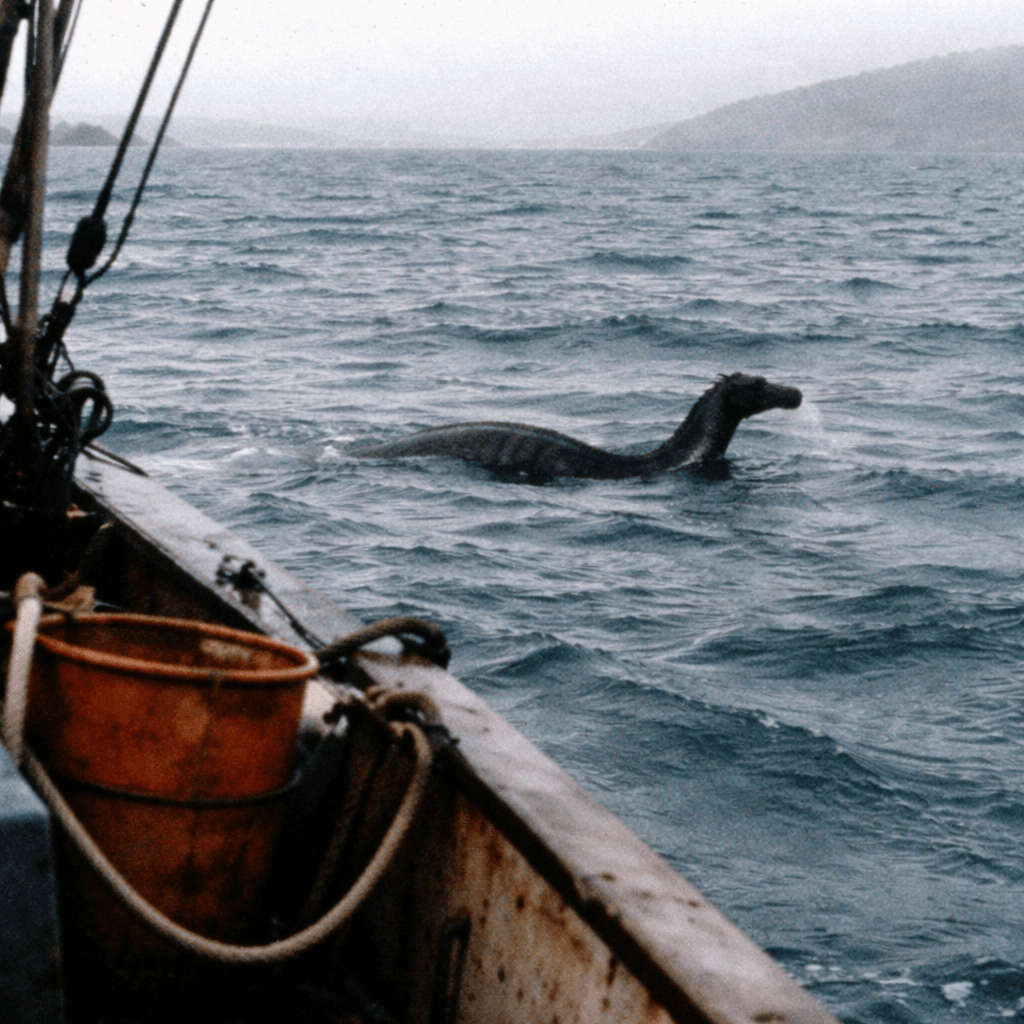
Fishermen thought they had hooked something enormous. What surfaced instead became one of the strangest pieces of sea-monster footage ever recorded.
March 4, 2026
On March 4, 1967, fishermen operating near Naden Harbour on Haida Gwaii, off the coast of British Columbia, Canada, reported encountering an unusual creature in the water.
The men — working from the fishing vessel Oreigon III — noticed a long, dark form moving through the sea nearby. What they first assumed was a large eel or driftwood began surfacing repeatedly alongside the boat.
According to their account, the creature appeared serpentine, with a narrow head and a long body that undulated through the water.
One of the fishermen grabbed a 16-mm camera and began filming.
The Footage
The resulting film — later circulated among cryptozoologists — shows a dark, eel-like animal moving just beneath the water’s surface.
Witnesses estimated the creature’s length anywhere from 40 to 60 feet.
The footage became associated with the legendary “Cadborosaurus,” a sea serpent said to inhabit waters along the Pacific Northwest, particularly around Cadboro Bay near Victoria.
Reports of similar creatures had appeared in newspapers since the 19th century, often described as having:
- A horse-like or camel-shaped head
- A long, eel-like body
- Smooth, dark skin
- A series of humps visible when swimming
What Happened After
The March 4, 1967 film circulated quietly for years among researchers studying unexplained sea creatures.
Some marine biologists suggested it could have been:
- A large conger eel
- A basking shark
- A floating line of sea lions
But none of those explanations fully matched the fishermen’s description of a single, continuous animal moving through the water.
The original footage remains one of the few recorded sightings tied to the long-standing Pacific Northwest sea-serpent legend — and the strange encounter on March 4, 1967 still sits in the files of cryptozoologists studying creatures that may or may not exist in the cold coastal waters of Canada.
 The ChillX Zone
Leave a comment