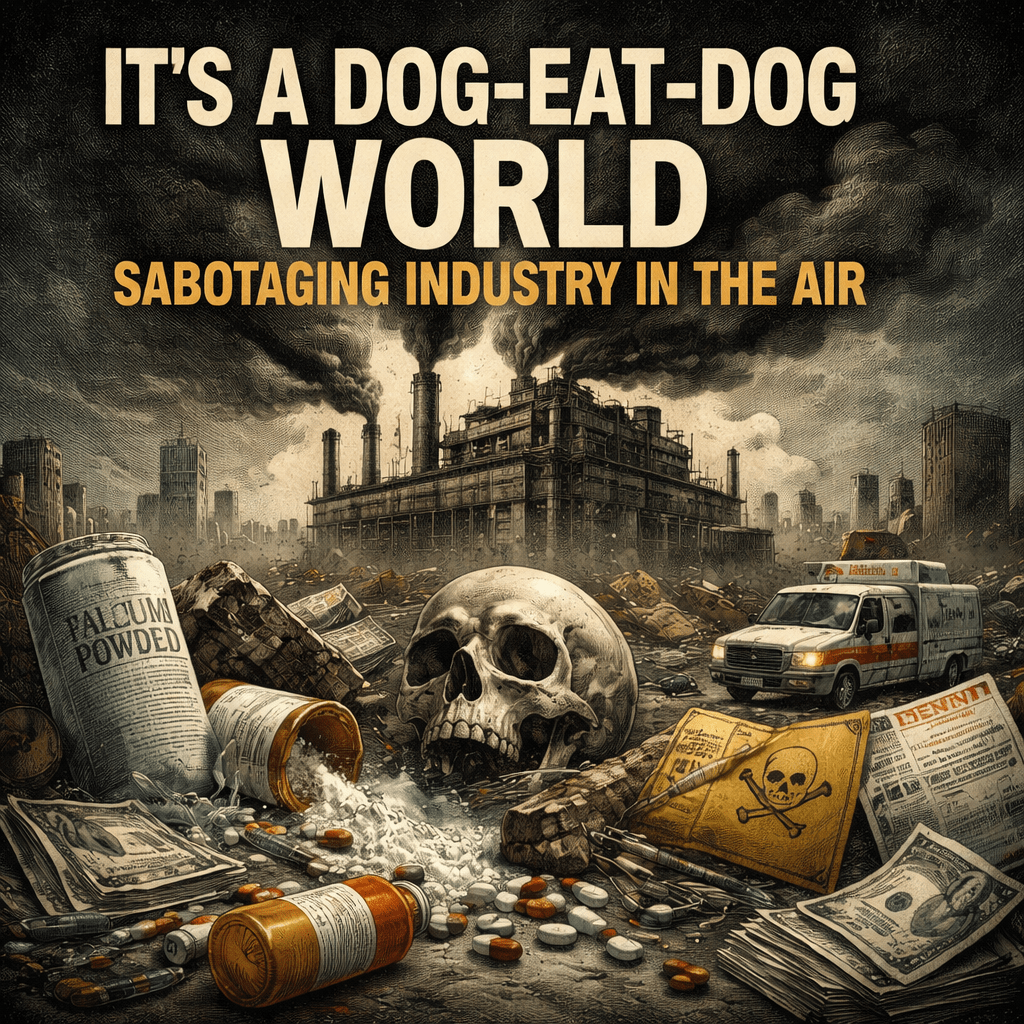
An address for a nation that deserves better than harm dressed up as progress
March 3, 2026
There was a time when American industry stood for invention, reliability, and shared prosperity. Steel built skylines. Medicine cured disease. Manufacturing meant pride.
Today, too often, it means something else.
It means products rushed to market before they are safe.
It means corporate memos that value quarterly earnings over human breath.
It means industries that quietly externalize risk — into the air, into homes, into bodies.
It feels, increasingly, like sabotage.
Not sabotage with explosives. Sabotage by indifference.
The Air We Breathe
Consider the ongoing legal reckoning facing companies such as 3M over PFAS — so-called “forever chemicals” linked to contamination in water supplies across the United States. Communities from the Midwest to military towns discovered, years later, that their drinking water carried compounds associated with cancer and developmental harm.
Or the decades-long litigation involving Johnson & Johnson over talc-based baby powder claims tied to ovarian cancer. While the company has denied wrongdoing and contested many claims, juries have awarded billions in verdicts in certain cases. Appeals continue. Families continue.
In both cases, the pattern is familiar: allegations of knowledge, delay, minimization — and then settlements that close the chapter without fully restoring public trust.
The question isn’t whether industry should innovate.
It’s whether innovation now comes with a warning label.
The Products That Hurt
In recent years, lawsuits have targeted pharmaceutical giants such as Purdue Pharma, whose aggressive marketing of opioid painkillers contributed to a national crisis. The opioid epidemic has claimed hundreds of thousands of American lives. Purdue has since filed for bankruptcy as part of a restructuring plan tied to settlements.
Elsewhere, defective automotive components, recalled medical devices, and unsafe consumer products have resulted in injuries and deaths that regulators often catch only after harm occurs.
We have created a system where the cost of doing business is sometimes calculated against the cost of litigation.
And if the math works, the product ships.
The Insurance Wall
Then there is the machinery that meets Americans at their most vulnerable: health insurance.
Companies such as United Health Group and other large insurers operate legally within regulatory frameworks. But critics argue that claim denials, prior authorization hurdles, and opaque billing practices can delay or prevent care.
When care is delayed, conditions worsen. When conditions worsen, families pay — financially and physically.
The paperwork becomes another form of air pollution.
Invisible, but suffocating.
Industrial Culture and the Worker
It isn’t only consumers who feel this pressure.
Workplace safety violations continue to surface across sectors. Warehouse quotas that strain the body. Construction shortcuts that compromise stability. Chemical exposure claims that take decades to resolve.
America’s workforce is productive, resilient, and adaptable.
But no worker should feel expendable.
When Profit Becomes Atmosphere
We are not talking about isolated bad actors. We are talking about culture.
A culture in which quarterly performance often overshadows long-term consequence. A culture in which accountability arrives years after damage is done. A culture in which settlements are priced in as overhead.
That is the sabotage in the air.
It is not dramatic. It is incremental.
It is a product release without sufficient testing.
A chemical released before its impact is fully studied.
A denied claim that becomes a delayed diagnosis.
No single moment makes the headline.
But the accumulation does.
A Presidential Question
What kind of country do we want to be?
One that builds wealth by absorbing human cost into spreadsheets? Or one that insists that safety, transparency, and responsibility are non-negotiable?
Markets reward efficiency. Democracies must demand ethics.
The American economy remains one of the most innovative in the world. But innovation cannot be measured solely in output. It must be measured in trust.
When people begin to believe that harm is simply the price of participation, faith erodes — in corporations, in institutions, in the promise of fairness itself.
That erosion is more dangerous than any single defective product.
The Way Forward
Stronger enforcement.
Transparent data.
Whistleblower protection.
Consumer advocacy with teeth.
And a cultural reset that redefines success not as “maximum extraction,” but as “minimum harm.”
This is not an argument against industry.
It is an argument against indifference.
Because when the atmosphere of commerce begins to feel hostile — when workers feel cornered, consumers feel misled, and families feel abandoned — we are no longer operating in a healthy economy.
We are operating in a dog-eat-dog world.
And that is not the America we were promised.
 The ChillX Zone
Leave a comment