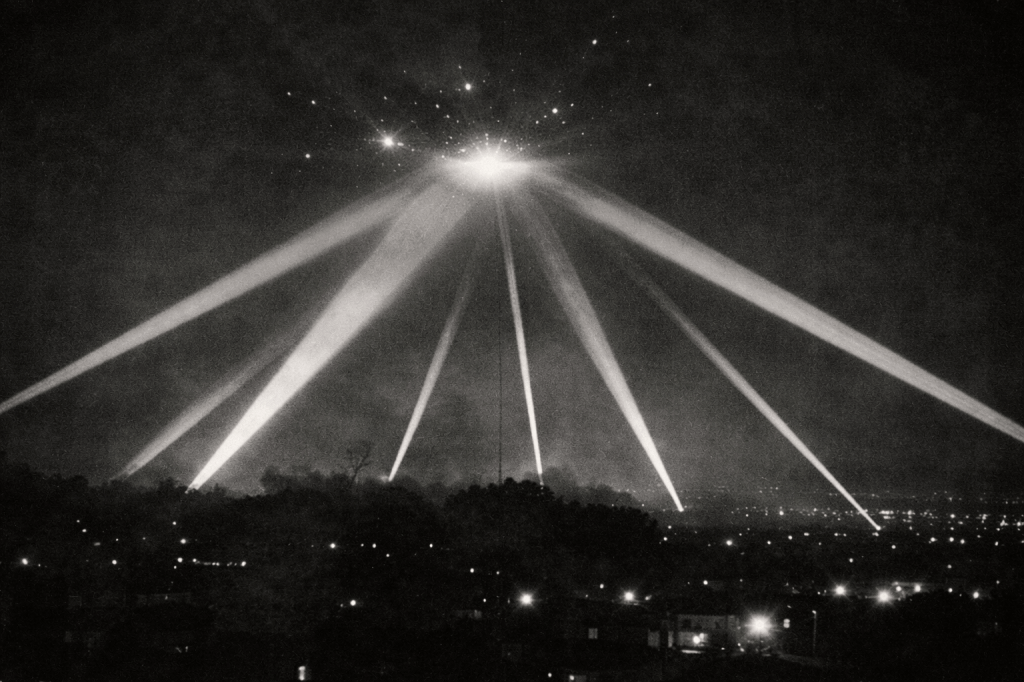
The Paranormal Legacy of February 25, 1942
February 25, 2026
Every year, February 25 passes quietly. No costumes, no bonfires, no rituals. Yet in the early hours of that date in 1942, the skies over Los Angeles erupted into one of the most puzzling events in American history—a night when searchlights clawed at the darkness, anti-aircraft shells thundered across the city, and something unknown refused to fall.
Today it’s remembered as The Battle of Los Angeles. But for many, it remains one of the most enduring paranormal mysteries of the twentieth century.
A City Under Siege
Just weeks after Pearl Harbor, the United States was tense and hyper-alert. At 2:25 a.m. on February 25, radar contacts appeared off the California coast. Air raid sirens screamed across Los Angeles, plunging the city into blackout. Residents stumbled from their beds and onto rooftops, scanning the sky for enemy aircraft.
Then the shooting began.
For over an hour, anti-aircraft batteries fired more than 1,400 shells into the night sky. Searchlights converged on a cluster of glowing objects that witnesses described as slow-moving, silent, and immune to damage. Some reported a single massive craft. Others saw formations. Many simply saw lights hovering where no airplane should have been able to linger.
And yet—no wreckage fell. No confirmed enemy aircraft were ever found.
The Official Story vs. The Strange One
The military’s explanation shifted quickly. First, officials suggested a possible Japanese attack. Later, the War Department labeled it a false alarm caused by weather balloons and flares.
But the public had already seen the photographs: beams of light converging on a luminous object suspended above the city. Newspapers printed the images the very next day. The contradiction between the violence of the response and the emptiness of the aftermath planted a seed that never stopped growing.
How could so much firepower produce no debris?
Why did witnesses insist the objects moved with deliberate slowness, unaffected by explosions?
And why did the explanations keep changing?
A Paranormal Turning Point
In hindsight, February 25, 1942 sits at a crossroads in cultural history. The term “UFO” didn’t yet exist. Roswell was still five years away. But the Battle of Los Angeles became an early template for modern sky mysteries: radar contact, mass sightings, military engagement, and a lingering sense that the official explanation didn’t match the experience.
For paranormal historians, this night marks one of the first moments when the unknown in the sky became a shared civic event rather than an isolated encounter.
It was no longer just one witness in a lonely field.
It was an entire city looking up together.
Learning to Listen to the Sky
The deeper legacy of February 25 isn’t just the possibility of extraterrestrial craft—it’s the cultural shift that followed. The event forced people to confront the idea that not everything in the sky could be immediately explained. It opened space for curiosity, skepticism, fear, and wonder to coexist.
In a way, it began a decades-long exercise in collective listening: watching the skies, parsing signals, and trying to separate noise from meaning.
Why the Date Still Matters
Most anniversaries celebrate certainty. February 25 commemorates uncertainty—the moment a city fired into darkness and received silence in return.
Whether the lights were balloons, secret aircraft, mass hysteria, or something truly unknown, the questions remain suspended over Los Angeles like those searchlights frozen in photographs.
Each year, the date returns as a quiet reminder: sometimes history isn’t defined by what happened, but by what never fully came down.
 The ChillX Zone
Leave a comment