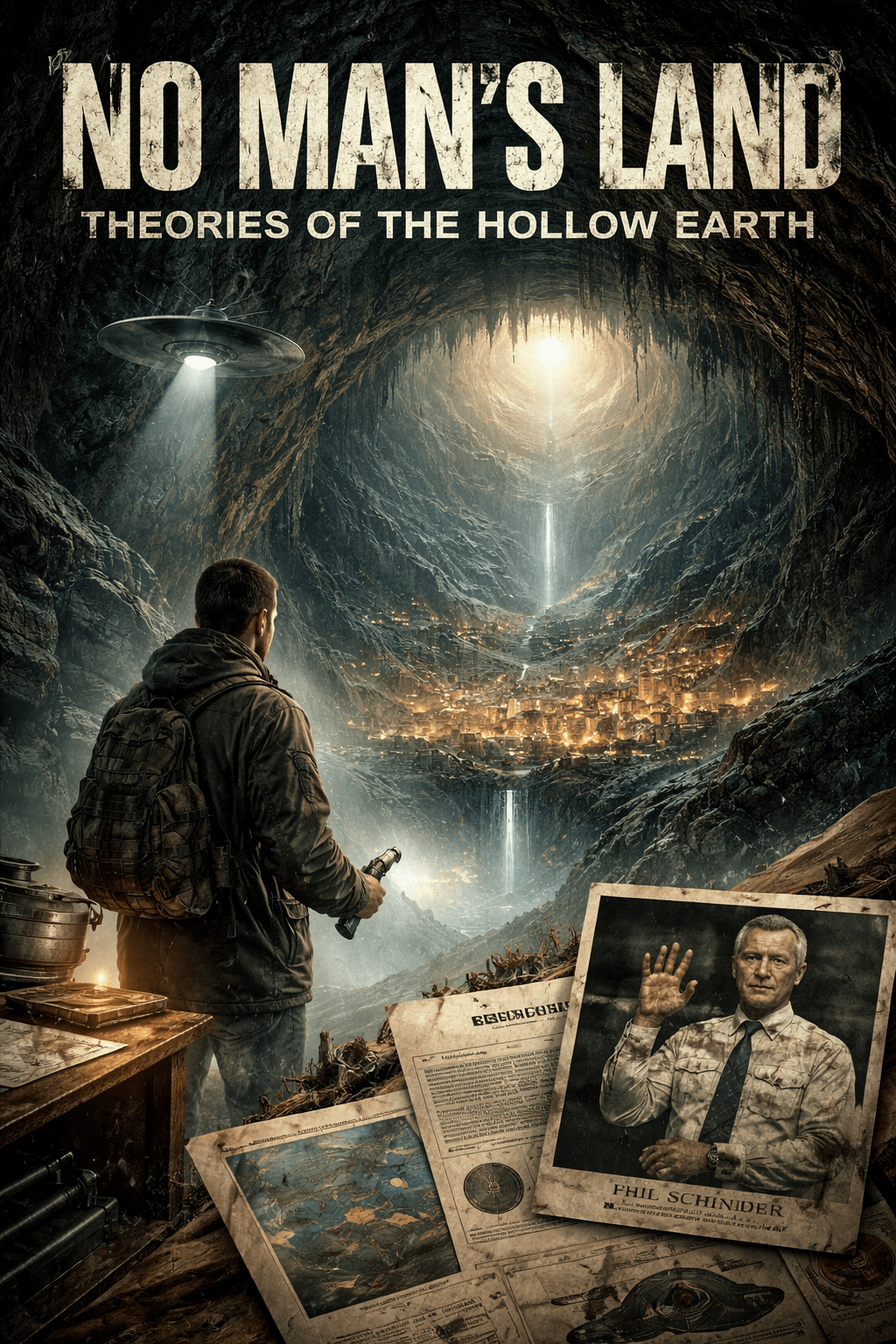
Some Theories of the Hollow Earth
February 24, 2026
There’s a strange moment in childhood when curiosity stops being a hobby and becomes a quiet obsession. For me, that moment came through conversations with people who had served in the military. They never told stories the way movies do. There were pauses. Half-finished sentences. Things hinted at, then brushed aside. And for a kid already fascinated by UFO sightings and the edges of the unknown, those gaps felt louder than any full explanation.
I didn’t grow up believing in conspiracy theories. I grew up noticing how often adults avoided finishing certain sentences.
Those early experiences pushed me toward the edges of strange topics — the kind most people dismiss quickly, but never quite forget.
This is not an attempt to prove anything. It’s an exploration of stories, claims, and the strange overlap between folklore, conspiracy, and personal curiosity.
This is No Man’s Land.
The World Beneath the World
The Hollow Earth theory has existed in one form or another for centuries. Ancient mythologies spoke of underground kingdoms and hidden civilizations living below the surface. From the Greek underworld to the Tibetan kingdom of Agartha, cultures across the world have described realms beneath our feet.
By the 19th century, the idea shifted from mythology into speculative science. Some early thinkers proposed that the Earth might be hollow, with openings near the poles and entire ecosystems existing inside the planet.
Modern geology has thoroughly rejected this idea. The Earth’s structure is well understood through seismic data and physics. Yet despite scientific dismissal, the Hollow Earth theory never truly disappeared.
Instead, it changed. It became a story people told quietly.
The Cold War Era of Secrets
After World War II, the tone of Hollow Earth theories shifted dramatically. No longer ancient myths, they became tied to military secrecy, classified projects, and the rise of UFO sightings.
The Cold War created an atmosphere of permanent tension and hidden technology. Governments developed weapons and surveillance systems that the public would not learn about for decades. Entire programs existed in secrecy.
This environment gave new life to old ideas. If governments could keep real projects secret, people began asking what else might be hidden.
Growing Up Around Military Stories
My own curiosity deepened because of proximity to people who had served. Conversations would drift into strange territory — unusual encounters, odd assignments, stories that stopped abruptly when someone realized how far they’d gone.
No one ever claimed anything extraordinary outright. But the tone mattered. The hesitation mattered.
It created a sense that the world might be larger — and stranger — than the official version we’re handed.
As UFO sightings became more common in media and public discussion, the overlap between military secrecy and unexplained phenomena became impossible for me to ignore.
Enter Phil Schneider
One of the most controversial figures in modern Hollow Earth and underground base lore is Phil Schneider.
Schneider was a former government contractor who, in the 1990s, began giving lectures about alleged secret underground facilities beneath the United States. His claims were extraordinary, even by conspiracy standards.
He described massive subterranean bases, classified technologies, and a hidden world operating below public awareness.
His most shocking claim centered on an alleged underground confrontation during the late 1970s. According to Schneider, he said he was part of a team drilling deep underground when they encountered non-human beings. He claimed a violent conflict occurred and that his hand was severely injured during the incident — an injury he later attributed to that event.
To believers, his story is testimony.
To skeptics, it is a tragic tale shaped by personal struggles.
To everyone else, it sits somewhere in the uncomfortable middle.
The Power of Stories
Whether one believes Schneider or not, his story highlights something important: the power of narrative in shaping curiosity.
Stories like his persist because they live in the same space as real secrecy. Governments do hide things. Military projects do remain classified. Technology does advance behind closed doors.
The existence of real secrets creates room for imagined ones. And the line between the two becomes harder to see from the outside.
UFO Sightings and Cultural Momentum
In recent years, UFO sightings have moved from fringe topic to mainstream conversation. Military pilots have publicly described encounters with unexplained aerial objects. Governments have released previously classified footage.
This doesn’t prove extraordinary theories — but it changes the cultural atmosphere.
Topics once dismissed outright are now discussed in official settings. Questions once laughed off are now investigated.
And when the boundaries of the known expand, the unknown expands with them.
Living in the Unknown
The Hollow Earth theory may never be proven. It may remain a story forever — part folklore, part modern myth.
But its persistence reveals something deeper about human nature.
We are drawn to the idea that there are places not yet mapped. Spaces not yet understood. Stories not yet finished.
We stand on the surface of a world we barely comprehend, and sometimes the most compelling question is the simplest one:
What if there is more beneath our feet?
Welcome to No Man’s Land.
 The ChillX Zone
Leave a comment