True American Disappearances and Encounters That Still Defy Explanation
February 2, 2026
America’s forests are not empty places. They are living systems older than roads, older than towns, older than memory. Most hikers describe them as peaceful—but those who have come closest to disaster often recall the same moment: when the sound disappears.
Birds stop calling. Wind dies without warning. Insects vanish. The silence feels deliberate, heavy, and wrong. Search-and-rescue veterans quietly acknowledge this detail appears again and again in survivor accounts. When the woods go silent, something has changed—and if you are alone, there is no one to confirm what you are experiencing.
This is where danger begins.
The Disappearance of Kenny Veach
One of the most unsettling modern cases involving a solo hiker is the disappearance of Kenny Veach.
Veach was experienced, confident, and familiar with the Nevada desert near Nellis Air Force Base. Prior to vanishing in November 2014, he posted videos describing a bizarre discovery during one of his solo hikes: a cave shaped like the letter “M.”
As he approached it, Veach said the ground beneath him began to vibrate. He described a sudden, overwhelming fear—so intense it forced him to retreat despite seeing no physical threat. He emphasized that the sensation felt unnatural, as if his body knew something was wrong before his mind could explain it.
Against better judgment, Veach returned alone to search for the cave again.
He never came back.
Search teams later recovered his cell phone near an abandoned mine shaft. No remains were found. No clear accident site was identified. For a hiker so methodical to vanish without trace has led many to question whether he encountered something beyond a simple fall or disorientation.
The desert kept his answers.
Why Familiar Trails Are Often the Most Dangerous
Many people assume danger only exists deep in remote wilderness. In reality, countless disappearances occur near marked trails, scenic overlooks, and areas considered “safe.”
Solo hikers are especially vulnerable to subtle disorientation. A wrong turn taken for curiosity. A noise off the trail. A landmark that doesn’t look quite right on the way back. The woods do not need to trap you—they only need you to step away from the path once.
When you do, the forest closes behind you.
Search teams frequently report abrupt scent loss, personal items found neatly placed, and no clear signs of struggle. These details challenge simple explanations and feed darker speculation, even among professionals who prefer rational answers.
The Phantom Hiker of Grandfather Mountain
In North Carolina’s Blue Ridge Mountains, Grandfather Mountain has long been associated with reports of a strange figure seen by hikers traveling alone.
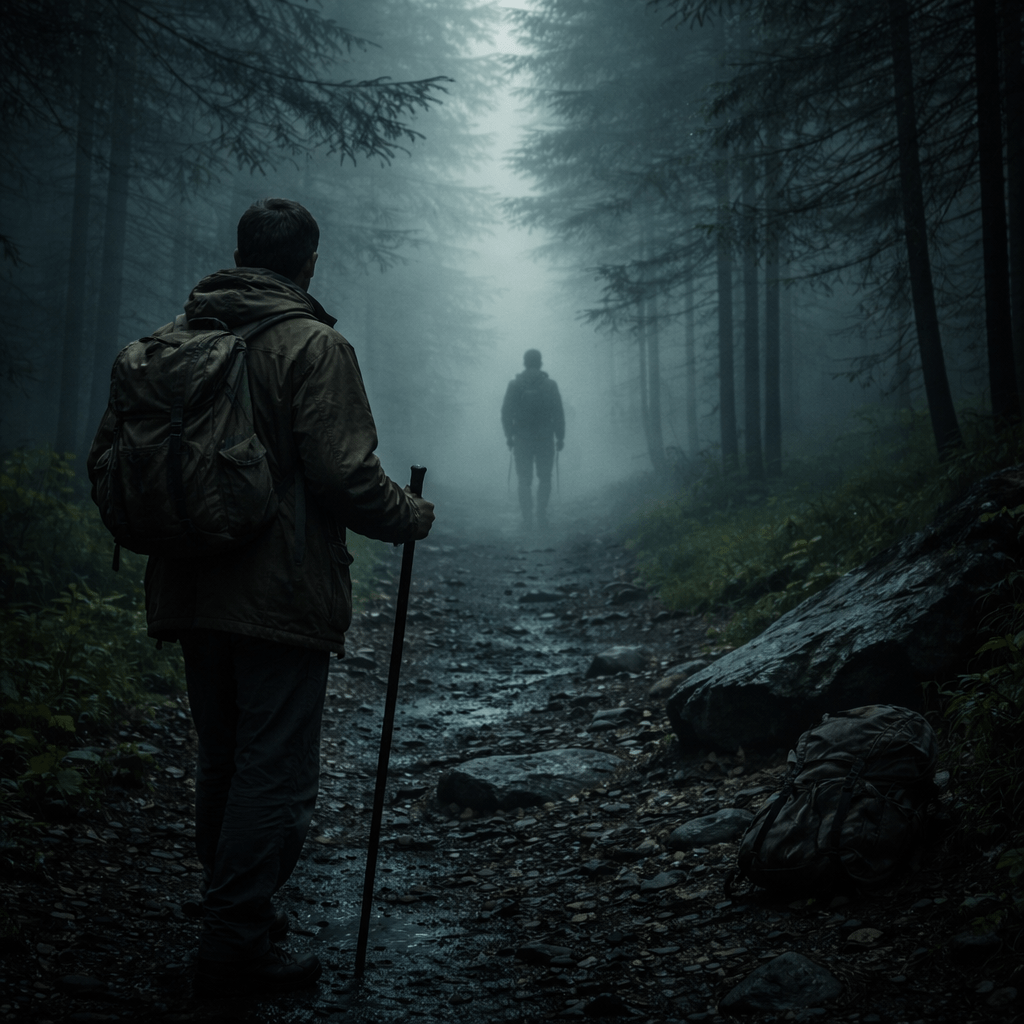
Witnesses describe a lone man walking ahead on narrow trails, dressed in outdated clothing and carrying old-fashioned hiking gear. He appears solid, human, and unremarkable—until hikers attempt to catch up.
No matter how fast they walk, the distance never closes. And when the trail bends, or the hiker looks away for only a moment, the figure vanishes completely.
Local legend claims the apparition is the spirit of a man who fell to his death while hiking alone decades ago, his body never recovered. Whether ghost, psychological projection, or something else entirely, the encounters share unsettling similarities—and almost always involve solitude.
Why Solo Hikers Are Rarely Found
Statistically, hikers who travel alone are far more likely to:
• Delay calling for help
• Leave established trails
• Misjudge distance and terrain
• Disappear without witnesses
In many cases, weather and wildlife cannot fully explain what remains behind—or what doesn’t. Dogs lose trails suddenly. Search grids come up empty. Days turn into weeks, then years.
Families are left with silence instead of answers.
The Old Warning Still Holds
Long before modern hiking culture, indigenous traditions and early frontier journals carried the same warning: do not enter the forest alone.
Not because you might slip.
Not because you might get lost.
But because if something happens, the woods may not give you back.
The forest does not rush. It does not announce danger. It waits.
And when you are alone, there is no one to notice when the woods begin to notice you.
 The ChillX Zone
Leave a comment