The Silence Behind the Moon
January 31, 2026
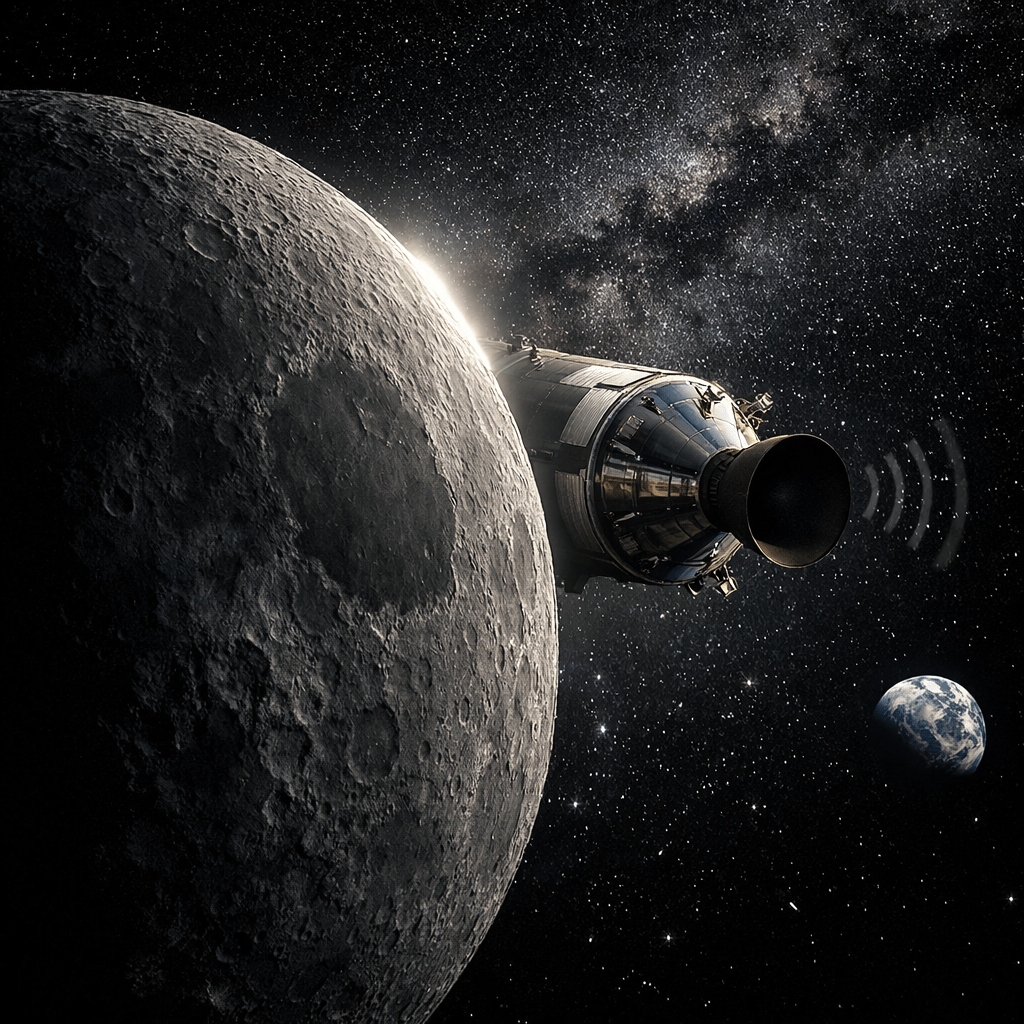
Today marks fifty-seven years since Apollo 11 passed behind the Moon, entering the radio blackout every mission planner expected and every astronaut remembers. For forty-seven minutes, Neil Armstrong, Buzz Aldrin, and Michael Collins were unreachable—no voice, no telemetry, no confirmation that three human beings still existed at all.
NASA has always described that interval clinically: loss of signal, nominal. It was a predictable consequence of orbital mechanics, the Moon itself blocking radio transmission. Nothing unusual was reported. Nothing officially occurred.
Yet the far side of the Moon remains unique in human history. It is the only place humans have physically traveled where total observational blindness was unavoidable. Not metaphorical isolation, but technical disappearance. When Apollo 11 slipped behind the lunar limb on July 19, 1969, every system designed to observe human presence went silent at once.
What Silence Meant Then
During that passage, Armstrong and Aldrin briefly tested independent communications pathways while still docked to the command module. Flight documentation from the era notes minor signal irregularities during that window—flagged at the time as noncritical, later ignored entirely. No failures followed. No investigation was pursued. Silence, when it does not cause damage, rarely earns attention.
Michael Collins later described the far-side orbit not as frightening, but as acutely aware. Not lonely, but attentive. “I was conscious of being conscious,” he said. Nothing more.
At the time, the silence was treated as a technical inconvenience. In hindsight, it marked the first moment humans existed beyond confirmation.
Why January 31, 2026 Matters
January 31, 2026 matters not because of symbolism, but because of timing. This date coincides with the expiration of multiple Cold War–era lunar data restrictions, including peripheral telemetry and electromagnetic monitoring channels that were never prioritized for public release. Most of what has surfaced is mundane. Some material remains absent—not classified, simply unaccounted for.
At the same time, renewed efforts to return humans to the Moon continue to slip. Artemis timelines extend. Crewed missions remain perpetually several launches away. International lunar surveys increasingly confirm what Apollo-era engineers suspected decades ago: the Moon’s interior is more structurally complex than once believed, particularly on the far side, complicating sustained human activity.
What the Paranormal Actually Is
None of this is paranormal in the traditional sense. The anomaly lies elsewhere.
The paranormal, here, is unverifiable presence—the realization that there are environments where human awareness exists without continuous external confirmation, where silence itself becomes a condition rather than a malfunction.
Modern spaceflight avoids this state whenever possible. Continuous telemetry is now treated as essential. Absolute signal absence is no longer tolerated—not because it is dangerous, but because it is unknowable.
Why We Hesitate to Return
The Moon did not scare us away. What lingered was the recognition that there are places where observation ends, where the universe does not respond when addressed, and where meaning emerges not from what happens, but from what cannot be confirmed.
This realization arrived quietly, behind the Moon, during a blackout everyone expected and no one fully processed.
A Pause, Not a Revelation
January 31 does not mark a discovery. It marks a pause.
Fifty-seven years ago, three people vanished from every instrument humanity possessed and returned unchanged, carrying nothing dramatic—only the knowledge that silence is not empty, and that sometimes, when the heavens go quiet, it is not because nothing is there, but because nothing is answering.
 The ChillX Zone
Leave a comment