Twenty Years After Enfield’s Most Contested Levitation
January 30, 2026
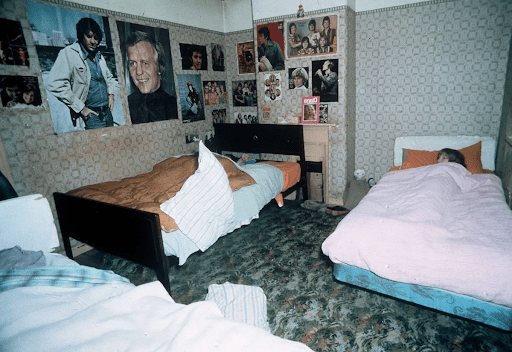
Enfield, North London — Twenty years ago tonight, in the narrow upstairs bedroom of a modest council house on Green Street, eleven-year-old Janet Hodgson appeared to do something that still resists tidy explanation. According to multiple adults present that evening, she rose from her bed and remained suspended against the wall—briefly, silently, and without obvious support.
It was January 30, 1978, near the height of what would become known as the Enfield Poltergeist case. Britain was deep in winter, the city locked in the familiar grey chill of late January. By then, investigators had already documented months of disturbances at the Hodgson home. But this night would become the most disputed—and enduring—episode of them all.
The Thirtieth Incident
Much of Enfield has since blurred into tabloid shorthand: the coarse disembodied voices, furniture skidding across linoleum, children accused of mischief. Yet the events of January 30 remain unusually well recorded.
Photographer Graham Morris was present that evening alongside Society for Psychical Research investigators Maurice Grosse and Guy Lyon Playfair. Expecting exaggeration—or outright theatrics—Morris positioned his camera in Janet’s bedroom. What he captured instead became one of the most reproduced images in modern paranormal history: a young girl apparently suspended horizontally in mid-air, her body rigid, her nightdress hanging unnaturally as her sister Margaret looks on from the corner.
“I know what a child jumping off a bed looks like,” Morris told me yesterday from his home in Essex. “They tuck, they twist, they brace for the fall. This wasn’t that. She rose, she held, and then she dropped. And the negative shows no trickery.”
Skeptics have long argued that the image merely captures Janet mid-jump. Morris remains unconvinced. “If it’s a fake,” he said, “it’s a very precise one.”
Skepticism and the Scientific Gaze
The Enfield case has not aged gently. In the 1990s, Janet Hodgson publicly admitted that some phenomena—particularly knocking sounds—were fabricated by the children during periods of boredom. That admission became a turning point, allowing critics to dismiss the entire case as childish deception.
Yet even among skeptics, the January 30 photograph remains a point of discomfort.
Dr. Anita Gregory, a vocal critic of the case during the late 1970s, acknowledged the difficulty of fully accounting for the image. “I believe the girls were capable of trickery,” she told me. “But this particular photograph is problematic. If it’s staged, it would require either equipment no one present reported seeing, or a physical maneuver that doesn’t obviously align with Janet’s build or posture at the time.”
Biomechanical assessments conducted in recent years have reached no consensus. While a jump could explain vertical lift, the apparent horizontal rigidity and lack of visible muscular strain continue to raise questions.
The Voice Called “Bill”
Adding to the unease of that night were audio recordings captured on Grosse’s reel-to-reel recorder. During the reported levitation, a harsh male voice—known to investigators as “Bill”—was picked up close to Janet’s position. The voice claimed to belong to a former tenant who had died in the house years earlier.
On the January 30 recording, the voice appears to count down moments before witnesses described a sudden chill and Janet lifting from the bed. Critics argue ventriloquism; supporters note the voice’s volume and tonal damage to Janet’s throat following prolonged episodes.
Witnesses, Then and Now
Several adults present that night never withdrew their statements. A neighbor who happened to be visiting the Hodgsons that evening told me she still stands by what she saw. “I didn’t come for ghosts,” she said. “I came to check on a family. And I watched a child leave the bed without jumping.”
A telecommunications engineer visiting the house for unrelated repairs also signed a statement describing the absence of visible support. His account, preserved in SPR archives, notes the strange stillness of the room and an unsettling sense of pressure in the air.
Twenty Years On
Janet Hodgson, now 31 and living quietly in Leeds, declined to comment for this article. Her sister Margaret has remained publicly silent for years. The house on Green Street, meanwhile, continues to draw curiosity seekers. This morning, a small group of tourists stood across the road, cameras raised, studying the upstairs window where a girl once appeared to hover.
Whether Janet Hodgson briefly levitated through some unknown psychokinetic force—or whether a roomful of adults misread a child’s movement in a charged atmosphere—remains unresolved. But twenty years on, the photograph endures: an image of impossible suspension, frozen between belief and doubt, asking an uncomfortable question.
What, exactly, are the limits of gravity—and who gets to decide when they’ve been broken?
 The ChillX Zone
Leave a comment