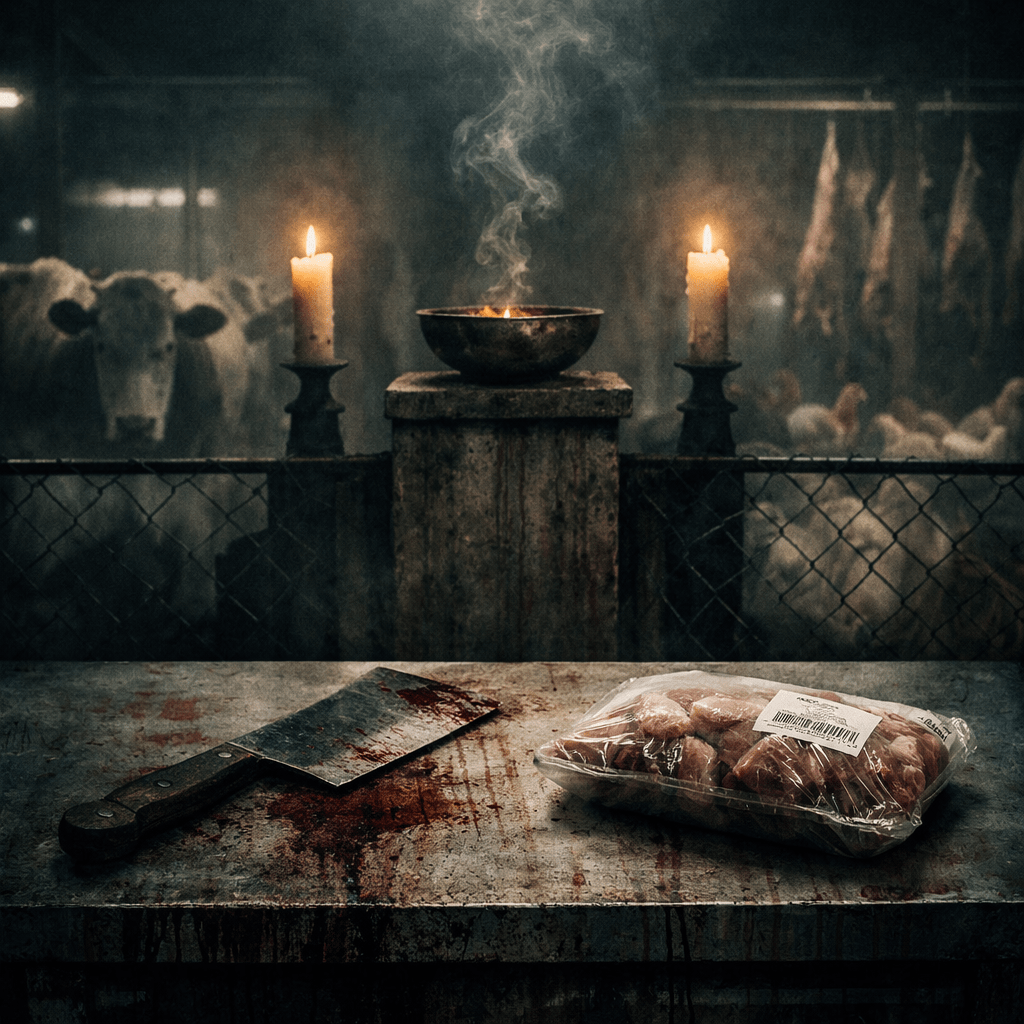
When ancient sacrifice evolved into an invisible system
January 28, 2026
The calendar offers no official holiday of blood or feast. Yet across history, this date sits quietly beside an ancient pattern—the offering. Not the dramatic altar scenes of legend, but something colder, industrial, and largely unseen.
Today, billions of animals are bred, processed, and consumed under fluorescent lights, conveyor belts, and efficiency metrics. The process is clean, regulated, and legally invisible. But when viewed through a symbolic lens—one older than agriculture itself—the system resembles something far more archaic.
A ritual that never ended.
Only modernized.
From Sacred Slaughter to Silent Systems
In ancient civilizations, animal sacrifice was never casual. It required intention, ceremony, and acknowledgment. The animal was seen, named, and symbolically exchanged—life offered for favor, protection, or balance.
What’s changed is not the scale of killing, but the absence of ritual consciousness.
Modern mass production removes:
- Witnesses
- Ceremony
- Accountability
- Meaning
Yet the act itself continues—on a scale no ancient empire could have imagined.
Some paranormal researchers argue that rituals don’t disappear when intention is removed. They degrade. And degraded rituals, according to folklore and occult theory, don’t vanish—they distort.
The Pattern of Industrial Blood
Across historical records, late January often marked post-winter slaughter—a time when livestock was culled before resources ran thin. While January 28 itself lacks a named feast, it consistently appears in butchery records, stock culls, and provisioning logs from pre-industrial Europe.
This timing matters.
Ritual theory suggests repetition without reflection creates residual effects—what some traditions call “echoes.” When an act is repeated millions of times daily, stripped of meaning but not of consequence, those echoes accumulate.
In paranormal terms, this is sometimes described as:
- Ambient unease
- Psychic residue
- A low-grade spiritual noise
Not a haunting.
A saturation.
The Unnamed Exchange
Unlike ancient sacrifice, modern consumption denies that anything is being exchanged at all. Meat appears sealed, sanitized, and dissociated from life. But folklore warns that an offering denied acknowledgment still demands payment.
Some theorists link this to:
- Heightened anxiety in industrial societies
- The normalization of violence without confrontation
- A persistent sense of imbalance
Not because people eat animals—but because the act has been fully abstracted, transformed into a system that functions without pause or reflection.
A ritual with no altar.
A sacrifice with no witnesses.
Is It Still a Ritual If No One Admits It Is?
Paranormal anthropology suggests rituals are defined not by candles or chants, but by:
- Repetition
- Structure
- Outcome
By that definition, industrial animal consumption may be the largest ongoing ritual in human history—one performed unconsciously, globally, and without closure.
January 28 serves as a reminder not of guilt, but of awareness.
The ancients believed offerings required acknowledgment to maintain balance. We’ve kept the offering—and erased the acknowledgment.
And according to old traditions, that’s when things begin to leak through.
Not monsters.
Not ghosts.
But a quiet sense that something, somewhere, is still waiting to be recognized.
 The ChillX Zone
Leave a comment