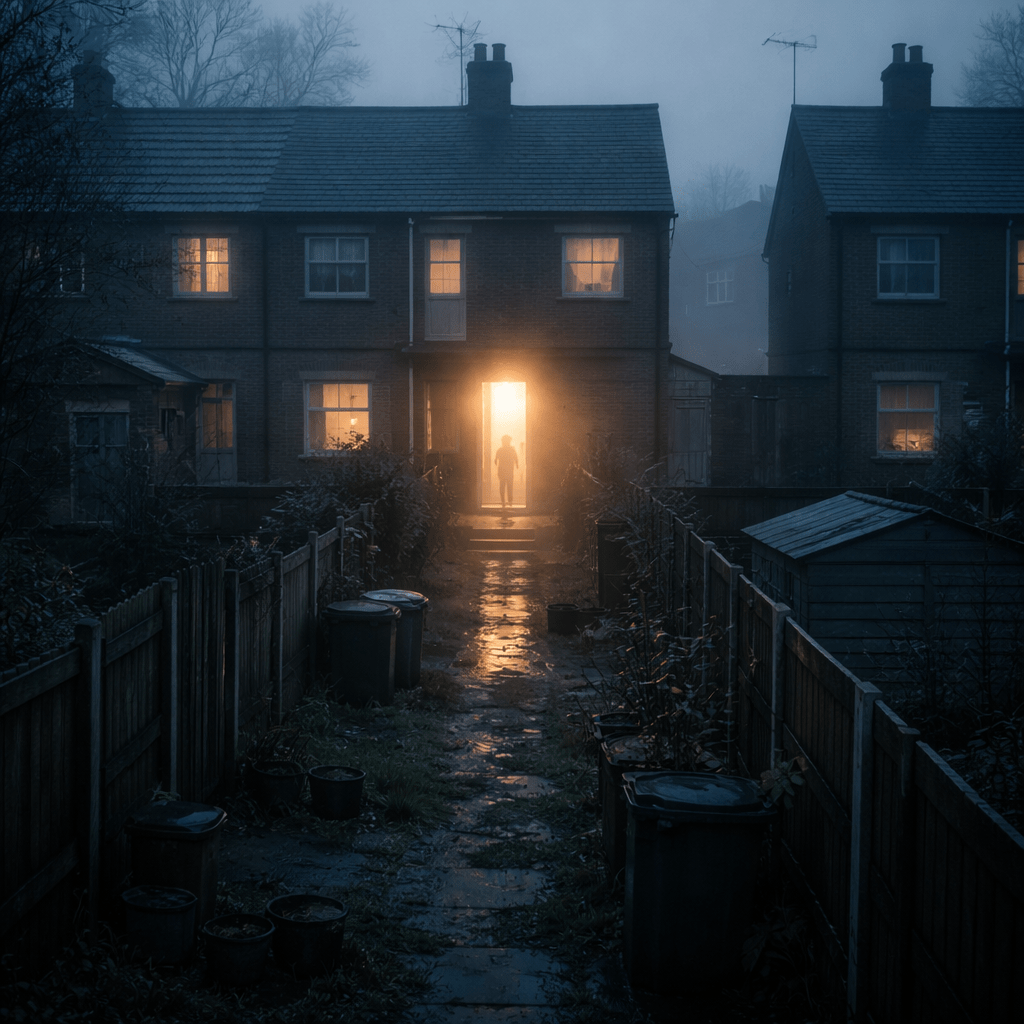
When something unseen settles into a neighborhood—and refuses to stay confined to one home
January 24, 2026
Most paranormal accounts center on a single house, a single family, or a single event. But a growing number of reports suggest a different kind of phenomenon—one that appears to move between neighboring homes, affecting people who live close together rather than those connected by history or ownership.
In these cases, no one residence serves as the origin point. Instead, the activity seems to exist in the shared space between properties: alleyways, adjoining walls, backyards, and even the routines neighbors unconsciously synchronize over time.
Subtle Signs, Shared Details
The earliest signs are rarely dramatic. Residents describe hearing movement where no one should be, noticing lights or electronics behaving oddly, or experiencing a persistent feeling of awareness in otherwise familiar rooms. On their own, these incidents feel mundane—easily explained away.
What changes everything is comparison.
When neighbors begin to talk, they discover overlaps: identical times, similar sensations, children describing the same “figure” or “someone,” pets reacting to the same empty spaces. The realization often comes late, and reluctantly—because acknowledging it means accepting that the experience is not isolated.
A Documented Example: Cannock Chase, England
One frequently cited area in discussions of shared paranormal activity is Cannock Chase, a large wooded area in Staffordshire surrounded by residential neighborhoods. For decades, residents living near one another have independently reported recurring phenomena—apparitions, unexplained sounds, and the feeling of being followed—often without prior knowledge of each other’s experiences.
What stands out is not the forest itself, but how reports cluster among nearby households and streets, sometimes rising and falling together over years. While no single explanation has been proven, investigators have noted that the activity appears community-wide, rather than tied to any single property.
Why Proximity May Matter
Some researchers suggest that close living conditions may unintentionally amplify perception—stress, emotional resonance, and expectation passing quietly from person to person. Others propose that if paranormal phenomena exist independently, they may exploit human density the way sound or electricity follows the easiest path.
In either case, proximity appears to matter. These presences often grow more noticeable as more people occupy the area—and diminish when homes are vacated or communities disperse.
The Most Unsettling Possibility
Unlike violent or dramatic hauntings, shared presences tend to persist quietly. They do not force confrontation. They become familiar. Residents adapt, learning which rooms feel “off,” which hours bring discomfort, which spaces feel watched but never threatened.
This normalization may be what allows such phenomena to last.
If something unseen can exist not in a house, but in the spaces between people, then the modern neighborhood—dense, interconnected, emotionally charged—may be its most natural habitat.
And the question left behind is an uncomfortable one:
Are these presences invading our communities—or emerging from them?
 The ChillX Zone
Leave a comment